Accenture Recruitment Process and Test Pattern: Verify Every Stage
Build a personal stage map from the current Accenture role page and invitation. The guide includes worked checks for timing, application data, pacing, coding and mock repair.
KnowledgeGate Team
Exam prep & CS education
Updated 7 Oct 20265 min read
You may have found several Accenture test patterns but still not know which one applies to your role or drive. Treat the current role page and invitation as control documents, then map your own stages from them. This guide brings that method into company-specific placement preparation before you spend hours preparing the wrong material. If an older post, candidate report or course structure differs, current official communication wins.
Accenture recruitment process: separate the journey from the drive pattern
The Accenture Careers recruitment guidance describes application acknowledgement, role-fit review, contact if you move forward, interview or interviews, an online activity for some roles, and an offer if selected. Interview count depends on the role. These are conditional checkpoints, not a universal sequence.
Copy eight fields from current sources:
Role title
Job ID
Location
Role requirements
Online activity assigned?
Completion window and timer
Interview format
Documents or support contact
Mark missing fields UNKNOWN. The TCS stage-by-stage process guide uses this habit, but no TCS stage, timer or rule transfers to Accenture.
Build the Accenture stage map from the invitation
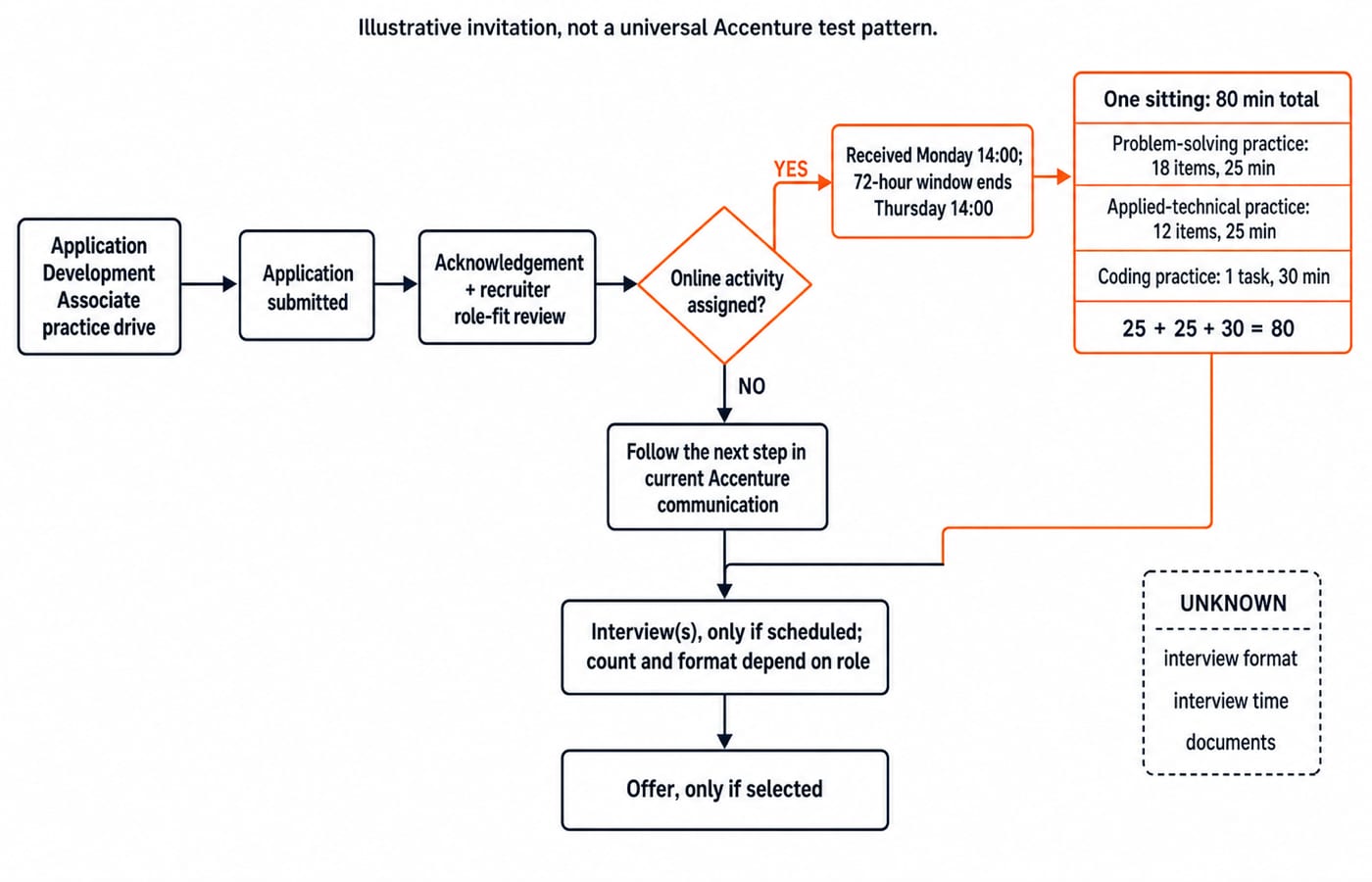
This fictional illustration is not a current Accenture notice. An Application Development Associate practice drive invitation arrives Monday at 14:00. It allows 72 hours for one 80-minute sitting: 18 problem-solving practice items in 25 minutes, 12 applied-technical practice items in 25 minutes, and one coding practice task in 30 minutes. Interview details are absent.
The deadline is Thursday at 14:00, and 25 + 25 + 30 = 80 minutes. Known fields are role title, activity, window, timer and practice composition. Interview format, interview time and documents remain UNKNOWN.
Accenture says assessments are typically available within 72 hours and most take about 30 to 90 minutes. Your invitation controls the actual limits. Map application -> acknowledgement and role-fit review -> assigned online activity -> next step named by Accenture -> interview(s) if scheduled -> offer if selected.
Application and review: reconcile every submitted value
Accenture says recruiters assess role fit, job descriptions define requirements, and current India guidance permits one active application at a time. Never generalise degree, branch, batch, backlog, gap, CGPA, location or work-authorisation rules.
Use this fictional six-field audit:
Check | Recorded value | Result |
|---|---|---|
Source-sheet name | Meera Nair | Match |
Photo-ID name | Meera Nair | Match |
Resume name | Meera Nair | Match |
Form name | Meera Nair | Match |
CGPA | Transcript 8.14, form draft 8.41 | Mismatch |
Graduation batch | Source sheet 2026, form 2026 | Match |
Five match and one does not, so 5/6 is incomplete. Enter 8.14, preserve the acknowledgement, and never alter academic values without an authorised rule. Copy upload rules and documents from the live form or invitation.
Technical assessment: use official rules and the live timer
Accenture says technical assessments are online, one-sitting evaluations of problem-solving, logical reasoning and applied technical knowledge in role-relevant scenarios. The invitation sets the time; assessment and integrity rules may apply. External AI tools are not permitted. Use a built-in assistant only when visibly enabled.
The Accenture Superset course organises cognitive, technical, coding, communication, PYQ and mock-test practice. The Aptitude for Placement course supports aptitude, reasoning and verbal work. Follow only buckets named in the invitation.
For the fictional 18-item set, use 12 items x 1 minute = 12 minutes, then 4 x 2 = 8 minutes, plus five minutes' review. Thus 12 + 8 + 5 = 25 minutes, with two unresolved. Check live scoring rules before guessing.
Coding activity: prove the solution beyond the sample
Accenture describes engineering-style coding tasks where approach, organisation and solution development matter alongside correctness. It does not promise a language list, task count, difficulty or scoring formula.
Rehearse this generic problem, not an Accenture question: for [4, 2, 4, 1, 2, 3], return the first value with frequency 1, else NONE. Frequencies are 4:2, 2:2, 1:1, 3:1; scanning left to right returns 1 at zero-based index 3. A two-pass map takes O(n) time and O(n) extra space.
Spend five minutes on input and edge cases, 17 implementing, and eight testing: 5 + 17 + 8 = 30. Test [] -> NONE, [7] -> 7, [5, 5] -> NONE, and [0, -1, 0] -> -1.
Accenture interview stage: prepare role-relevant evidence
Accenture says interviews may be by phone, video or in person. Number and focus depend on role skills. Do not assume a technical-then-HR sequence or guaranteed questions.
A fictional evidence card uses a local placement tracker with 5,000 seeded records. Across 30 runs, an index cuts median load from 1.24 to 0.68 seconds: 1.24 - 0.68 = 0.56 seconds, then 0.56 / 1.24 x 100 = 45.2%. Name dataset, run count, change, measurement and limitation: local testing, not production traffic.
Turn one mock into a repair plan, not a cutoff prediction
For 30 objective practice items, suppose 21 are correct, six incorrect and three unattempted. Attempts are 21 + 6 = 27; accuracy is 21 / 27 x 100 = 77.8%; completion is 27 / 30 x 100 = 90%; full-set correctness is 21 / 30 x 100 = 70%. Code passes six of eight local tests. None is an Accenture score or threshold.
Sort the six errors into two concept, two reading and two time-selection errors. Assign 40 minutes to concepts, 25 to redoing misread items and noting missed conditions, and 35 to two failed coding tests: 40 + 25 + 35 = 100 minutes. The Accenture placement preparation and study plan can organise repairs, but its sections are not an official drive promise.
Short version: verify before you begin
Check that role title and job ID match, current role requirements are open, and invitation window, timer and scoring rules are copied. Confirm device and integrity rules, then interview format and documents when supplied. Trust no payment request. Accenture says no one must pay for employment.
Use the Accenture course for company-focused areas named in the invitation, and the aptitude course for matching aptitude, reasoning or verbal gaps. Return to Accenture Careers and the invitation before starting. Courses organise practice; they cannot define a private drive, guarantee progression or replace official communication.
Keep learning
Accenture Coding Questions: 4 Patterns with Solved Dry Runs
Stop memorising company-question lists. Learn four reusable coding patterns through precise examples involving strings, arrays, digits, and matrices.
Updated 2 Oct 20265 min readCompany-Specific Prep
Accenture Placement Preparation: 4-Week, 56-Hour Study Plan
Turn four preparation lanes into a practical weekly calendar. Start with a baseline, move hours towards your errors, and recover missed sessions without cramming.
Updated 27 Sep 20265 min readCompany-Specific Prep
Capgemini Interview Questions: Technical and HR Rounds with Model Answers
Practise clear technical and HR answers through Java, SQL, a coding trace and one consistent project story. Each example shows what to say and how to support it.
Updated 25 Sep 20265 min readCompany-Specific Prep
Capgemini Drive Mistakes: Stage-by-Stage Rejection Risks and Fixes
Diagnose the controllable evidence gaps behind common Capgemini drive risks. Repair your CV, timed practice, code traces, project proof and behavioural stories with worked drills.
Updated 24 Sep 20266 min readCompany-Specific Prep