In each of the following questions two statements are given and these…
2023
In each of the following questions two statements are given and these statements are followed by two conclusions numbered (1) and (2). You have to take the given two statements to be true even if they seem to be at variance from commonly known facts. Read the conclusions and then decide which of the given conclusions logically follows from the two given statements, disregarding commonly known facts.
Statements:
1. All the pencils are pens.
2. All the pens are inks.
Conclusions:
(1) All the pencils are inks.
(2) Some inks are pencils.
- A.
Only (1) conclusion follows
- B.
Only (2) conclusion follows
- C.
Either (1) or (2) follows
- D.
Neither (1) nor (2) follows
- E.
Both (1) and (2) follow
Attempted by 1 students.
Show answer & explanation
Correct answer: E
Concept
'All A are B' means the whole of set A lies inside set B. When two such statements share a middle term they chain transitively: if A is inside B and B is inside C, then A is inside C. These reasoning-exam syllogisms follow the standard convention that a named class is non-empty, so a universal affirmative also yields a particular converse: if all A are B, then some B are A.
Applying it here
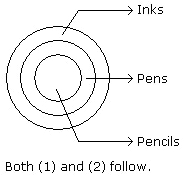
'All pencils are pens' gives pencils inside pens; 'all pens are inks' gives pens inside inks.
By transitivity pencils lie inside inks, so every pencil is an ink; therefore conclusion (1), 'All the pencils are inks,' follows.
Since all pencils are inks and pencils exist, those pencils are inks that are also pencils, so conclusion (2), 'Some inks are pencils,' follows by partial conversion.
Cross-check
Draw three concentric circles: Pencils innermost, then Pens, then Inks outermost. The Pencils region lies entirely within Inks, which confirms conclusion (1), and it also overlaps the Inks region, which confirms conclusion (2). Both conclusions hold, so the correct answer is 'Both (1) and (2) follow.'