A teacher wrote on the blackboard: Find 29 × 4. A student copied it on her…
2017
A teacher wrote on the blackboard: Find 29 × 4. A student copied it on her notebook as 27 × 4 and solved it as follows: The teacher should:
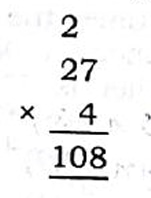
Answer: D. try to ascertain the reason of wrongly copying the question by the student and give her full 5 marks for the correct process — Assessment for Learning (formative assessment) evaluates a student's grasp of the underlying process, not merely whether the final answer matches the problem…
- A.
give 0 mark to the student
- B.
ask her to be attentive in the class and give 0 mark
- C.
give 2 marks out of 5 marks to the student
- D.
try to ascertain the reason of wrongly copying the question by the student and give her full 5 marks for the correct process
Attempted by 25 students.
Show answer & explanation
Correct answer: D
Assessment for Learning (formative assessment) evaluates a student's grasp of the underlying process, not merely whether the final answer matches the problem as originally set. Procedural competence and an incidental transcription error are judged separately: a mistake in copying the numbers is a distinct issue from a mistake in the mathematical method, and diagnosing the cause of an error matters as much as scoring the response.
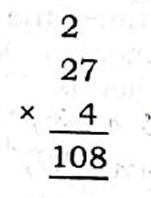
Here, the student copied 29 x 4 as 27 x 4 - a transcription slip unrelated to mathematics - but then multiplied 27 x 4 correctly, arriving at 108. Applying the concept above, the teacher's response should do two things: find out why the copying went wrong (inattention, a hard-to-read board, distraction) so it does not recur, and award full marks for the process, since the multiplication method itself has no error at all.
Docking all marks scores the transcription slip as if it were a mathematics error, giving no credit at all for a multiplication that was carried out correctly.
Reprimanding the student for inattention while still giving zero marks corrects behaviour but still denies credit for the flawless multiplication method she used.
Awarding partial marks softens the penalty but still treats the response as substantially wrong, even though the procedural error rate is zero - the docked marks are misattributed.
Separating the transcription slip from the mathematical process - and crediting the process in full while addressing the slip on its own terms - is the response consistent with process-focused, diagnostic assessment.