Directions : Read the data carefully and answer the questions. Some data are…
2019
Directions : Read the data carefully and answer the questions. Some data are missing which you have to calculate as per information provided in the questions.
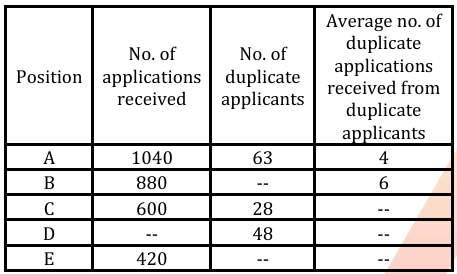
NOTE:- A duplicate applicant is an applicant who has submitted additional (duplicate) application after submitting their original application. All application forms (original + duplicate) received from duplicate applicant were rejected. Remaining all application were accepted. None of the applicants applied for more than one post.
For position E, no. of accepted applications from males, from females & no. of rejected applications (total) are X, X + Y, X + 2Y respectively. Which of the following is true? (average no. of duplicate applications received from duplicate applicant is non zero integer)
A. no. of accepted applications from males for E can be 139.
B. no. of accepted applications from males for E can be 141.
C. no. of accepted applications from males for E can be 131.
Answer: C. A & C — Concept: For any position, total applications received split into accepted applications (male + female) and rejected applications (from duplicate applicants).…
- A.
C
- B.
A & B
- C.
A & C
- D.
B
- E.
A
Attempted by 4 students.
Show answer & explanation
Correct answer: C
Concept: For any position, total applications received split into accepted applications (male + female) and rejected applications (from duplicate applicants). When these are written as X, X + Y, X + 2Y, adding all three and setting the sum equal to the position's total received converts each candidate value of X into a check of whether the resulting Y is a valid positive integer. Because accepted-female and rejected are built by adding successive increments of Y to the male count in that increasing order, Y is taken as a positive integer here (the standard reading for this X, X+Y, X+2Y format) — a candidate value of X that forces Y to be zero or negative does not fit this format and is not admissible.
From the table, Position E received a total of 420 applications.
Accepted (male) + Accepted (female) + Rejected = X + (X + Y) + (X + 2Y) = 3X + 3Y = 420, so X + Y = 140, i.e. Y = 140 − X.
Test X = 139 (statement A): Y = 140 − 139 = 1, a positive integer, so this value fits the format.
Test X = 141 (statement B): Y = 140 − 141 = −1, a negative value, so this value does not fit the format.
Test X = 131 (statement C): Y = 140 − 131 = 9, a positive integer, so this value fits the format.
Cross-check: For X = 139, the three counts are 139, 140, 141, which sum to 420 — matching the table. For X = 131, the counts are 131, 140, 149, which also sum to 420. The rejected count in each valid case (141 and 149) can still come from at least one duplicate applicant submitting a non-zero integer number of duplicate applications, so the "non-zero integer average" condition does not rule out either case.
Result: Only X = 139 and X = 131 give a valid positive Y under this format; X = 141 forces a negative Y and does not fit. So statements A and C are true, and statement B is false.