The table below shows the number of registered vehicles in a city (in lakhs)…
2022
The table below shows the number of registered vehicles in a city (in lakhs) in different years. The relevant total-row values are:
1990-91: 9.18 lakhs
2000-01: 19.95 lakhs
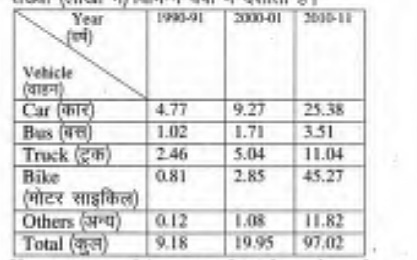
If the percentage increase in the total number of vehicles from 2000-01 to 2010-11 is made equal to the percentage increase in the total number of vehicles from 1990-91 to 2000-01, then what would the total number of vehicles in 2010-11 be (in lakhs)?
Answer: D. 43.36 — Concept: When the percentage increase from one value to a later value is known, applying that SAME percentage increase to a different base value scales that…
- A.
42
- B.
42.5
- C.
43.95
- D.
43.36
Attempted by 118 students.
Show answer & explanation
Correct answer: D
Concept: When the percentage increase from one value to a later value is known, applying that SAME percentage increase to a different base value scales that base by the identical multiplying factor (1 + rate) — not by the same absolute amount. So the phrase ‘the same percentage increase’ must first be converted into a multiplier before it is applied to a new base.
Application:
Find the percentage increase from 1990-91 to 2000-01: increase = 19.95 − 9.18 = 10.77 lakhs.
Growth rate = 10.77 / 9.18 ≈ 1.1732, i.e. about 117.32%. So the multiplying factor for ‘the same percentage increase’ is 1 + 1.1732 = 2.1732.
Apply this SAME multiplying factor to the 2000-01 total (the new base), not to the 1990-91 total: projected 2010-11 total = 19.95 × 2.1732.
19.95 × 2.1732 ≈ 43.36 lakhs.
Cross-check: Since the 2000-01 total already equals the 1990-91 total scaled by this same multiplier (9.18 × 2.1732 ≈ 19.95), applying the multiplier once more gives 19.95 × (19.95 / 9.18) = 19.952 / 9.18 ≈ 43.36 lakhs — matching the value above and confirming the result independently.
So the projected total number of vehicles in 2010-11 is 43.36 lakhs.