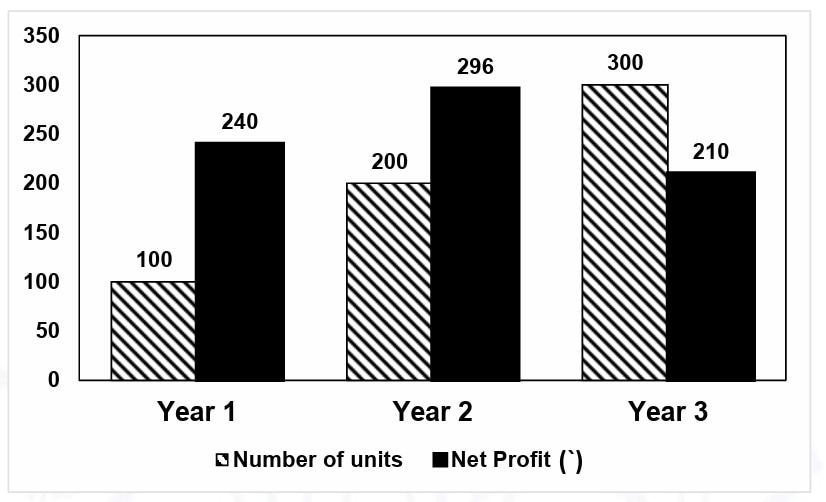
The number of units of a product sold in three different years and the…
2021

The number of units of a product sold in three different years and the respective net profits are presented in the figure above. The cost/unit in Year 3 was ₹1, which was half the cost/unit in Year 2. The cost/unit in Year 3 was one-third of the cost/unit in Year 1. Taxes were paid on the selling price at 10%, 13% and 15% respectively for the three years. Net profit is calculated as the difference between the selling price and the sum of cost and taxes paid in that year.
The ratio of the selling price in Year 2 to the selling price in Year 3 is ________.
Answer: A. 4:3 — Concept: For a profit-and-loss data-interpretation item like this, a year's net profit is what remains after every outgo is subtracted from that year's total…
- A.
4:3
- B.
1:1
- C.
3:4
- D.
1:2
Attempted by 12 students.
Show answer & explanation
Correct answer: A
Concept: For a profit-and-loss data-interpretation item like this, a year's net profit is what remains after every outgo is subtracted from that year's total selling price (revenue): Net Profit = Selling Price − (Total Cost + Tax), where Tax = tax rate × Selling Price and Total Cost = cost per unit × units sold. Given the year's net profit, units sold, cost per unit and tax rate, this identity can be solved for that year's total selling price.
Read the chart: units sold = 100, 200, 300 and total net profit = ₹240, ₹296, ₹210 for Years 1, 2, 3 respectively.
Cost per unit: Year 3 = ₹1 (given). Since Year 3's cost is half of Year 2's, Year 2 cost/unit = ₹2. Since Year 3's cost is one-third of Year 1's, Year 1 cost/unit = ₹3.
Total cost for a year = cost per unit × units sold, so Year 2's total cost = 2 × 200 = ₹400 and Year 3's total cost = 1 × 300 = ₹300.
Apply the identity to Year 2 (tax = 13%): 296 = SP2 − (400 + 0.13 × SP2) ⇒ 0.87 × SP2 = 696 ⇒ SP2 = ₹800.
Apply the identity to Year 3 (tax = 15%): 210 = SP3 − (300 + 0.15 × SP3) ⇒ 0.85 × SP3 = 510 ⇒ SP3 = ₹600.
Ratio SP2 : SP3 = 800 : 600 = 4 : 3.
Cross-check: Substituting back: Year 2 tax = 0.13 × 800 = ₹104, so profit = 800 − (400 + 104) = ₹296, matching the chart. Year 3 tax = 0.15 × 600 = ₹90, so profit = 600 − (300 + 90) = ₹210, also matching the chart. Both check out, confirming SP2 = ₹800 and SP3 = ₹600.
Result: The ratio of the selling price in Year 2 to the selling price in Year 3 is 4 : 3.
Explore the full course: Iocl Engineers Officer Grade A Paper 1