Choose the box that is similar to the box formed from the given sheet of paper…
2024
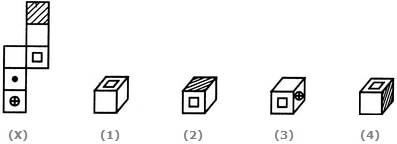
Choose the box that is similar to the box formed from the given sheet of paper (X).
Answer: C. 1 and 3 only — When a net of six squares folds into a cube, two faces end up opposite each other only if folding never brings them into contact. A quick way to read opposite…
- A.
1 only
- B.
2 and 3 only
- C.
1 and 3 only
- D.
1, 2 and 4 only
Attempted by 3 students.
Show answer & explanation
Correct answer: C
When a net of six squares folds into a cube, two faces end up opposite each other only if folding never brings them into contact. A quick way to read opposite pairs straight off the net: within any straight run of squares, the two faces that have exactly one square between them (two steps apart) always fold onto opposite sides of the cube. Every face has exactly one opposite, so once two such pairs are pinned down, the two faces left over must form the third pair.
Sheet (X) is made of two straight runs joined along one shared edge: going down the right-hand column, the shaded face, a blank face, then the square-marked face; going down the left-hand column from that same shared edge, a second blank face, the dot face, then the circle-marked (⊕) face.
In the first run, the shaded face and the square-marked face are the two ends, with one square between them, so the shaded face and the square-marked face fold to opposite sides of the cube.
In the second run, the blank face and the circle-marked face are the two ends, so that blank face folds opposite the circle-marked face.
That leaves the dot face and the other blank face unpaired; since a cube has only three opposite pairs and two are already fixed, these last two faces must be opposite each other.
So sheet (X) fixes three opposite pairs: shaded face ↔ square-marked face, one blank face ↔ circle-marked face, and the other blank face ↔ dot face.
Figure (2) shows the shaded face sharing an edge with the square-marked face, but those two faces must land opposite each other, never side by side, so figure (2) cannot be folded from sheet (X).
Figure (4) again places the square-marked face directly next to the shaded face, the same forbidden pairing, so figure (4) is also impossible.
Figures (1) and (3) each keep the shaded face and the square-marked face apart, the shaded face never touches the square-marked face in either figure, so both are genuine folds of sheet (X).
Hence only figures (1) and (3) can be formed from sheet (X), matching the option "1 and 3 only".