Choose the box that is similar to the box formed from the given sheet of paper…
2025
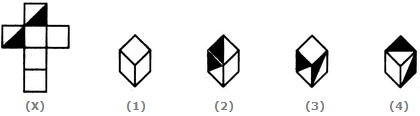
Choose the box that is similar to the box formed from the given sheet of paper (X).
- A.
1 and 4 only
- B.
3 and 4 only
- C.
1 and 2 only
- D.
2 and 3 only
Attempted by 1 students.
Show answer & explanation
Correct answer: A
Concept
When a flat net is folded into a cube, any two squares of the net that are separated by exactly one square along a straight run become OPPOSITE faces of the cube, while squares that directly touch in the net become ADJACENT faces. A cube always has exactly three opposite pairs, and once two pairs are fixed from the net, the two faces left over automatically form the third pair. A picture of the assembled cube can only be a genuine fold of that net if none of its three visible faces form a mutual opposite pair, and each face keeps its own pattern exactly as printed, oriented consistently with the crease it shares with its neighbours.
Applying it to sheet (X)
Label the six squares of sheet (X): the top square (half black, half white, split diagonally), the centre square directly below it (blank) -- the square through which both the horizontal and the vertical strip of the net pass -- the square to the centre's left (also half black, half white), the square to the centre's right (blank), and two more blank squares extending further down from the centre.
Along the vertical strip (top square -> centre square -> the two blank squares below it), the outer two squares of each straight run of three are opposite: the top square is opposite the first of the two lower blank squares, and the centre square is opposite the second (last) lower blank square.
Along the horizontal strip (left square -> centre square -> right square), the left square is opposite the right square.
This fixes all three opposite pairs: {top square, first lower blank square}; {centre square, second lower blank square}; {left square, right square}. The two half-shaded squares -- top and left -- belong to two DIFFERENT pairs, so they are never opposite each other; wherever both are visible, they must be ADJACENT, sharing one fixed edge.
Cross-check each option figure
Figure | What it shows | Consistent with sheet (X)? |
|---|---|---|
(1) | No shaded face is visible at all -- all three visible faces are blank. | Yes -- three of the four blank faces (the centre square, the right square, and one lower blank square) can sit together at one corner of the cube without ever forcing an opposite pair into view. |
(2) | Both half-shaded faces are visible together, but meeting each other along the wrong pair of edges for the diagonals shown. | No -- this relative placement of the two shaded triangles cannot be reached by any rotation of the cube folded from sheet (X). |
(3) | Only one shaded face is visible, together with two blank faces, but its diagonal runs the wrong way relative to its neighbours. | No -- this placement of the single visible shaded triangle is inconsistent with how sheet (X) actually folds. |
(4) | The two half-shaded faces are visible together, meeting exactly along the shared edge fixed in step 4 above, each triangle oriented the way folding sheet (X) produces. | Yes -- this is a genuine view of the same cube shown in figure (1), just rotated to show the shaded pair instead of the blank trio. |
Result
Only the boxes in figures (1) and (4) can be formed by folding sheet (X); figures (2) and (3) cannot, because in each of them the shaded triangle(s) sit in a relative orientation that this particular net can never produce.