Choose the box that is similar to the box formed from the given sheet of paper…
2023
Choose the box that is similar to the box formed from the given sheet of paper (X).
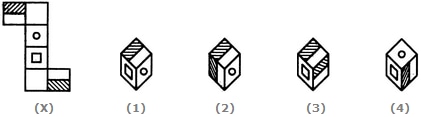
- A.
1
- B.
2
- C.
3
- D.
4
Attempted by 1 students.
Show answer & explanation
Correct answer: A
When a flat net folds into a cube, a straight run of four consecutively-joined squares wraps around to form the four side faces of the cube, so its 1st and 3rd squares become one opposite pair and its 2nd and 4th squares become another; separately, a square attached side-on to either end of that run folds onto one of the remaining two faces, and those two end-flaps are themselves opposite each other. Two faces that end up opposite this way can never be seen together on the assembled cube, and the assembled cube also has a fixed handedness — a mirror-flipped picture of it is not obtainable by any rotation.
Applying this to sheet (X):
The vertical run of four squares in sheet (X) — blank, circle, the square symbol, blank (top to bottom) — wraps around to form the four side faces of the cube, so the 1st and 3rd squares of this run (the top blank square and the square-symbol square) become opposite faces, and the 2nd and 4th squares (the circle square and the bottom blank square) become opposite faces.
The two half-shaded squares are each attached side-on to one end of this same run (one to the left of the top blank square, one to the right of the bottom blank square), so they fold onto the two remaining faces of the cube — which are perpendicular to the run and opposite each other.
So folding sheet (X) fixes three opposite-face pairs: the two half-shaded faces are opposite each other, the blank face from the top of the run is opposite the square-symbol face, and the circle face is opposite the other blank face.
Checking the four boxes against these three pairs and the cube's handedness:
The boxes in figures (2) and (3) each draw the two half-shaded faces adjacent to one another, sharing a visible edge — impossible, since folding sheet (X) always sends these two faces to opposite sides of the cube, where they can never appear together.
The box in figure (4) keeps the two half-shaded faces apart, but the circle, square-symbol, and half-shaded faces meet at their shared corner in the mirror-reversed rotational order compared to the cube produced by actually folding sheet (X), so it is a reflection, not a rotation, of the real box.
The box in figure (1) is the only one that keeps the two half-shaded faces separated and shows the circle, square-symbol, and half-shaded faces meeting in the same rotational order as the cube obtained by folding sheet (X).
Hence, the box in figure (1) is the one formed by folding sheet (X).