Choose the box that is similar to the box formed from the given sheet of paper…
2024
Choose the box that is similar to the box formed from the given sheet of paper (X).
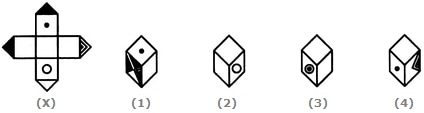
Answer: A. 1 and 2 only — Concept: In a ‘sheet folds into a box’ question, two faces of the net that are separated by exactly one square along the same straight strip always end up…
- A.
1 and 2 only
- B.
1, 2 and 3 only
- C.
1 and 3 only
- D.
1, 2, 3 and 4
Attempted by 4 students.
Show answer & explanation
Correct answer: A
Concept: In a ‘sheet folds into a box’ question, two faces of the net that are separated by exactly one square along the same straight strip always end up OPPOSITE each other on the folded box, and two opposite faces can never be seen together in a single 3-D view. But avoiding opposite pairs is not enough on its own — the three faces meeting at any one corner of the box can only be arranged in ONE of their two possible rotational orders (clockwise or anticlockwise, as fixed by how the net actually folds); a picture that shows the correct three faces but in the mirror-image order is still an impossible box.

Labelling the six faces of sheet (X) by their marks — the dot, the circle, the solid (filled) arrow face, the hollow (outline) arrow face, and the two plain/blank faces — and reading off the straight strips gives three opposite pairs:
dot ↔ circle (they sit one square apart in the vertical strip, with the shared middle square between them)
the solid-arrow face ↔ the far blank face (they sit one square apart in the horizontal strip)
the shared middle (hub) blank face ↔ the hollow-arrow face
Testing the four given boxes against these three pairs, and against the corner order that folding actually produces:
Figure (1) shows the dot with the solid-arrow face and a blank face — none of these three is one of the opposite pairs above, and tracing the fold of sheet (X) shows these three faces meeting at their corner in exactly this rotational order, so this box can be formed.
Figure (2) shows the circle with the two blank faces — again no opposite pair is repeated, and this is exactly the corner order that folding sheet (X) produces, so this box can be formed.
Figure (3) shows the dot and the circle meeting at the same corner — but dot and circle are one of the opposite pairs, so this box is impossible.
Figure (4) shows the dot, the hollow-arrow face and a blank face — none of these three is one of the opposite pairs above, but tracing how sheet (X) actually folds shows these three faces meeting at their shared corner in the mirror-image of the order figure (4) draws them in, so this box, too, is impossible.
Cross-check: figures (1) and (2) both avoid every opposite pair AND match the corner order that folding sheet (X) actually produces; figure (3) fails the opposite-pair check outright (dot and circle together), and figure (4) passes the opposite-pair check but fails the corner-order check — confirming the same split by two independent tests.
Hence, only the boxes in figures (1) and (2) can be formed from sheet (X).