Choose the box that is similar to the box formed from the given sheet of paper…
2025
Choose the box that is similar to the box formed from the given sheet of paper (X).
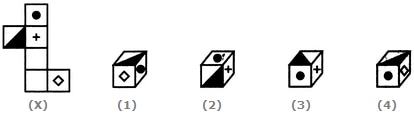
- A.
1
- B.
2
- C.
3
- D.
4
Attempted by 1 students.
Show answer & explanation
Correct answer: B
When a flat sheet is folded into a cube, opposite faces are the two faces that never share an edge in the folded shape. For a net that runs as a straight strip of four squares, the 1st and 3rd squares of that strip become one opposite pair, and the 2nd and 4th squares become another opposite pair (the strip wraps around to form the four side faces of the cube). Any remaining squares attached as flaps to two different squares of that strip fold up to become the last opposite pair. Two opposite faces can never be seen adjacent to each other in any view of the same cube, and three faces that genuinely meet at one corner of a cube can only be arranged in one fixed turning (clockwise/anticlockwise) sense — its mirror image can never be reached by turning the cube, only by reflecting it.
Sheet (X) has a vertical strip of four squares, in order: the black-dot square, the '+' square, and two blank squares. By the strip rule, the black-dot square is opposite one blank square, and the '+' square is opposite the other blank square. The half-shaded square and the rhombus (◇) square are the two flaps, attached to two different squares of that strip, so they fold up to form the last opposite pair: the half-shaded face is opposite the rhombus face. Consequently, in the folded cube the black-dot, '+', and half-shaded faces all meet at one common corner, in the specific turning sense that sheet (X) produces, while the rhombus sits directly behind the half-shaded face.
Any arrangement showing the half-shaded face directly next to the rhombus (◇) face is impossible — folding sheet (X) puts these two faces opposite each other, never adjacent.
An arrangement showing the black-dot, '+', and half-shaded faces meeting at one corner with no forbidden pair touching, but running in the mirror-image turning sense to the one sheet (X) actually produces, is also impossible — turning a rigid cube any which way can never convert one turning sense into its mirror image.
Only the box in which the black-dot, '+', and half-shaded faces meet at that corner in the SAME turning sense produced by folding sheet (X), with the rhombus correctly hidden directly opposite the half-shaded face, can actually be formed — that is the box labelled 2.