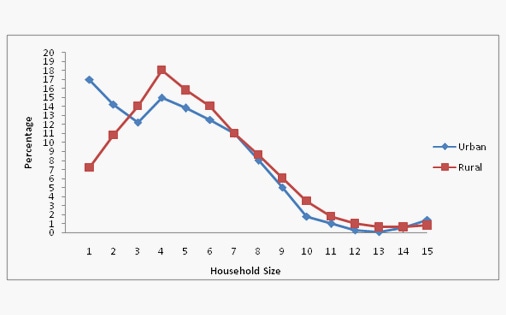
DIRECTIONS for questions: The percentage distribution of households by…
2024
DIRECTIONS for questions: The percentage distribution of households by household size and the average sizes of household in
All India Rural and Urban areas.
Urban areas classified as per population size are presented below.
Data Interpretation Practice Questions
As the urban population of towns increases, the average household size
Answer: D. Fluctuating — Concept: To describe how a value changes across an ordered series of categories, compare each value with the one immediately before it. If every step rises,…
- A.
Increases
- B.
Decreases
- C.
Remains constant
- D.
Fluctuating
Attempted by 1 students.
Show answer & explanation
Correct answer: D
Concept: To describe how a value changes across an ordered series of categories, compare each value with the one immediately before it. If every step rises, the value increases; if every step falls, it decreases; if every value is identical, it remains constant; if the direction of change reverses at least once (a fall followed by a rise, or a rise followed by a fall), the value is fluctuating.
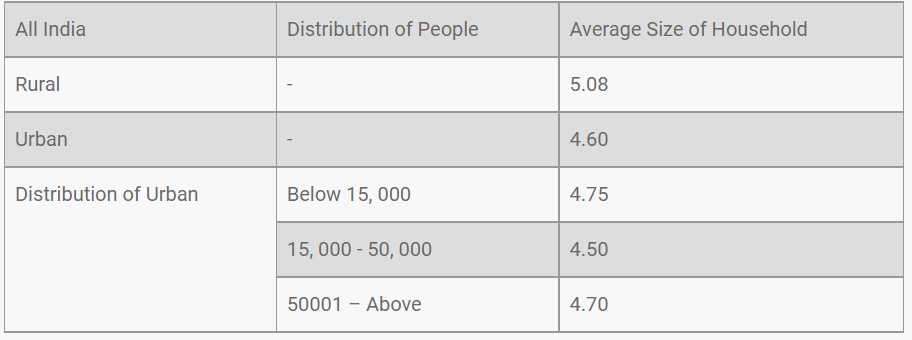
From 'Below 15,000' to '15,000-50,000', the average household size changes from 4.75 to 4.50 — a decrease.
From '15,000-50,000' to '50,001-Above', the average household size changes from 4.50 to 4.70 — an increase.
Cross-check: The three values 4.75, 4.50 and 4.70 are all different, so the size does not remain constant; it does not rise at every step (ruling out 'Increases'), and it does not fall at every step (ruling out 'Decreases'). A decrease followed by an increase matches only the fluctuating pattern.
Hence, as the urban population of towns increases, the average household size fluctuates.