Wipro Coding Questions: 3 Solved Patterns with Step-by-Step Traces
Learn three reusable coding patterns through exact Python traces, complexity checks and edge cases, then adapt your rehearsal to the instructions in your current Wipro invite.
KnowledgeGate Team
Exam prep & CS education
Updated 11 Sep 20266 min read

Searching for “Wipro coding questions” often produces lists that mix hiring routes, years and candidate memories. Memorising a supposed fixed paper is therefore fragile. A safer approach is to learn three reusable patterns through exact traces, then adapt them after reading your current assessment invite: frequency counting for strings, two pointers for in-place array work, and a fixed sliding window for contiguous ranges. Every example below is representative practice, not a recalled or official Wipro question.
1. What “Wipro coding question patterns” can honestly mean
The official Wipro Careers site is the source for current roles and applications, but it does not establish one universal coding-question list, round duration, problem count, scoring rule or cutoff. Your active role page, official invite and recruiter communication override any preparation article.
Here, a pattern means a reusable solution family, not a company-specific promise. The Wipro Preparation: Elite NTH, Turbo & WILP course includes coding within broader preparation. That supports practising the skill, but it is not an official Wipro specification.
Readers comparing preparation across recruiters can also use the Company-Specific Placement Courses page. Keep the distinction clear: the company communication tells you what your route requires; pattern practice helps you solve the problems you actually receive.
2. Read constraints first, then choose the pattern
Look for the operation the prompt requires before choosing a data structure.
Prompt cue | Likely pattern |
|---|---|
Need the first, most or least frequent item | Frequency map |
Keep order while filtering or compacting an array | Read and write pointers |
Every contiguous block has fixed length | Fixed sliding window |
Nested opening and closing symbols | Stack |
These are general cues, not rules tied to one company. Scale matters: for n = 100,000, an O(n^2) nested scan can perform about 10,000,000,000 pair checks, while one pass examines 100,000 values. For a length-n array and k = 3, compute the first window once, then add the entering value and subtract the leaving value for every later window.
The code below uses Python for compactness. The invariants, complexity and method transfer directly to C++ and Java.
3. Solved pattern 1: first non-repeating character with a frequency map
Representative practice problem: given the lowercase string swiss, return its first character that appears exactly once, or -1 if none exists.
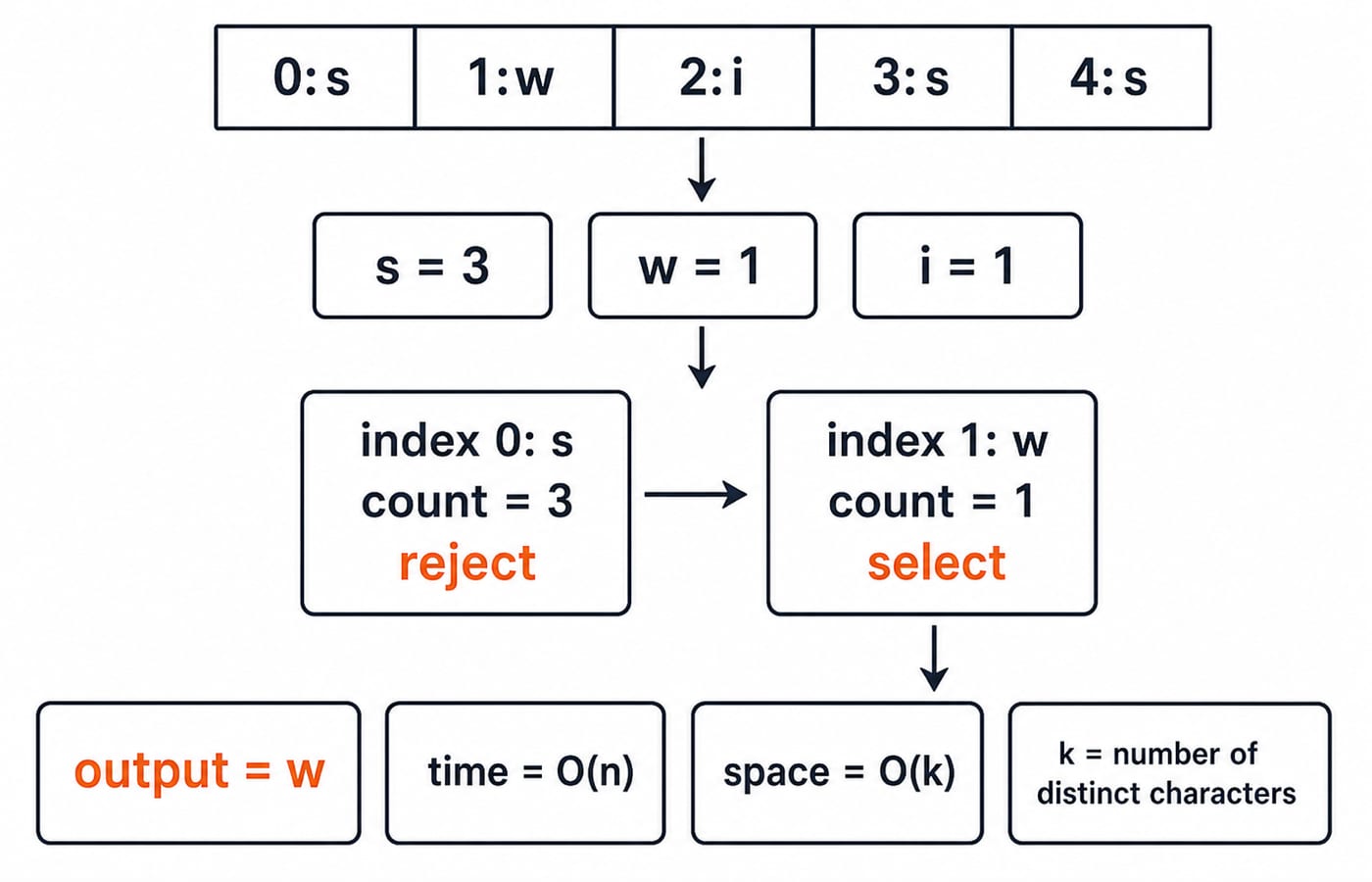
Invariant: after each character in the first pass, freq stores the count seen so far. A second pass preserves the string's original order.
def first_non_repeating(s):
    freq = {}
    for ch in s:
        freq[ch] = freq.get(ch, 0) + 1
    for ch in s:
        if freq[ch] == 1:
            return ch
    return -1
index | character | count after read |
|---|---|---|
0 | s | 1 |
1 | w | 1 |
2 | i | 1 |
3 | s | 2 |
4 | s | 3 |
After pass one, s = 3, w = 1 and i = 1. Pass two rejects s at index 0, then returns w at index 1. The method takes O(n) time and O(k) auxiliary space for k distinct characters.
Boundary checks: aabb returns -1, z returns z, and an empty string returns -1. Iterating only over the map can lose the required “first in the original string” reasoning, so the ordered second pass is deliberate.
4. Solved pattern 2: move zeroes with stable two-pointer compaction
Representative practice problem: move every zero in [0, 5, 0, 3, 0, 2] to the end in place while preserving the order of non-zero values.
Invariant: before each read, positions 0 through write - 1 contain every non-zero value seen so far, in original order.
def move_zeroes(a):
    write = 0
    for value in a:
        if value != 0:
            a[write] = value
            write += 1
    for i in range(write, len(a)):
        a[i] = 0
    return a
read index | value | action | write after |
|---|---|---|---|
0 | 0 | no write | 0 |
1 | 5 | set | 1 |
2 | 0 | no write | 1 |
3 | 3 | set | 2 |
4 | 0 | no write | 2 |
5 | 2 | set | 3 |
The final loop fills indices 3, 4 and 5 with zero, producing [5, 3, 2, 0, 0, 0]. The method takes O(n) time and O(1) auxiliary space. [0, 0] stays unchanged, [7, 8] stays unchanged, and [-1, 0, -1] becomes [-1, -1, 0].
![Two-pointer zero-compaction trace for [0, 5, 0, 3, 0, 2]. Show write = 0 initially and six read steps exactly: read index 0 value 0 -> no write, write = 0; read index 1 value 5 -> set a[0] = 5, write = 1; read index 2 value 0 -> no write, write = 1; read index 3 value 3 -> set a[1] = 3, write = 2; read index 4 value 0 -> no write, write = 2; read index 5 value 2 -> set a[2] = 2, write = 3. Then show zeros written at indices 3, 4 and 5 and the exact final array [5, 3, 2, 0, 0, 0]. Label stable order, time = O(n), and space = O(1).](https://cdn.knowledgegate.ai/blog-assets/blog_asset_1786359777779_51l7dg.jpg)
5. Solved pattern 3: maximum fixed-window sum without rescanning
Representative practice problem: for a = [4, -1, 2, 10, -3, 5] and k = 3, find the maximum sum of any contiguous block of exactly three values.
Invariant: window is the sum of the current length-k block, while best is the largest valid window sum seen so far.
def max_window_sum(a, k):
    if k <= 0 or k > len(a):
        raise ValueError("invalid window size")
    window = sum(a[:k])
    best = window
    for right in range(k, len(a)):
        window += a[right] - a[right - k]
        best = max(best, window)
    return best
indices | values | update | sum |
|---|---|---|---|
|
| initial window | 5 |
|
|
| 11 |
|
|
| 9 |
|
|
| 12 |
Initialise window = sum(a[:3]) = 5 and best = 5. The answer is 12, produced by [10, -3, 5], in O(n) time and O(1) auxiliary space.
k = 1 returns 10, while k = 6 returns the full-array sum 17. The function rejects k = 0 and k > len(a). Never initialise best to zero because a correct answer can be negative.
6. Hidden-test traps that make correct-looking code fail
Cause | Failure | Repair |
|---|---|---|
Return while counting characters | A later duplicate changes the answer | Finish counting, then scan in order |
Assume | Output disagrees with the prompt | Use the exact requested no-answer value |
Sort to move zeroes |
| Use stable compaction |
Build a second array | Values look right, but the method is not in place | Write into the original array |
Start | All-negative cases return an impossible zero | Initialise from the first valid window |
For the final trap, use [-8, -3, -5] with k = 2. Its sums are -11 and -8, so the maximum is -8. Also check empty input, invalid k, and the required input and output format.
7. Turn the patterns into a realistic coding-round rehearsal
Try this self-imposed 45-minute practice drill. It is not an official Wipro timing.
Read all three prompts and constraints: 5 minutes.
Solve
swiss: 10 minutes.Perform stable zero compaction: 10 minutes.
Solve the fixed-window problem: 12 minutes.
Test edge cases and final input and output handling: 8 minutes.
The total is 5 + 10 + 10 + 12 + 8 = 45 minutes. For every failure, keep a four-field review log:
problem | wrong assumption | failing input | repair |
|---|---|---|---|
fixed-window maximum | best started at 0 |
| initialise from the first valid window |
Use Wipro Mock Analysis: Turn Errors into a Study Plan to convert the log into focused practice. The Coding Round Strategy: Triage, Time-Box, Bank Marks article adds triage and hidden-case checks. When your invite arrives, replace this rehearsal timing with its platform rules.
8. Wipro coding questions: the short version and next step
Identify whether the prompt needs counts, stable filtering or a fixed contiguous block. State the invariant, trace the smallest exact example, write the linear-time version, then test empty, one-item, duplicate, zero and negative cases where relevant. The three answers are swiss -> w, [0, 5, 0, 3, 0, 2] -> [5, 3, 2, 0, 0, 0], and maximum length-3 sum 12 for [4, -1, 2, 10, -3, 5].
Coding for Placements: C, C++, Java, Python is an optional structured next step for expanding this pattern base across languages. Before deciding what to simulate, confirm your current Wipro route through official communication.
Keep learning
Accenture Coding Questions: 4 Patterns with Solved Dry Runs
Stop memorising company-question lists. Learn four reusable coding patterns through precise examples involving strings, arrays, digits, and matrices.
Updated 2 Oct 20265 min readCompany-Specific Prep
Accenture Placement Preparation: 4-Week, 56-Hour Study Plan
Turn four preparation lanes into a practical weekly calendar. Start with a baseline, move hours towards your errors, and recover missed sessions without cramming.
Updated 27 Sep 20265 min readCompany-Specific Prep
Capgemini Interview Questions: Technical and HR Rounds with Model Answers
Practise clear technical and HR answers through Java, SQL, a coding trace and one consistent project story. Each example shows what to say and how to support it.
Updated 25 Sep 20265 min readCompany-Specific Prep
Capgemini Drive Mistakes: Stage-by-Stage Rejection Risks and Fixes
Diagnose the controllable evidence gaps behind common Capgemini drive risks. Repair your CV, timed practice, code traces, project proof and behavioural stories with worked drills.
Updated 24 Sep 20266 min readCompany-Specific Prep