

UPTET Mock Score Planning: Set Your Target and Buffer
A passing rule and a useful mock target answer different questions. Work through a baseline, score buffer and error review to set a target you can test.
KnowledgeGate Team
Exam prep & CS education
Updated 21 Nov 20265 min read

An online “UPTET cutoff” can be mistaken for both the qualifying rule and a safe mock target. Separate the official threshold from a personal target: verify the rule for your paper and category, measure your score variation, then add a buffer. Use hypothetical examples only to practise the calculation; the applicable notification controls official UPTET marks and eligibility, and no target guarantees a pass.
Decide what “UPTET cutoff” means before comparing scores
Start by identifying which question the number answers:
Qualifying threshold: What result meets the applicable examination rule?
Recruitment selection cutoff: What score meets the selection requirement in a particular recruitment process?
Personal practice target: What mock score are you working towards, allowing for your own variation?
Qualifying should not be treated as a job offer. Any recruitment use depends on the applicable recruitment notice.
Identify your paper and category before applying a numerical rule. For that context, read UPTET eligibility and paper choice. That post owns UPTET paper choice and eligibility; this one owns the verified-rule to target-buffer calculation. Keep the official qualifying rule beside your mock record, but label your personal target separately. Otherwise, a practice goal can easily become a supposed official requirement when shared with friends.
Record the rule behind your practice baseline
A useful baseline needs a documented rule. Complete this record for your examination cycle before calculating a target; leave missing entries marked “not verified”.
Field | Entry to complete |
|---|---|
Examination cycle | Not verified |
Paper | Not verified |
Applicable category | Not verified |
Official document title and date | Not verified |
Clause or page | Not verified |
Maximum marks | Not verified |
Qualifying rule | Not verified |
Official marks and rounding wording | Not verified |
If the notification gives a percentage, record its denominator and rounding wording. If it gives an integer qualifying mark, copy that exact rule. Do not transfer a category-specific threshold from another paper or cycle. A blank field means pause the calculation, not infer a value from an old table or social-media post.
A harder mock does not prove that the qualifying threshold changed. A recruitment cutoff is a different measure too. Read UPTET and CTET differences for context; CTET figures cannot establish a UPTET trend. For timing and paper-execution tactics, see CTET mock-test strategy; this post focuses on setting a UPTET target from verified rules and score variation.
Translate the verified rule into a working baseline
Call the officially verified threshold for your paper and category Q. Check whether the document gives a percentage, an integer mark or a specific rounding instruction. Record the document title, date and clause or page before using the value. Arithmetic alone cannot establish the authority's rounding rule.
Suppose the maximum is 120 marks and the threshold is 65%:
Convert the percentage: 65 ÷ 100 = 0.65.
Multiply by the maximum: 120 × 0.65 = 78 marks.
Carry Q = 78 through the example. When using your own threshold, keep both the baseline and mock scores on the same marks scale.
Calculate a buffer from your own mock-score variation
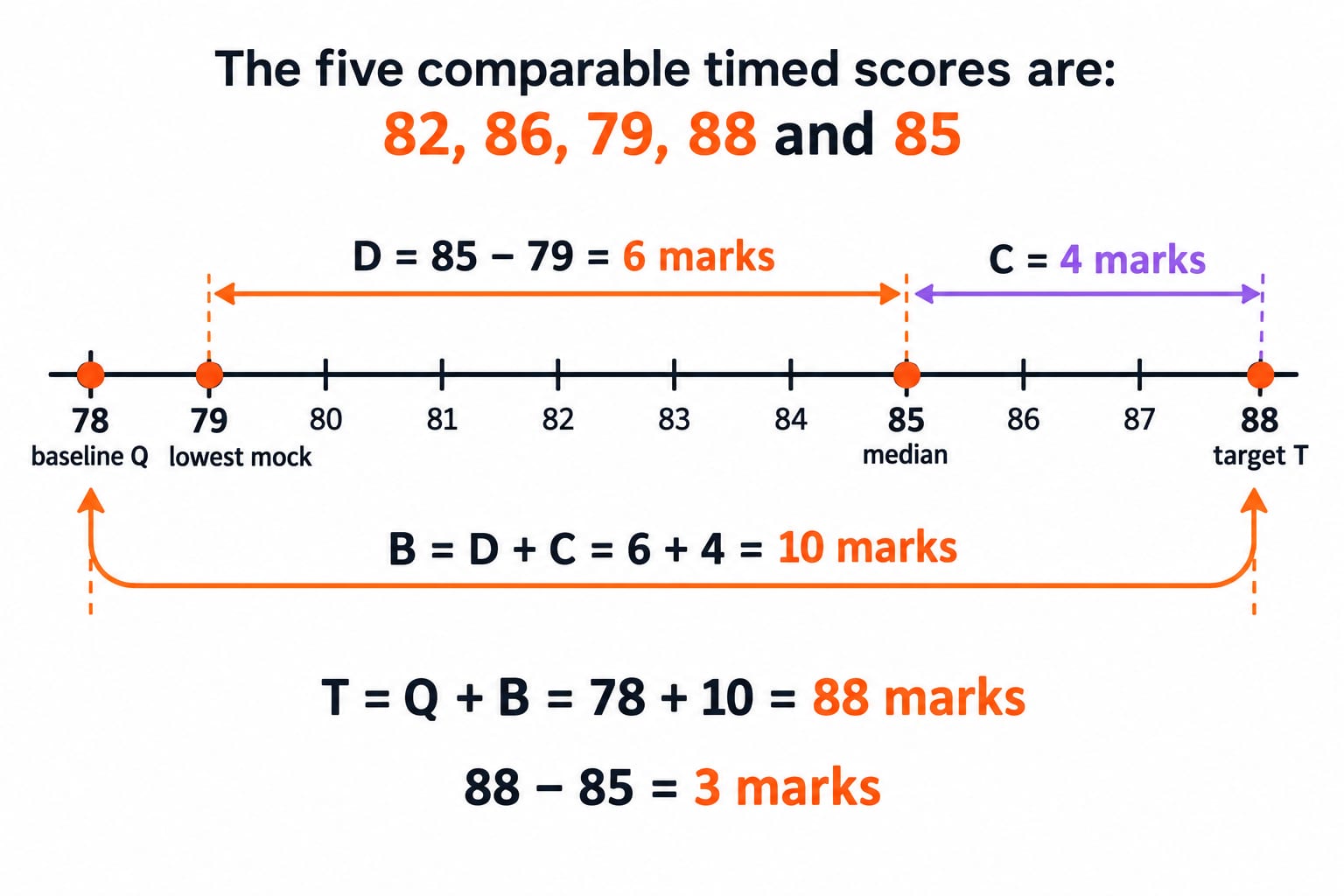
Take five comparable timed scores: 82, 86, 79, 88 and 85. Arrange them in order: 79, 82, 85, 86, 88.
The middle score, or median, is 85. The lowest is 79, so the observed median-to-low drop is:
D = 85 - 79 = 6 marks.
Choose an additional cushion C = 4 marks. Choose it according to the extra room you want above the observed drop. Now calculate:
Buffer: B = D + C = 6 + 4 = 10 marks.
Target: T = Q + B = 78 + 10 = 88 marks.
Current median gap: 88 - 85 = 3 marks.
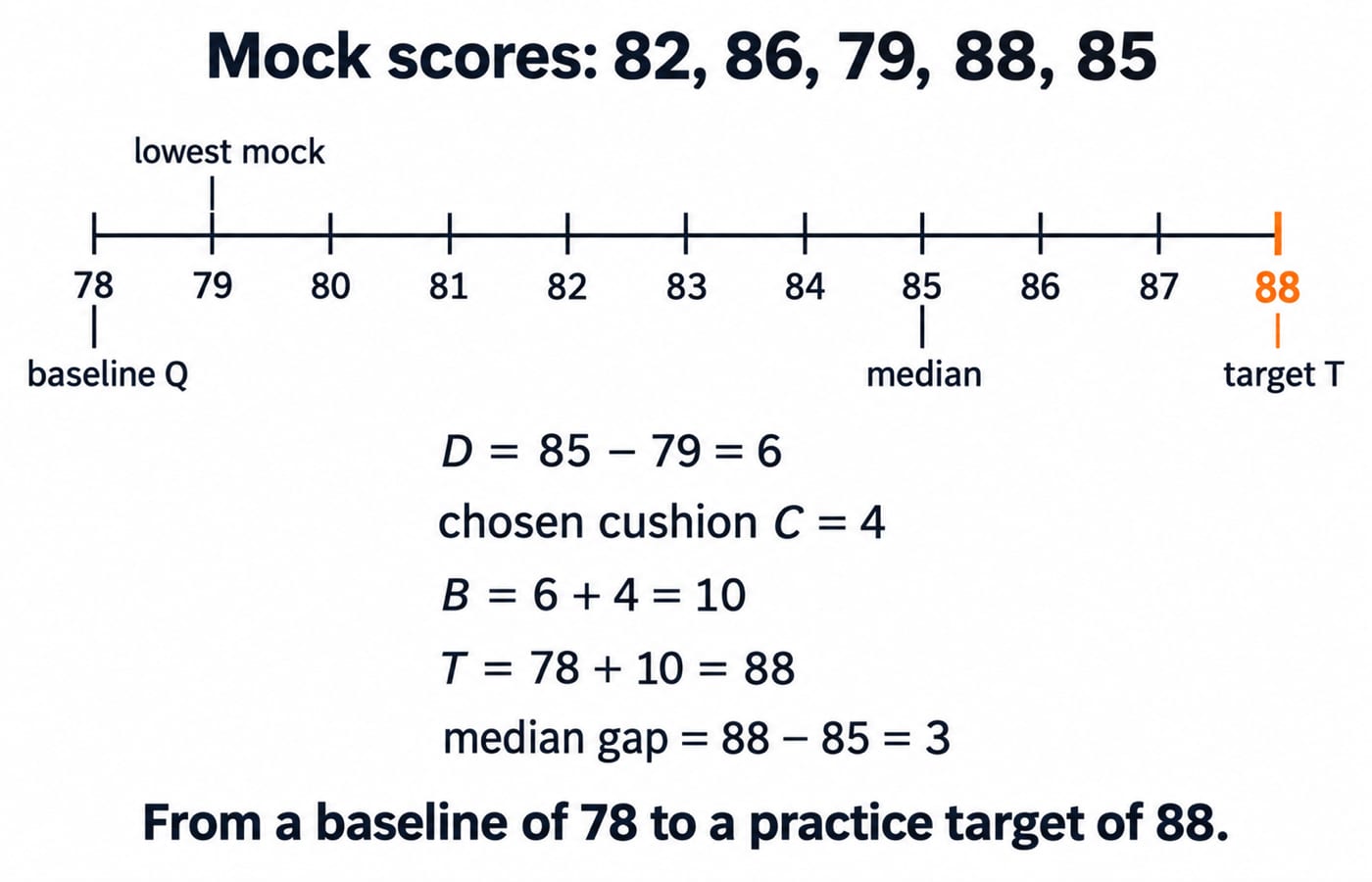
You have reached 88 once, but that is not stable performance. Use the lowest score to identify what disrupted your performance. Keep mock difficulty and conditions comparable so the observed drop remains useful.
Turn the three-mark gap into specific repair work
Suppose a separate error review of the median mock finds 4 concept errors, 3 misread questions and 2 answer-transfer errors. That totals 4 + 3 + 2 = 9 errors.
For this example, assume each repaired error recovers one mark. Recovering one from each bucket gives 1 + 1 + 1 = 3 marks, moving 85 + 3 = 88. Check that recovery on the next fresh mock.
Give each bucket a concrete action:
Concept: Revisit the misunderstood idea, then explain it aloud before solving a fresh question.
Misreading: Underline the instruction or negation before answering.
Answer transfer: Practise the response-recording routine used by the applicable exam.
Retest on fresh comparable questions. Remembered answers can inflate apparent improvement. Keep the paper, scoring rules and testing conditions consistent when interpreting movement.
Check whether the improvement survives the next three mocks
Suppose fresh scores are 87, 89 and 88. Sorted, they are 87, 88, 89: the median is 88, the minimum is 87, and two of three meet the target of 88.
Both results matter. The median reaches the target, but the weakest performance remains 88 - 87 = 1 mark short. Maintain the buffer and investigate that remaining error instead of declaring the score safe.
Decide whether conceptual coverage or practice quality is limiting progress. Then compare teaching eligibility preparation options against that need. Choose resources for the gap your review actually found.
Write one target card and choose the next study action
Keep this target card beside your mock log:
Baseline 78, observed drop 6, chosen cushion 4, target 88, original median 85, initial gap 3.
Replace the example baseline with the properly sourced official rule and recompute using your own comparable mocks.
If you are preparing for Paper 1 and need structured coverage, consider the UPTET Paper 1 course. Paper 2 readers should choose resources matching their own paper.
Your next action: record the official rule and analyse your latest five comparable mocks before setting a target.
Go deeper with the full courseCTET Paper 1 2026 — प्राथमिक शिक्षक (कक्षा 1–5)
Keep learning
Computer Graphics Basics: From Coordinates to Pixels and Frame-Buffer Bytes
Follow one triangle from object coordinates through matrix transformation and viewport mapping to edge pixels, a 135-byte RGB buffer, and exact byte offsets.
Updated 19 Nov 20265 min readComputer Organization & Architecture

UPTET eligibility and exam structure: what to know before you apply
A UPTET eligibility and structure explainer: the two-paper design, who each paper is for, the section backbone, and which details to confirm before applying.
Updated 29 Oct 20265 min read51 viewsCTET & UPTET
UPTET vs CTET: the differences that decide which you should take
UPTET vs CTET compared: national versus state scope, the two-paper structure they share, where recruitment differs, and how to decide or prepare for both.
Updated 29 Oct 20266 min readCTET & UPTET

Disaster Recovery Planning: RTO, RPO, Backup Design and Worked Exam Scenarios
Learn to separate outage time from data-loss exposure, compare backup chains, and build a dependency-aware recovery runbook through exact worked calculations.
Updated 17 Nov 20266 min readGATE Strategy & Roadmap