

Arunachal Pradesh TET: Paper I vs II Eligibility, Pattern and Syllabus
Choose the Arunachal TET paper for your teaching level, check recognised qualification routes, and organise subject content alongside pedagogy. Worked examples explain question shares and classroom error analysis.
KnowledgeGate Team
Exam prep & CS education
Updated 21 Nov 20264 min read
Preparing for the Arunachal Pradesh Teacher Eligibility Test starts with three decisions: your teaching level, your recognised qualification route and your syllabus. This is different from Andhra Pradesh AP TET, despite similar search terms. The cited SCERT notification is a past-cycle reference; later notices on the official portal govern the next application.
Source note: The cited APTET notification is a past-cycle document. Use the official APTET portal for its notification, both syllabus PDFs and subsequent notices.
What Arunachal Pradesh TET qualifies you for
SCERT's notification identifies Paper I with Classes I–V and Paper II with Classes VI–VIII. APTET establishes an elementary-teaching eligibility criterion.
Page 2 explicitly says qualifying does not confer a right to employment. The recruiting or appointing authority verifies eligibility.
For a structured preparation route, see KnowledgeGate courses.
Paper I or Paper II: choose the teaching level first
For example, Tara wants to teach Class IV, so Paper I matches her intended level. Tashi wants to teach Class VII mathematics, so Paper II and its mathematics/science branch match his target.
If you want both levels, check both qualification routes before selecting both papers.
The CTET Paper 1 versus Paper 2 comparison helps explain preparation levels.
Eligibility: match qualifications, recognition and the age reference date
The recent SCERT notification, page 1, specified these selected qualification routes:
Paper | Academic and training route |
|---|---|
I | Senior Secondary 50% plus two-year D.El.Ed |
I | Senior Secondary 50% plus four-year B.El.Ed |
I | Graduation plus two-year D.El.Ed |
II | Graduation plus two-year D.El.Ed |
II | At least 50% in graduation or postgraduation plus B.Ed |
II | Senior Secondary at least 50% plus four-year B.El.Ed |
Consult the notification for alternative and special-education routes. The notification also lists graduation with at least 50% plus B.Ed for Paper I; confirm this route's current applicability with SCERT. The notification requires NCTE-recognised D.El.Ed/B.Ed training and the stated RCI condition for special-education qualifications.
The notification's historical maximum ages were 30 for Paper I and 35 for Paper II as on 30 November 2025, with APST relaxation per norms. Its appearing-candidate provision covered final-semester/final-year students, requiring the third-semester or first-year passed marksheet.
For example, 52% Senior Secondary plus a completed recognised two-year D.El.Ed matches the first academic route because 52 ≥ 50.
Section-wise pattern: what changes between the papers
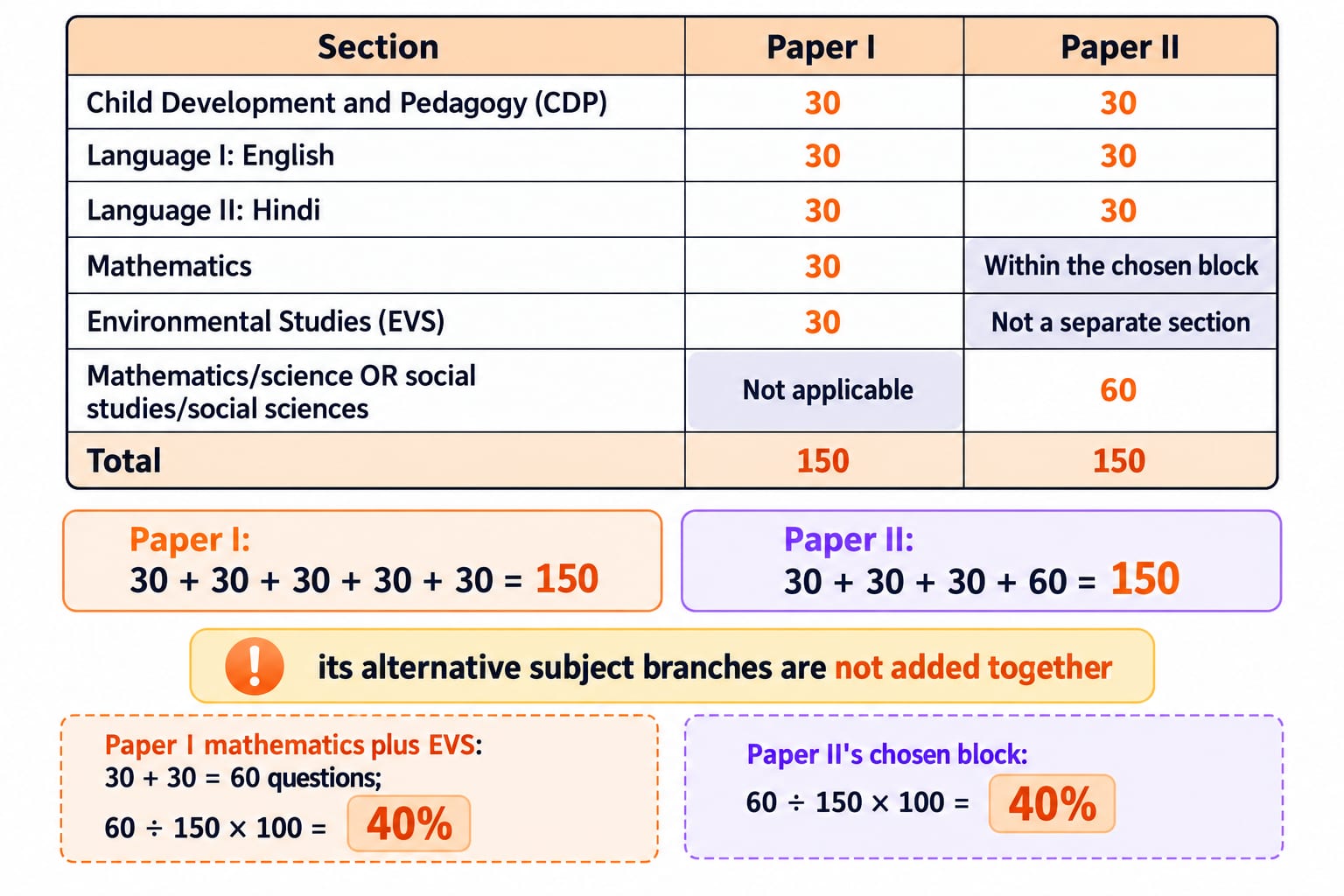
The official Paper I and Paper II syllabus PDFs give these question counts:
Section | Paper I | Paper II |
|---|---|---|
Child Development and Pedagogy (CDP) | 30 | 30 |
Language I: English | 30 | 30 |
Language II: Hindi | 30 | 30 |
Mathematics | 30 | Within the chosen block |
Environmental Studies (EVS) | 30 | Not a separate section |
Mathematics/science OR social studies/social sciences | Not applicable | 60 |
Total | 150 | 150 |
Paper I totals 30 + 30 + 30 + 30 + 30 = 150. Paper II totals 30 + 30 + 30 + 60 = 150; its alternative subject branches are not added together. English and Hindi are the named languages here.
Worked allocation: Paper I mathematics plus EVS gives 30 + 30 = 60 questions; 60 ÷ 150 × 100 = 40%. Paper II's chosen block also gives 60 ÷ 150 × 100 = 40%.
Syllabus priorities: connect subject content with how children learn
Both official syllabi specify these question sub-splits:
CDP: 15 child development + 5 inclusive education + 10 learning and pedagogy = 30.
Each language: 15 comprehension + 15 pedagogy = 30.
Paper I mathematics and EVS: 15 content + 15 pedagogy = 30 each.
Paper II mathematics and science: 20 content + 10 pedagogy = 30 each, together 60.
Paper II social studies: 40 content + 20 pedagogy = 60.
Paper I adds primary mathematics and EVS. Paper II mathematics/science includes number systems, algebra, geometry and science; social sciences includes history, geography and social/political life, alongside pedagogy.
Practise explaining errors as well as finding answers. Suppose a child writes:
1/2 + 1/3 = 2/5, which is incorrect.
The child has added numerators and denominators separately. Convert both fractions to common units:
1/2 = 3/6.
1/3 = 2/6.
3/6 + 2/6 = 5/6.
Use equal-length fraction strips divided into sixths to show why the pieces must share a size. Then repeat the symbolic method. This joins subject knowledge with error analysis.
Use the CTET syllabus comparison to organise shared topics, while keeping the Arunachal PDFs as your coverage checklist.
Qualifying marks: distinguish the rule from your practice target
Clauses C–D of the SCERT notification specified 60% or above for qualification and certificate issue, with up to 5% relaxation in qualifying marks for reserved categories under state norms. The notification gives no single relaxed figure, so check the state norms for your category.
For example, on a teacher-created 100-mark diagnostic:
58 ÷ 100 × 100 = 58%; 60 - 58 = 2 percentage points below the benchmark.
64 ÷ 100 × 100 = 64%; 64 - 60 = 4 percentage points above it.
Prepare by paper and finish with an Arunachal checklist
Try this six-hour study week, for example: two hours CDP, one English, one Hindi and two for your subject block. Include question review within each block: 2 + 1 + 1 + 2 = 6 hours. If you miss an hour, record 6 - 1 = 5 completed hours and move the remaining hour to next week.
Primary-level readers seeking structure can consider the CTET Paper 1 course for overlapping topics after comparing coverage against Arunachal's Paper I syllabus. Upper-primary candidates should organise coverage using Paper II.
Before applying, check your chosen level and paper, recognised qualification and applicable age rules, and official syllabus plus newest notice. Return to the official portal above for later-cycle updates.
Go deeper with the full courseCTET Paper 1 2026 — प्राथमिक शिक्षक (कक्षा 1–5)
Keep learning

CG TET Eligibility and Selection: Paper-Wise Routes to Recruitment
Choose the teaching level first, then match your qualifications to the correct route. Worked examples show how academic percentages, TET qualification and recruitment checks answer different questions.
Updated 22 Nov 20265 min readCTET & UPTET
CTET Language I and Language II: a strategy that actually scores
A CTET Language I and Language II strategy: what each paper really tests, why pedagogy of language is the scoring half, and a prep plan for both papers.
Updated 29 Oct 20265 min readCTET & UPTET
Flood Control and Disaster Management EVS Notes: CTET and TET Concepts with a Worked Example
Learn how floods turn into disasters, match controls to causes, sort actions across four management phases, and check a fictional evacuation plan step by step.
Updated 13 Nov 20266 min readCTET & UPTET
CTET vs State TET: Acceptance, Validity and Which One to Take
Choose CTET, a State TET, or both by checking where each certificate is accepted. Use worked examples to turn your target vacancies into a practical study route.
Updated 9 Nov 20265 min readCTET & UPTET