EMRS Computer Science 14-Week Preparation Plan for Working Aspirants
Build a realistic EMRS Computer Science study routine around work, college or teaching duties, from baseline diagnosis to timed practice and tapering.
KnowledgeGate Team
Exam prep & CS education
Updated 23 Jul 20266 min read
Preparing for EMRS Computer Science beside work, college or teaching duties creates a practical problem: fourteen weeks can disappear into unfinished videos, notes you never retrieve and practice postponed until the end. NESTS recruits Computer Science teachers for the Eklavya Model Residential Schools through a two-tier written selection, and both tiers pay for steady contact, not a late surge. So the week here is 8.5 planned hours with a separate 90-minute recovery buffer for the days that collapse. Marks, durations and negative marking are settled only by the current notice at nests.tribal.gov.in.
1. Before Week 1: fix the EMRS syllabus boundary and take a baseline
Make a one-page source sheet from the current NESTS notice. Record exact post name, qualification wording, official syllabus headings, stated tiers, current dates and source URLs. Leave an unverified field blank rather than filling it from memory or a coaching page.
EMRS Computer Science Tier 1 vs Tier 2 sets out what each tier tests, and EMRS Computer Science Exam Preparation holds the material behind it. Six buckets fit the Tier 2 core: programming, data structures and algorithms, DBMS, operating systems, computer networks, and computer organisation. Check those against your source sheet, then build a 60-question baseline, ten per bucket.
2. Build an 8.5-hour week that survives missed study days
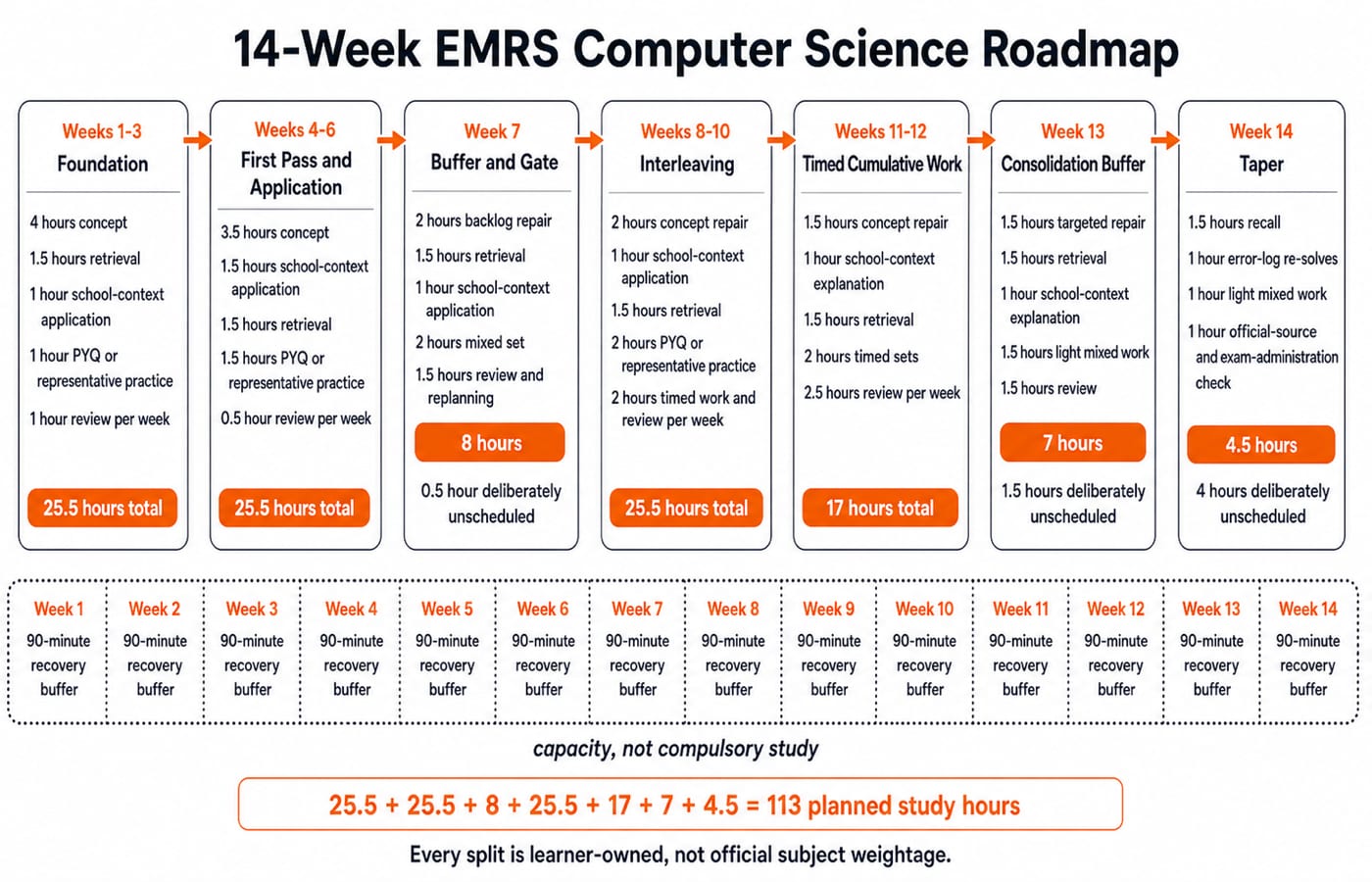
Study 60 minutes from Monday to Thursday, giving 4 hours. Add 2 hours 30 minutes on Saturday and 2 hours on Sunday. That is 8 hours 30 minutes. Keep Friday as a separate 90-minute recovery buffer, so capacity is 10 hours and the buffer is optional.
Give each day one job: two weekdays for concepts, one for closed-book retrieval and one for school-context explanation or short practice. Saturday joins concept, questions and application; Sunday mixes practice, review and planning. Split an evening into 35 minutes learning or solving, 20 minutes recall or re-solving, and 5 minutes logging the next action.
Lose Tuesday's 60 minutes, Thursday's 60 and Sunday's 120, and 240 minutes disappear. Recover 90 from the buffer, carry only 60 minutes of priority repair forward, and drop 90 minutes of low-priority coverage. The next week is 9.5 hours, not exhausting catch-up.
3. Weeks 1-3: diagnose the core and repair foundations
Each week uses 4 hours for concepts, 1.5 for retrieval, 1 for school-context application, 1 for PYQs or representative practice, and 1 for review. That is 8.5 hours weekly and 25.5 across three weeks. Select all six buckets from the EMRS syllabus headings on your source sheet, never a GATE, DSSSB or placement proxy.
Score the 60-question baseline. Results of 8/10, 5/10, 6/10, 7/10, 4/10 and 6/10 give 36 correct. Clean output, correct answers over the whole set, is 36/60 = 60%. With 15 wrong and 9 blank, attempts are 36 + 15 = 51, so attempted accuracy is 36/51 x 100 = 70.6%.
Repair the 4/10 and 5/10 buckets first. A completed topic produces one recall sheet, ten closed-book prompts and a changed-question check. Rewatching without these outputs is not repair.
4. Weeks 4-6: finish the first pass and practise classroom transfer
Use 3.5 hours for concepts, 1.5 each for school-context application, retrieval and practice, and 0.5 for review. Total: 8.5 hours weekly, 25.5 in the phase.
One 510-minute layout: Monday and Tuesday, 60 minutes concepts each; Wednesday, 60 retrieval; Thursday, 60 application; Saturday, 90 concepts, 30 application, 30 retrieval; Sunday, 90 practice, 30 review.
Computer organisation carries number systems, so build an application card for it. In the 8-bit row 128, 64, 32, 16, 8, 4, 2, 1, decimal 45 is 00101101 because 32 + 8 + 4 + 1 = 45. For 54, use 00110110, because 32 + 16 + 4 + 2 = 54. Ask why six-bit 101101 represents 45 but is not the requested eight-bit form. Use Computer Science Pedagogy for Teacher Exams to build explanation, misconception and understanding prompts.
5. Week 7: use the buffer as a decision gate
Add no compulsory new chapter. Use 2 hours for backlog repair, 1.5 for retrieval, 1 for school-context application, 2 for a mixed set and 1.5 for review and replanning: 8 hours, leaving 30 minutes unscheduled.
Backlog: process scheduling 50 minutes, normalisation 70, networking 90, neat-note rewriting 120. Total: 330 minutes. The 2-hour repair budget covers the first two: 50 + 70 = 120. Carry networking only if rechecking shows a gap; discard cosmetic rewriting.
A 40-question gate you build has 29 correct, 7 wrong and 4 blank, so 36 attempts. Attempted accuracy is 29/36 x 100 = 80.6%; clean output is 29/40 x 100 = 72.5%. Eleven non-correct outcomes set Week 8 priorities.
6. Weeks 8-10: interleave questions, retrieval and targeted repair
Use 2 hours concept repair, 1 school-context application, 1.5 retrieval, 2 PYQs or representative practice, and 2 timed work and review: 8.5 hours weekly and 25.5 total. EMRS paper sets are sparse: use NESTS papers where a cycle has released them, and write syllabus-matched practice for the rest. Never relabel a DSSSB or KVS paper as an EMRS PYQ.
A 30-question set with 20 correct, 7 wrong and 3 blank has 27 attempts. Attempted accuracy is 20/27 x 100 = 74.1%; clean output is 20/30 x 100 = 66.7%.
Classify the ten non-correct outcomes as 2 concept, 2 recall, 3 process or misread, and 3 time or blank errors. Budgeting 20 minutes per concept error, 10 per recall, 10 per process error and 15 per blank gives 40 + 20 + 30 + 45 = 135 minutes. This replaces part of the next concept block, not overtime.
7. Weeks 11-14: time mixed work, revise cumulatively and taper
Weeks 11-12 allocate 1.5 hours concept repair, 1 school-context explanation, 1.5 retrieval, 2 timed sets and 2.5 review: 8.5 each, 17 total. Match each timed minute with at least one review minute. Teaching Exam Mock Strategy for CS Papers gives the full attempt-review-repair loop.
Set A: 37 correct, 8 wrong, 5 blank; 45 attempts, 37/45 x 100 = 82.2% attempted accuracy, and 37/50 = 74% clean output. Set B: 40 correct, 6 wrong, 4 blank; 46 attempts, 40/46 x 100 = 87.0% attempted accuracy, and 40/50 = 80% clean output. Compare the two on process, six wrong instead of eight, not on imagined selection chances.
A 40-prompt deck across the six buckets moves from 27/40 = 67.5% recall in Week 11 to 34/40 = 85% on a changed-order Week 13 check. Daily-review the six unresolved prompts; move the other 34 to the final recall pass.
Week 13 caps at 7 hours, 1.5 unscheduled. Week 14 caps at 4.5 hours, 4 for rest or disruption. Start no full chapter. The only admin work left is the call letter, reporting time and permitted items, taken from the NESTS instruction.
8. The EMRS 14-week plan in one decision rule
One rule decides every week: repair before you cover. A bucket that failed retrieval outranks a chapter you never started, in Week 3 and in Week 12 alike. Planned study: 113 hours; the recovery buffer stays optional.
Fetch the current NESTS notice, make the one-page source sheet, choose six diagnostic buckets and schedule four 60-minute sessions this week. If that first pass exposes broad foundation gaps rather than two weak buckets, Zero to Hero Complete CS Course rebuilds the CS core those buckets sit on; if only two are weak, repair them from your own notes instead. Fourteen weeks of 8.5 honest hours beat six weeks of the fifteen you imagined.
Keep learning

EMRS Teacher Selection Process: Tier-wise Weightage and Verification
Passing screening, earning merit marks and proving eligibility are separate tasks. Follow the PGT/TGT stage map with worked score examples and a practical document checklist.
5 Oct 20265 min read50 viewsEMRS

EMRS PGT Computer Science Preparation: 7 Mistakes to Fix
Watched the lectures but still repeating errors? Use seven checks to separate reading from tested understanding, repair mock-test mistakes and choose resources against actual gaps.
29 Sep 20264 min readEMRS

EMRS vs State PSC Teaching Jobs: Choose by Work Setting, Mobility and Fit
Compare an EMRS post with a named State PSC route using official clauses, personal mobility limits, syllabus overlap and a worked 100-point fit score.
Updated 7 Aug 20266 min readEMRS
EMRS Computer Science: DBMS, Networks and Cyber Safety Through One Lab Scenario
A fictional residential-school lab connects normalization, SQL, subnetting and cyber safety. Follow one sign-in from PC-B12 to the database boundary.
Updated 5 Aug 20266 min readEMRS