

Types of Risk in the Banking Sector: Examples and Exam Traps
A default, a bond-price fall and a cash shortage have different causes. Learn to identify four central banking risks through independent worked examples and avoid common exam traps.
KnowledgeGate Team
Exam prep & CS education
Updated 1 Nov 20265 min read

A default, a bond-price fall and a cash shortage can all hurt a bank, but the cause decides the risk category. Four independent incidents at a fictional bank make that cause-first method concrete. These four categories are central examples, not an exhaustive classification of every banking risk.
Four banking risks: identify what actually went wrong
Risk is the possibility of an adverse outcome. An exposure is something at risk, such as a loan outstanding; it is not automatically a loss.
Risk | What goes wrong? |
|---|---|
Credit | A borrower or counterparty fails to meet obligations. |
Market | Market prices move adversely. |
Liquidity | Cash or asset-sale proceeds are difficult to obtain on acceptable terms when needed. |
Operational | Processes, people, systems or external events cause failures. |
Ask what triggered the problem before looking at the word “loss”. A lending bank can face all four risks, sometimes together.
All amounts are in rupees and are illustrative teaching figures, not bank disclosures or regulatory thresholds. Each case is independent, so do not treat the examples as one balance-sheet stress test. The cause-first distinction also helps in banking and insurance exam preparation.
Credit risk: a borrower does not repay as agreed
A borrower defaults with 10 lakh of principal outstanding. The bank eventually recovers 6 lakh. Ignoring interest, legal costs and discounting:
Principal shortfall = 10 lakh - 6 lakh = 4 lakh.
Loss share of exposure = 4 / 10 x 100 = 40%.
Contractual non-payment is the credit event; later recovery does not undo the default.
For a separate, comparable exposure, distinguish a realised shortfall from expected loss. Probability of default (PD) is the chance of default over the chosen period, here 2% over one year. Loss given default (LGD) is the proportion lost if default occurs, here 40%. Exposure at default (EAD) is the amount exposed then, here 10 lakh.
Expected loss = PD x LGD x EAD = 0.02 x 0.40 x 10,00,000 = 8,000.
This is an average under those assumptions, not a certain single-loan loss or mandatory provision. Credit appraisal tests repayment ability; diversification limits concentration. Collateral can reduce loss severity but cannot eliminate default risk.
Market risk: the value changes even without default
Independently, a tradable bond holding worth 20 lakh falls in price by 5% after market interest rates rise.
Value reduction = 20 lakh x 0.05 = 1 lakh.
New market value = 20 lakh - 1 lakh = 19 lakh.
The 5% price fall is given. It is not calculated from a 5% yield change. Conventional fixed-rate bond prices generally move inversely to market yields, but there is no fixed percentage conversion.
Here, valuation changes without a borrower missing payment. Exchange-rate and equity-price movements are other market-risk drivers. A valuation fall is distinct from a realised sale loss; accounting treatment depends on the holding's classification.
Interest-rate risk in the banking book also affects earnings and economic value and is treated separately in regulatory frameworks; this example uses a tradable holding. Exposure limits and appropriately chosen hedges help control risk.
Liquidity risk: enough assets, too little cash today
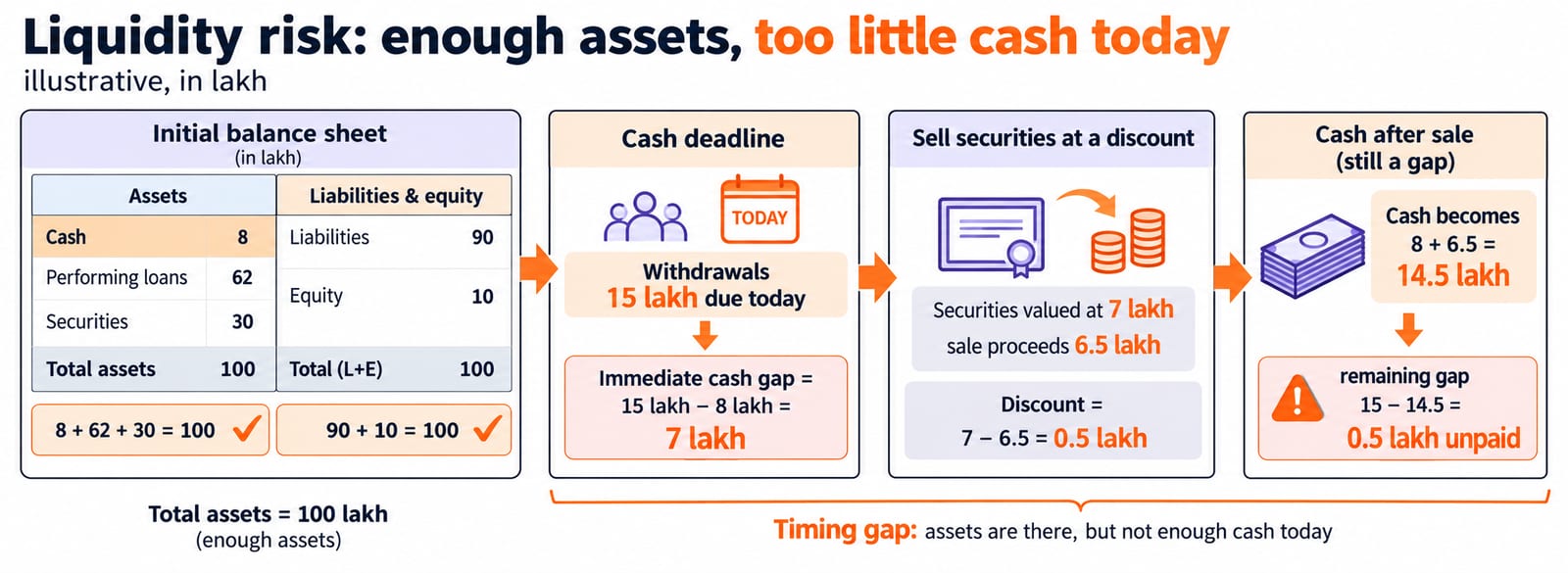
Consider this independent snapshot, with no asset impairment:
Balance-sheet item | Amount (lakh) |
|---|---|
Cash | 8 |
Performing loans | 62 |
Securities | 30 |
Total assets | 100 |
Liabilities | 90 |
Equity | 10 |
Assets total 8 + 62 + 30 = 100 lakh, matching liabilities plus equity, 90 + 10 = 100 lakh. Withdrawals of 15 lakh are due today, with no other inflows before the deadline.
Immediate cash gap = 15 lakh - 8 lakh = 7 lakh. Positive net assets do not remove this timing problem; positive book equity alone does not establish regulatory solvency.
A securities slice valued at 7 lakh sells immediately for only 6.5 lakh. Discount = 7 - 6.5 = 0.5 lakh. Cash becomes 8 + 6.5 = 14.5 lakh, leaving 15 - 14.5 = 0.5 lakh unpaid.
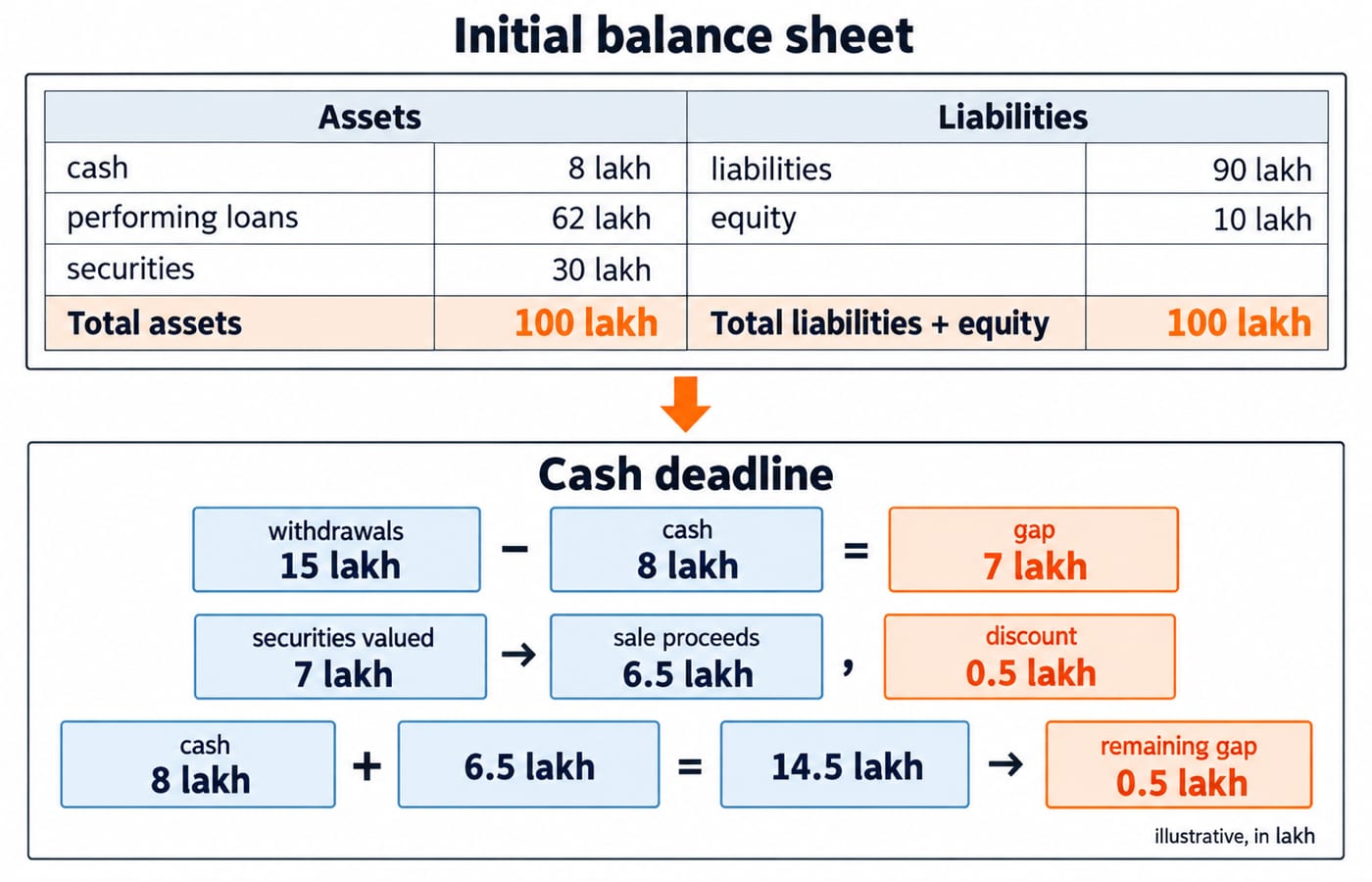
RBI's 2012 liquidity guidance distinguishes funding liquidity, meeting cash obligations, from market liquidity, exiting positions at prevailing prices despite market-depth constraints. Liquid buffers or funding facilities may help, subject to availability.
Operational risk: a process or system fails
A software defect duplicates five transfers of 20,000 each. Calculate only the excess transfers:
Excess transferred = 5 x 20,000 = 1,00,000.
After 80,000 is recovered, unrecovered amount = 1,00,000 - 80,000 = 20,000, ignoring other costs.
The initiating cause is a system or process failure, not a borrower refusing to repay a loan. Recovery reduces the monetary damage without changing that classification.
Operational risk can arise from unauthorised employee action, missed reconciliation, a system outage or a flood. Match each control to its cause: duplicate-payment checks prevent repeat execution, reconciliation detects mismatches, access restrictions limit unauthorised actions, and tested recovery arrangements support continuity.
For historical background, see RBI's 2005 Guidance Note on Management of Operational Risk. Use it as a conceptual reading pointer, not as a statement of current capital-calculation rules.
Exam traps: risks can overlap without becoming identical
Trap | Better reasoning |
|---|---|
Every loss is credit risk. | Inspect who failed to pay and what obligation was breached. |
Assets exceed liabilities, so cash cannot run out. | Compare today's available cash with today's obligations. |
A cybersecurity incident is automatically only reputational risk. | The initiating system/control event is operational; reputation and liquidity may also suffer. |
Consider this chain: payment-system failure -> customer concern -> withdrawals -> funding pressure. The arrows show possible transmission, not an inevitable sequence. An operational incident can therefore generate reputational damage and liquidity pressure without making those categories identical.
Reputational, strategic and compliance risks are additional categories. Systemic risk concerns disruption spreading across institutions or the financial system, rather than just one bank's immediate incident.
For bank-awareness interview preparation, explain the chain aloud in two sentences: first name the initiating failure, then describe its possible consequences.
How to practise banking-risk questions for the exam
These are original practice cases, not past-paper questions:
A borrower misses an instalment: credit risk, because a repayment obligation is not met.
A tradable bond loses value after yields rise: market risk, because valuation changes.
Performing assets remain, but withdrawals exceed ready cash: liquidity risk. With 15 lakh due and 8 lakh cash, the gap is 15 lakh - 8 lakh = 7 lakh.
Use an elimination routine: identify the initiating event, locate the problem in repayment, value, cash timing or operations, then separate the immediate risk from later consequences. Do not select a category merely because the question mentions money lost.
For the exam reference, consult IBPS's 2025 PO/MT notification landing page and the notice for your own recruitment cycle. Connect concept revision with the static and current banking-awareness study plan.
Short version and the next revision step
Keep four cues ready: borrower obligation -> credit; market valuation -> market; payment timing -> liquidity; process/system failure -> operational. Name the cause first, then discuss consequences.
Now recompute the 4 lakh principal shortfall, 1 lakh valuation fall and 7 lakh cash gap without looking back. Explain why each answer measures a different problem, even though all three use rupees.
Learners preparing for that stage can review the IBPS PO Mains preparation course and check its listed coverage against their needs before choosing their next revision step.
Keep learning

Old vs New Pension Scheme: OPS and NPS Contributions, Benefits and Risk
Separate pension contributions from retirement income with an OPS and NPS comparison. Work through salary deductions, a basic pension, an annuity and inflation, then test the common exam traps.
Updated 31 Oct 20266 min readBanking Exams
Security, Risk Management and Maintenance in System Analysis and Design: A Worked Risk Register
Follow one university registration system from testable security requirements through risk ranking, maintenance classification, and a controlled production change.
Updated 7 Nov 20266 min readGATE Strategy & Roadmap

Physical Security Assets and Risk Factors: Worked Audit, Controls and Exam Traps
Follow a fictional college server-room audit from asset inventory to residual risk. Calculate four priorities, test power continuity, and avoid common exam traps.
Updated 6 Nov 20266 min readUGC NET Computer Science
Banking Exams Quantitative Aptitude: Build Arithmetic Foundations Before Speed Tricks
Shortcuts fail when the arithmetic underneath them is unstable. Rebuild five connected foundations with worked examples, then move to timed practice in controlled stages.
Updated 24 Aug 20266 min readBanking Exams