

Old vs New Pension Scheme: OPS and NPS Contributions, Benefits and Risk
Separate pension contributions from retirement income with an OPS and NPS comparison. Work through salary deductions, a basic pension, an annuity and inflation, then test the common exam traps.
KnowledgeGate Team
Exam prep & CS education
Updated 31 Oct 20266 min read

You may remember “old pension guaranteed, new pension market-linked” yet mix up salary deductions and monthly retirement benefits. For banking and insurance preparation, the useful distinction is what each scheme defines: the benefit or the contribution. Here, “new pension scheme” means the National Pension System (NPS). The Central Government reference point and worked rupee examples separate contributions, pensionable pay and retirement income.
OPS vs NPS: what is defined in each scheme?
A pension provides income after retirement. A defined-benefit scheme, such as the Old Pension Scheme (OPS), links the promised pension to service and pay rules. A defined-contribution scheme specifies money entering an invested account; ordinary NPS does not promise a fixed fraction of final salary.
OPS | NPS |
|---|---|
Benefit basis: rules-based pension | Benefit basis: contribution account |
Funding route: government-funded pension obligation | Funding route: employee plus employer in this example |
Investment exposure: no direct individual market-linked pension corpus | Investment exposure: market-linked accumulation |
Retirement income basis: eligible pay and service formula | Retirement income basis: corpus and selected retirement-income product |
Scope of rules: applicable service rules | Scope of rules: sector-specific rules |
PFRDA's Central Government NPS explanation gives 1 January 2004 as the introduction baseline for new Central Government recruits, excluding armed-forces personnel.
For exam questions, use the Central Government rules as the reference. State, bank and special-service rules can differ. All rupee figures are teaching inputs, not personal pension advice or projections.
Contributions: calculate the money going into NPS
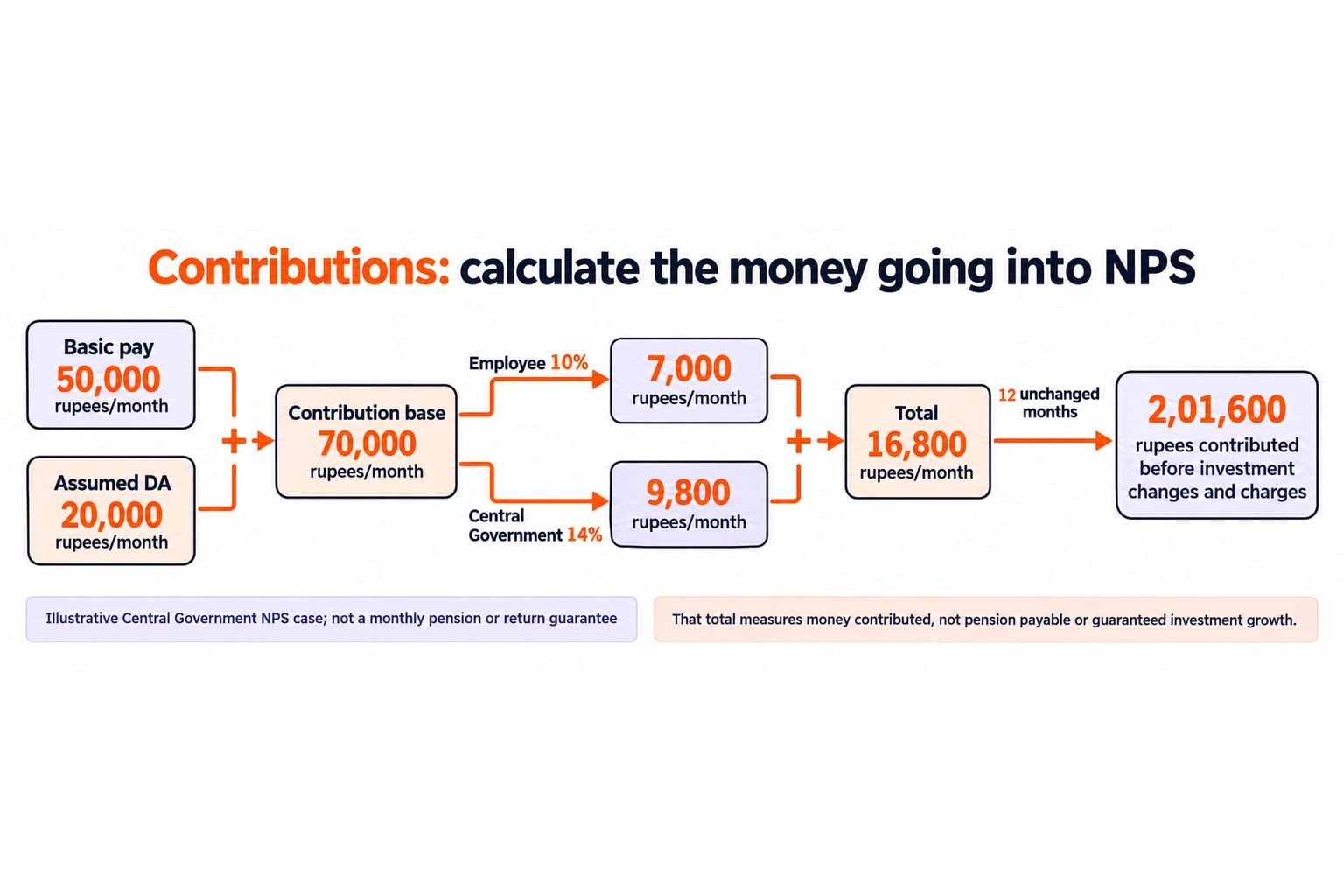
PFRDA specifies employee and Central Government contributions of 10% and 14% respectively of basic pay plus dearness allowance (DA) for this NPS case.
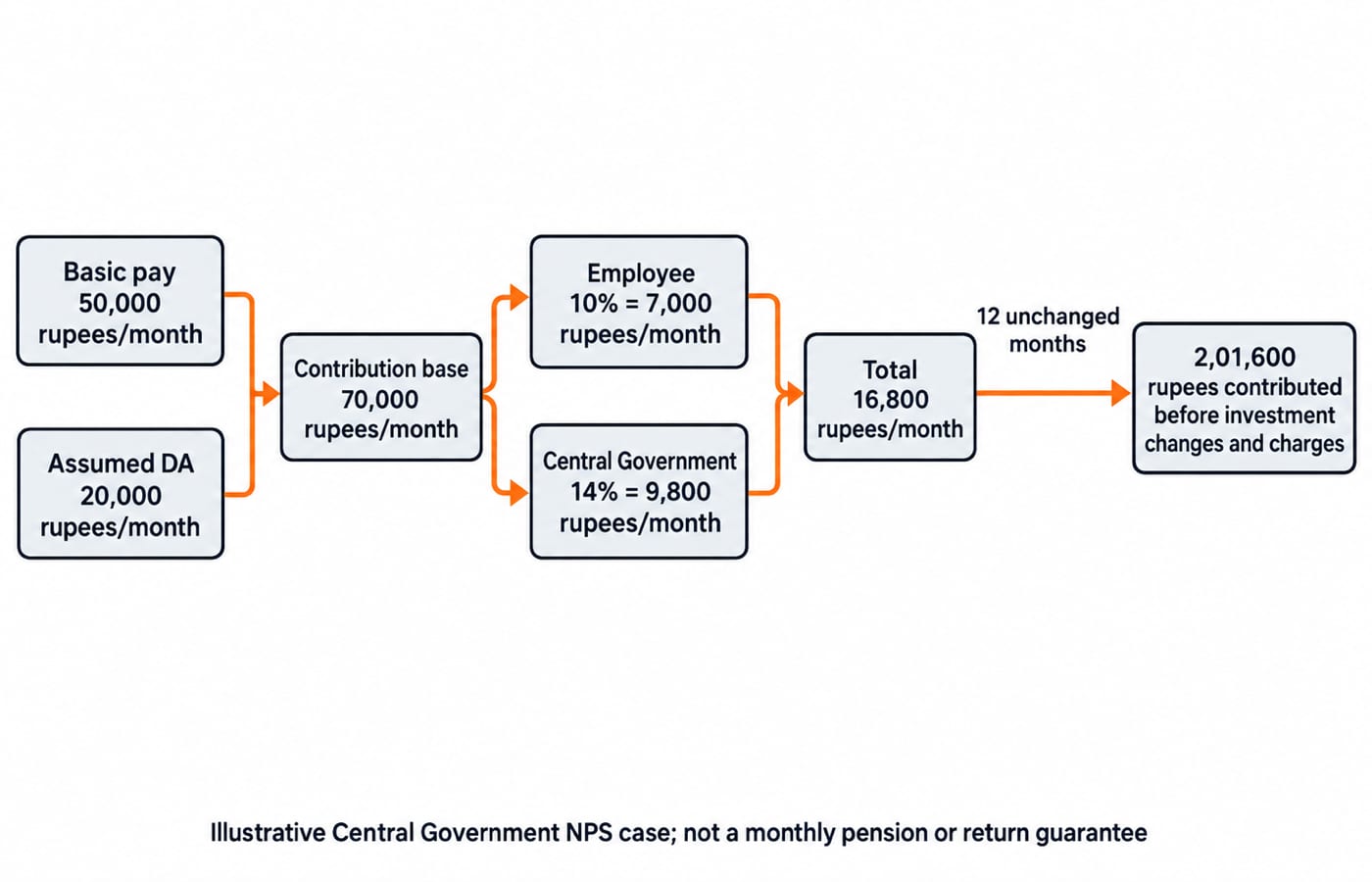
Assume monthly basic pay of 50,000 rupees and DA of 20,000 rupees:
Contribution base = 50,000 rupees + 20,000 rupees = 70,000 rupees.
Employee contribution = 10% of 70,000 rupees = 7,000 rupees.
Government contribution = 14% of 70,000 rupees = 9,800 rupees.
Combined monthly contribution = 7,000 rupees + 9,800 rupees = 16,800 rupees.
With unchanged pay for twelve months, the employee contributes 7,000 rupees times 12 = 84,000 rupees. The employer contributes 9,800 rupees times 12 = 1,17,600 rupees. Together, 84,000 rupees + 1,17,600 rupees = 2,01,600 rupees, before investment changes and charges.
That total measures money contributed, not pension payable or guaranteed investment growth.
OPS does not build its pension through this individual contribution account. Separate provident-fund deductions can still exist: no NPS-style pension contribution does not mean no payroll deductions.
Benefits: work through a pension and a corpus example
OPS: apply the pension formula
The Ministry of Personnel explanation published on 19 December 2018 describes 50% of last pay or of average emoluments over the final ten months, whichever benefits the eligible retiree more, with at least ten years of qualifying service.
Assume qualifying service and other conditions are satisfied. Last pensionable emoluments are 60,000 rupees; the ten-month average is 58,000 rupees:
Last-pay calculation: 50% of 60,000 rupees = 30,000 rupees.
Average-pay calculation: 50% of 58,000 rupees = 29,000 rupees.
More beneficial monthly basic pension: 30,000 rupees.
This excludes dearness relief, commutation and other adjustments. Pensionable emoluments are neither take-home salary nor the earlier 70,000 rupees contribution base.
NPS: turn part of a corpus into income
Independently assume a retirement corpus of 50,00,000 rupees. Select 20,00,000 rupees for a hypothetical annuity, income bought from an insurer with a lump sum. The arithmetic remainder is 50,00,000 rupees - 20,00,000 rupees = 30,00,000 rupees.
At an assumed annual payout rate of 6%:
Annual income = 20,00,000 rupees times 0.06 = 1,20,000 rupees.
Monthly equivalent = 1,20,000 rupees / 12 = 10,000 rupees.
The purchase amount and rate are illustrative. At 5%, the same purchase gives 20,00,000 rupees times 0.05 = 1,00,000 rupees yearly, or 1,00,000 rupees / 12 = approximately 8,333 rupees monthly.
These examples cannot establish which scheme pays more for an identical career: salary history, accumulation, product terms and benefit rules have not been matched.
Returns and risk: who carries the uncertainty?
During NPS accumulation, market performance affects the account's value. Investment mix and charges also affect the eventual corpus. Market-linked does not mean entirely invested in equities, and a contribution rate is not a return rate.
At retirement, the amount used to purchase income and the annuity option matter. Once purchased, an annuity's payment obligations follow its contract; its payments do not necessarily fluctuate with stock prices.
OPS places the pension-funding obligation on government finances. That is a commitment to fund a benefit under rules, not an individual investment return.
Inflation creates a separate risk: the same rupees buy fewer goods. With assumed inflation of 5% over one year, a fixed 10,000 rupees monthly payment has today's purchasing power of:
10,000 rupees / 1.05 = 9,523.81 rupees, approximately 9,524 rupees.
The nominal payment remains 10,000 rupees. Its purchasing power falls. Relief provisions and annuity contract terms matter when judging protection against inflation; do not assume every annuity automatically increases with prices.
Common traps, including confusing NPS with UPS
Watch for these statements:
“NPS guarantees 50% of final salary.” This confuses a benefit formula with ordinary NPS contributions.
“The government contributes 14% for everyone.” Employer and sector rules determine the applicable rate.
“OPS employees have no payroll deductions.” Separate deductions can exist without funding an individual pension account.
“30,000 rupees versus 10,000 rupees proves which scheme is better.” This ignores the assumed 30,00,000 rupees remainder and unmatched career inputs and benefit adjustments.
There is also a terminology trap. According to PFRDA material on the Unified Pension Scheme, UPS became effective on 1 April 2025 as an option within NPS for eligible Central Government employees.
UPS is not simply another name for OPS. In common exam wording, “new pension scheme” points to NPS; UPS is a separate option within NPS for eligible Central Government employees. Read the scheme name and employee category before applying a remembered formula; a blanket claim that every new employee has only one pension pathway misses this distinction.
How an exam can test the distinction
Use these concept checks.
Check A: A scheme fixes the contribution while the retirement corpus depends on investment performance. Which model is this?
Answer: Defined contribution, illustrated by ordinary NPS. The clue is that the input is specified while accumulation depends on investments.
Check B: For the 70,000 rupees contribution base, is 9,800 rupees the employee share, employer share, total contribution or monthly pension?
Answer: Employer share under the scoped rates. The employee share is 7,000 rupees and the total is 16,800 rupees.
Correct “all government employees everywhere entered NPS in 2004” to “the Central Government baseline covers new recruits from 1 January 2004, excluding armed-forces personnel, with applicable rules and exceptions.”
For static and current banking-awareness revision, keep definitions in static notes and dated policy changes in a separate update column. Label every amount as contribution, corpus or income before calculating.
Short version and next practice step
OPS defines the pension benefit through service rules; ordinary NPS defines contributions and accumulates an invested corpus. Keep contribution base, pensionable pay and retirement corpus distinct when solving a question.
Without notes, reproduce 7,000 rupees + 9,800 rupees = 16,800 rupees and explain why that sum is not monthly pension. Then redo the annuity example at the lower assumed rate.
For broader preparation, the IBPS PO Mains preparation course is an optional next step alongside your concept notes and policy revision.
Keep learning

SBI PO Group Exercise: Build Evidence-Based Contributions with the C-E-A-B Framework
Learn to turn a group-exercise prompt into a concise claim, support it with accurate evidence, and move the discussion towards a decision.
Updated 30 Oct 20265 min readSBI Exams

CTC Breakdown: Fixed Pay, Variable Pay and Benefits Compared
Two fictional offers share the same 12 lakh CTC but differ sharply in dependable cash: 9.00 lakh fixed against 10.20 lakh, and 75,000 versus 85,000 a month.
Updated 10 Aug 20265 min readInterview Corner
Set Operations: Union, Intersection, Difference, Symmetric Difference and Complement with Worked Examples
Use one fixed Venn partition to compute five set operations, verify De Morgan's laws, solve an 80-student survey, and repair common exam mistakes.
Updated 27 Oct 20265 min readEngineering Mathematics

Set Operations MCQs: 11 Solved Questions with Step-by-Step Explanations
Solve 11 set operations MCQs, then compare your decisive step with a fresh explanation covering counts, identities, complements and constructions.
Updated 8 Oct 20267 min read84 viewsDiscrete Mathematics MCQs