

FDI vs FPI vs FII: Key Differences in Control and Liquidity
FDI and FPI classify investments, while FII names an investor category. Work through the 8%, 10%, 12% and unlisted 2% cases to separate ownership rules from control and ease of exit.
KnowledgeGate Team
Exam prep & CS education
Updated 2 Nov 20265 min read

Exam notes often put FDI, FPI and FII in one table, hiding the difference between an investment and an investor. For readers working on Banking & Insurance exam preparation, or revising economy for SSC, that confusion matters when a question changes the company type or holding percentage. A worked ownership example will help you distinguish these terms and avoid treating management control and ease of sale as the same thing.
What FDI, FPI and FII actually mean
FDI means foreign direct investment. Conceptually, it commonly involves a lasting business relationship. Think of a foreign manufacturer buying a strategic equity stake in an Indian business to participate in its growth.
FPI means foreign portfolio investment. Here, the focus is financial exposure through securities, such as an overseas fund holding tradable shares.
FPI can also mean foreign portfolio investor, particularly when a sentence discusses registration. Read the noun around the acronym: an investment is a holding, while an investor is the person or entity making it.
FII means foreign institutional investor. It is an institutional-investor label historically used in India's portfolio-investment system, not a third asset class alongside FDI and FPI. Neither the investor's nationality nor the length of time a holding is kept settles its classification. Start by asking whether the question describes the money invested or the entity investing it.
FDI vs FPI vs FII at a glance
Use this table to separate the terms before applying a numerical rule. The purpose and exit rows describe typical characteristics.
What to compare | FDI | FPI | FII |
|---|---|---|---|
What the term identifies | Investment category | Portfolio investment, or investor in registration context | Historical institutional-investor category |
Typical purpose | Strategic business participation | Financial exposure | Portfolio investing |
Management relationship | Influence may exist; control is not guaranteed | Generally no operating-management role | No separate control test implied by the acronym |
Ease of exit | Exit can be less liquid | Tradable holdings can be easier to sell | Liquidity depends on holdings |
How to read it in Indian exam notes | Assess the actual investment | Read instrument and company details | Interpret legacy terminology within the FPI framework |
SEBI's announcement on commencement of the FPI regime records that FIIs, sub-accounts and qualified foreign investors were merged into the FPI class, effective 1 June 2014. Older books and market commentary still use FII, so recognise the historical terminology without assuming that all foreign investors are FIIs.
A worked example: classify 8%, 10% and 12% holdings
RBI's Master Direction on Foreign Investment in India distinguishes listed-equity FPI below 10% from FDI at 10% or more, measured against post-issue paid-up equity capital on a fully diluted basis. Unlisted-company equity is a separate FDI case, and an existing FDI investment remains FDI if its holding later falls below 10%.
Fully diluted shares include shares arising if all possible conversions occur. Apply this Indian equity rule by checking whether the company is listed or unlisted.
Assume listed Bharat Tools Ltd has 10,00,000 fully diluted shares. Consider three independent hypothetical acquisitions, with no new issuance or denominator change.
Calculate each percentage as shares held / total shares times 100:
Investor A: 80,000 / 10,00,000 = 0.08; 0.08 times 100 = 8%, FPI.
Investor B: 1,00,000 / 10,00,000 = 0.10; 0.10 times 100 = 10%, FDI.
Investor C: 1,20,000 / 10,00,000 = 0.12; 0.12 times 100 = 12%, FDI.
Now take an independent unlisted-company acquisition. Investor D holds 20,000 shares out of 10,00,000: 20,000 / 10,00,000 = 0.02; 0.02 times 100 = 2%, FDI.
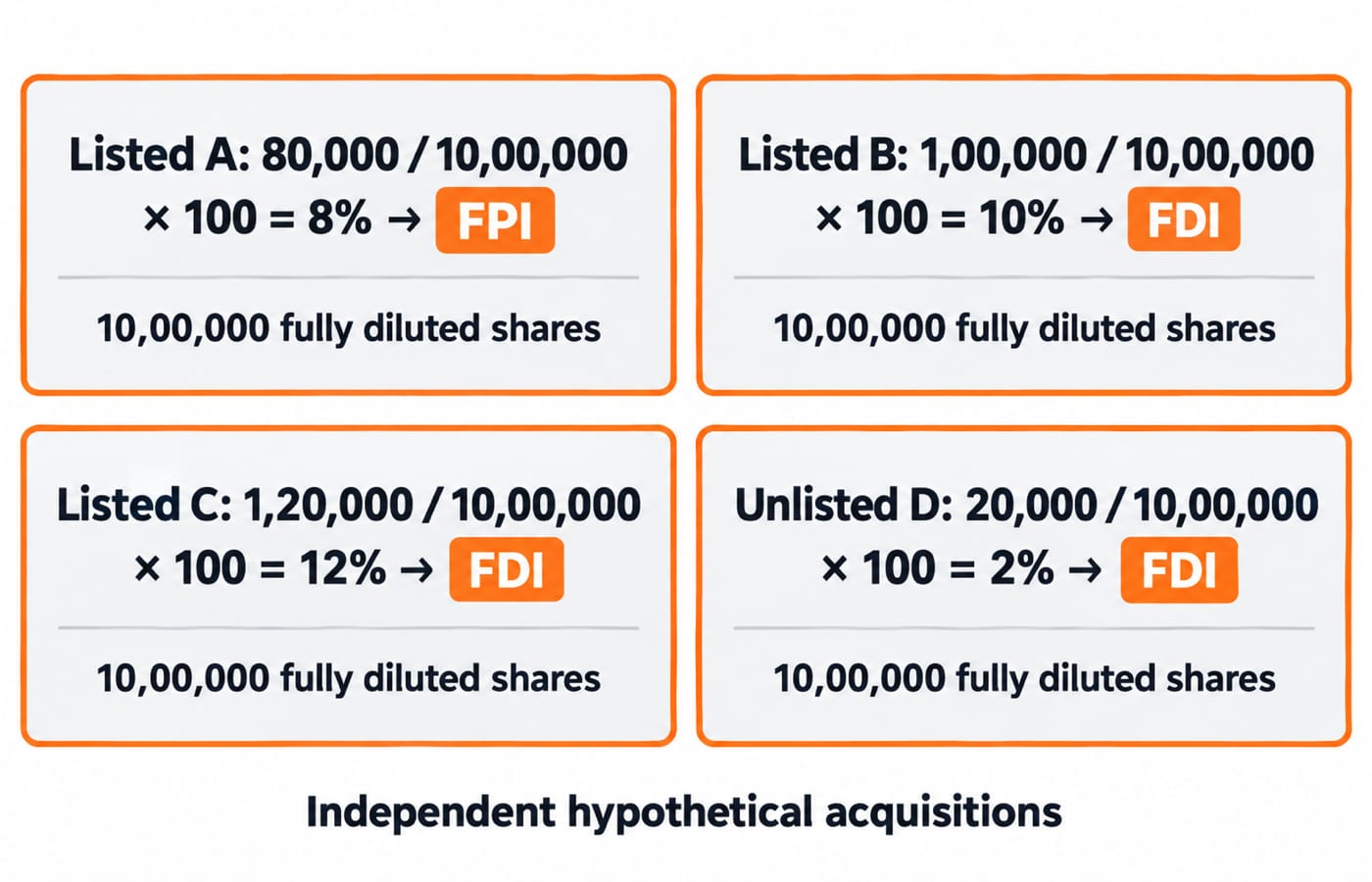
Finally, suppose an already-classified FDI holding declines from 12% to 8%. It remains FDI. This differs from A's independent acquisition.
Control and liquidity answer different questions
Investor C owns 12%, leaving 100% - 12% = 88% with others. That percentage alone cannot prove who runs the company. Ownership, voting rights and contractual rights are distinct ideas; reaching 10% does not automatically confer a board seat.
Liquidity asks how easily a holding can be sold. Suppose Investor A sells 30,000 of its 80,000 shares:
Shares remaining = 80,000 - 30,000 = 50,000.
Remaining stake = 50,000 / 10,00,000 times 100 = 5%.
A's holding stays below the boundary and remains FPI in this example.
A strategic business stake may require negotiation to sell. Tradable shares can be easier to sell, but liquidity does not mean absence of loss: a quick sale may still happen at an unfavourable price. Equally, a portfolio investor can hold securities for years.
Four traps that make the comparison misleading
“FII is a third investment route.” This confuses the investor with the investment. Ask whether the term identifies an institution or classifies its holding.
“FDI always means building a factory.” Buying a stake in an existing business can also be FDI. Ask what investment was made, rather than whether a new building appeared.
“Every holding below 10% is FPI.” This ignores the unlisted 2% case and the existing-FDI continuity example. Check the company type and the holding's history before using a percentage shortcut.
“10% ownership guarantees control.” A classification boundary does not itself establish management rights. Ask what rights accompany the shares, not just how many are owned.
Also avoid ranking all FDI as safe or all FPI as speculative. An investment label does not tell you everything about business risk, market prices or the investor's strategy.
How to practise exam-style distinctions
Try these original practice checks:
Which term names an institutional investor? FII. The final word is “investor”, so the label describes an entity.
An independent eligible listed-equity acquisition is exactly 10%: FDI or FPI? FDI. Exactly 10% belongs on the “10% or more” side of the RBI definition cited above.
Does the ability to sell quickly guarantee no loss? No. Ease of sale and the price received answer different questions.
Before choosing an answer, identify what the stem asks about: the investor, company listing status, stake or exit behaviour. Then apply only the relevant distinction.
For banking revision, Banking Awareness IBPS PO Mains: Static Core + Weekly Plan explains the IBPS PO static/current split, a separate problem from FDI, FPI and FII classification, thresholds and liquidity. For the broader syllabus, RBI Grade B Syllabus: Phase I and 3 Phase II Papers provides the exam map.
The short version and your next step
FDI and FPI describe investment categories; FII is a historical institutional-investor label. Keep ownership classification, control and liquidity as separate questions, even when a single example mentions all three.
Reconstruct the listed 8%, 10% and 12% cases and the unlisted 2% case from memory. Then explain why an existing FDI holding that falls below the boundary differs from a fresh portfolio acquisition.
The IBPS PO covers the wider banking exam syllabus.
Keep learning

RRBs vs Nationalised Banks: Ownership, Purpose and Reach
A village branch does not tell you whether a bank is an RRB or a nationalised bank. Compare their legal origins, ownership and reach, then test the distinction with a worked 200 crore rupees example.
Updated 30 Oct 20265 min readBanking Exams

SBI PO vs IBPS PO: Exam Pattern, Difficulty and Career Differences That Decide Your Prep
SBI PO vs IBPS PO compared: the shared syllabus, SBI's tougher Mains and extra selection stages, career differences, and a plan that prepares for both.
Updated 29 Oct 20265 min read160 viewsBanking Exams
SCAN and C-SCAN Algorithms: Worked Example, Differences and Exam Traps
Solve the same eight-request queue with SCAN and C-SCAN, then learn how endpoints, direction, circular return, and service order change the answer.
Updated 14 Nov 20266 min readOperating Systems

CTET vs State TET: Acceptance, Validity and Which One to Take
Choose CTET, a State TET, or both by checking where each certificate is accepted. Use worked examples to turn your target vacancies into a practical study route.
Updated 9 Nov 20265 min readCTET & UPTET