

Types of Logical Cases: Tautology, Contradiction, Contingency, Satisfiability and Validity with Worked Truth Tables
Learn how valuations classify formulas, why satisfiable is not a separate fourth case, and how a countermodel decides whether an argument is valid.
KnowledgeGate Team
Exam prep & CS education
Updated 11 Nov 20265 min read
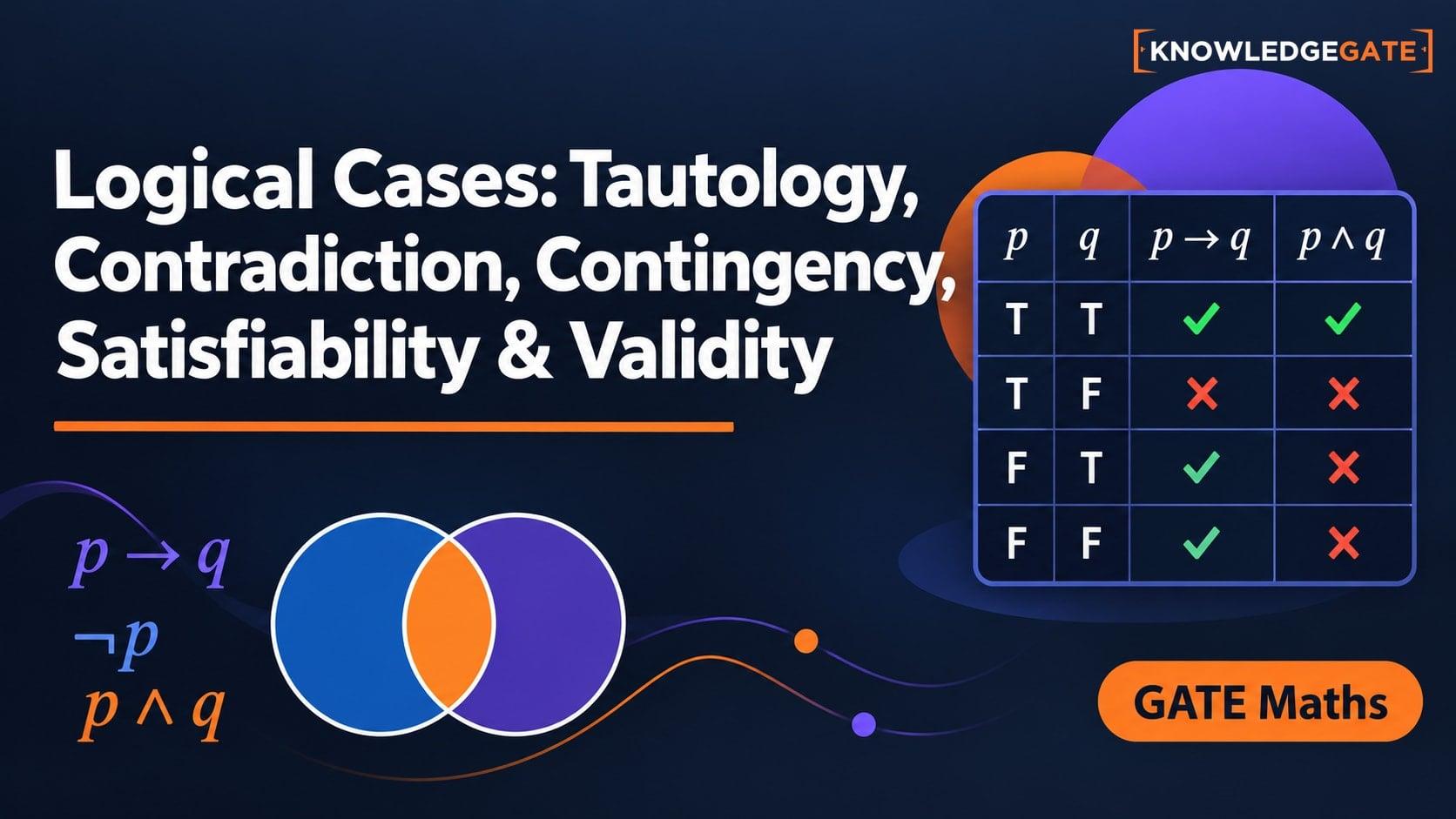
Students often remember isolated definitions but still label a formula incorrectly. The usual causes are treating satisfiable as a fourth mutually exclusive case and treating argument validity as if the conclusion merely needs to be true. A four-row master truth table separates formula classes, countermodels separate valid from invalid arguments, and interpretations extend the method to predicate logic.
Logical cases begin with valuations and interpretations
A propositional valuation assigns either T or F to every atomic proposition. With n atoms, there are 2^n valuations. Two atoms p,q therefore need four rows in the order TT, TF, FT, FF.
Classification depends on the formula's result across all those rows, not on how complicated the formula looks. One true row may be enough to prove satisfiability, but it cannot prove validity.
Predicate logic uses a broader idea of a model. A structure fixes a non-empty domain and gives meanings to predicates, functions, and constants. A variable assignment supplies values for any free variables. Truth can change when the domain, interpretation, or relevant assignment changes.
Two questions control the whole topic:
Is there at least one permitted model that makes the formula true? This tests satisfiability.
Does every permitted model make it true? This tests validity.
Tautology, contradiction and contingency in one truth table
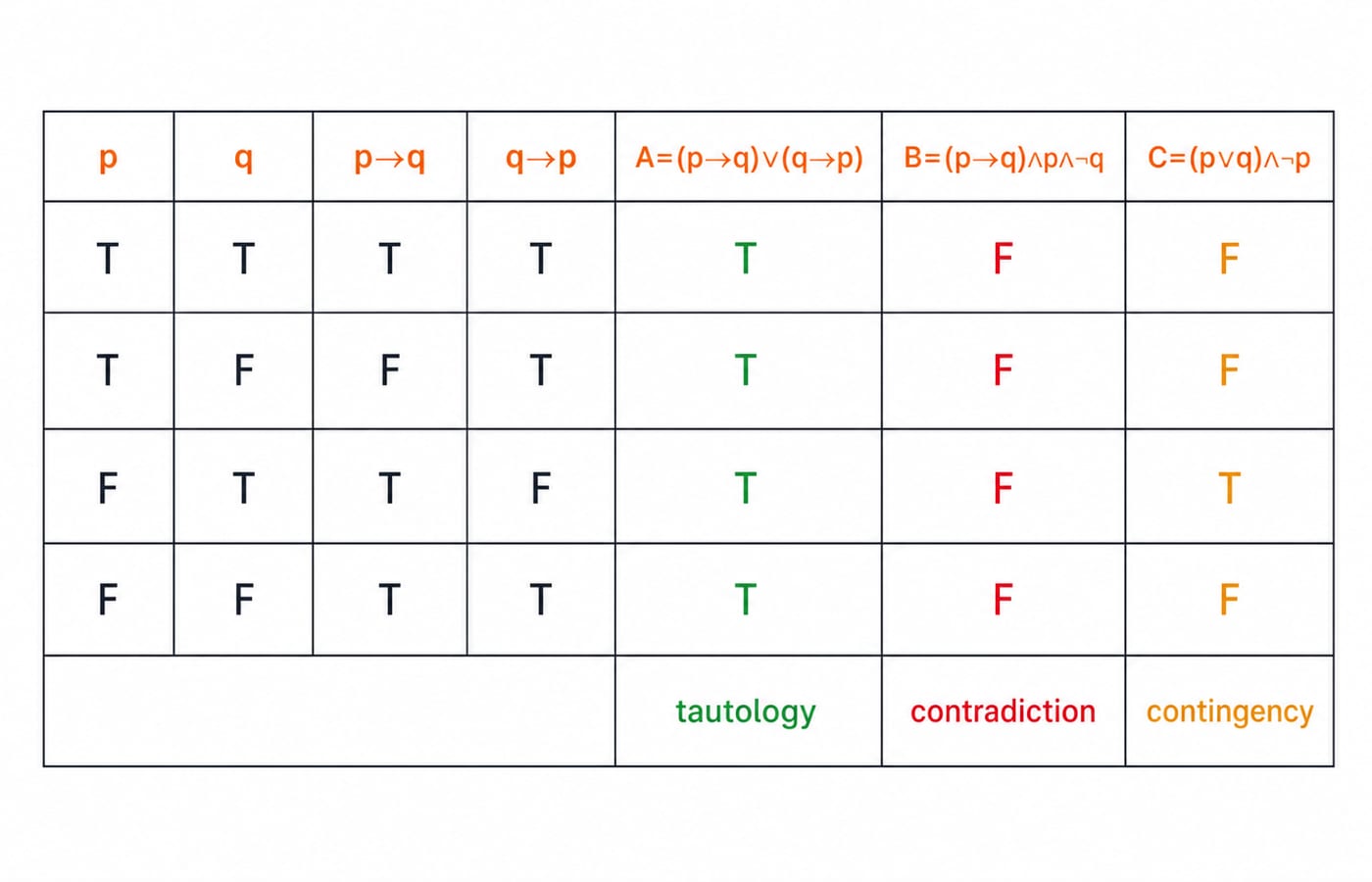
Use the same four valuations for these formulas:
A=(p→ q)∨(q→ p),
B=(p→ q)∧ p∧¬ q,
C=(p∨ q)∧¬ p
p | q | p→ q | q→ p | A | B | C |
|---|---|---|---|---|---|---|
T | T | T | T | T | F | F |
T | F | F | T | T | F | F |
F | T | T | F | T | F | T |
F | F | T | T | T | F | F |
The implication columns use the rule that an implication is false only when its antecedent is T and its consequent is F. The implication and biconditional operator MCQs give targeted practice for that easily missed case.
The final column of A is T,T,T,T, so A is a tautology. At least one of the two directed implications must be true on every row.
The final column of B is F,F,F,F, so B is a contradiction. The tempting TF row makes the conflict explicit:
(T→ F)∧ T∧¬ F
=F∧ T∧ T
=F.
The apparent premises and counterexample cannot all hold together. On the other rows, either p is false or ¬ q is false, so B remains false.
The final column of C is F,F,T,F. It is true only when p=F,q=T, making it a contingency.
Satisfiability and validity are existential and universal tests
A formula is satisfiable if at least one valuation makes it true, valid if every valuation makes it true, falsifiable if at least one makes it false, and unsatisfiable if none makes it true.
The master table supplies witnesses. A is valid and satisfiable. B is unsatisfiable, which is exactly what being a contradiction means. C is satisfiable with witness p=F,q=T, and falsifiable with witness p=T,q=T, so it is contingent.
Final-column pattern | Classification |
|---|---|
All T | Valid, tautological, and satisfiable |
All F | Unsatisfiable and contradictory |
A mix of T and F | Contingent, satisfiable, and falsifiable |
Valid formulas are a subset of satisfiable formulas. Therefore, satisfiable is not a disjoint peer of tautology, contradiction, and contingency. It overlaps tautologies and contingencies.
Argument validity is an unsatisfiable countermodel search
For premises P1,...,Pk and conclusion Q, the argument
P1,...,Pk⊢ Q
is valid exactly when P1∧...∧ Pk∧¬ Q is unsatisfiable. Equivalently, (P1∧...∧ Pk)→ Q must be valid.
The broader Propositional and Predicate Logic in Discrete Mathematics guide uses these same two arguments to introduce inference patterns and counterexamples. Here they prove the narrower classification rule: argument validity is exactly the unsatisfiability of the premises conjoined with the negated conclusion.
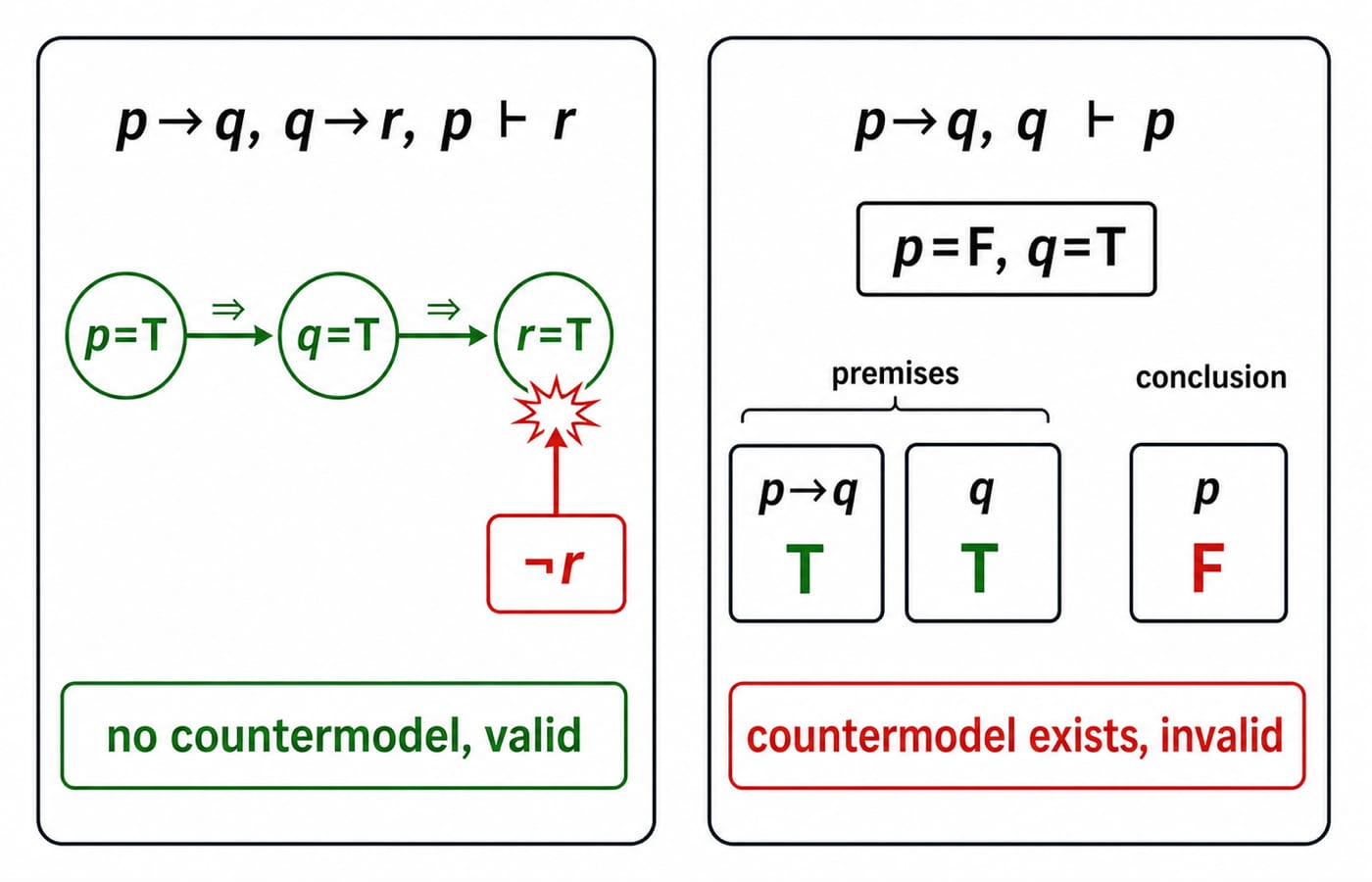
Consider p→ q,\ q→ r,\ p⊢ r. Search for a countermodel by testing
M=(p→ q)∧(q→ r)∧ p∧¬ r.
The conjunct p forces p=T. Keeping p→ q true then forces q=T. Keeping q→ r true forces r=T. But ¬ r requires r=F. No valuation satisfies M, so no countermodel exists and the argument is valid.
Now test the invalid affirming-the-consequent argument p→ q,\ q⊢ p. Set p=F,q=T. Then p→ q=T and q=T, while the conclusion p is F. Its countermodel formula confirms the result:
(p→ q)∧ q∧¬ p
=T∧ T∧ T
=T.
The countermodel formula is satisfiable, so the argument is invalid.
Predicate-logic satisfiability depends on the interpretation
Let H=∀ x(P(x)→ Q(x)) over D={1,2}. Under interpretation I_1, take P={1} and Q={1,2}. At x=1, the instance is T→T, which is T. At x=2, it is F→T, also T. Hence H is true under I_1.
Under I_2, take P={1,2} and Q={1}. The x=2 instance is T→F, so H is false. Thus H is satisfiable and falsifiable, making it contingent rather than logically valid.
Now consider J=∃ x(P(x)∧¬ P(x)). For every possible object, P(x)∧¬ P(x) is false. No interpretation can supply a witness, so J is unsatisfiable and contradictory.
The domain itself can reverse truth. ∃x(2x=1) is false over the integers Z, but true over the rationals Q with witness x=1/2. Truth in one intended structure is not logical validity in every structure.
Logical-case traps that change the answer
One true row proves satisfiability, not validity. Inspect the entire final column before writing “tautology”.
False under one valuation does not mean contradiction. Formula C is false at TT but true at FT.
A valid argument need not describe factual truths. Validity only rules out a case where every premise is true and the conclusion is false.
Swapping an implication changes it. p→ q and q→ p differ on TF and FT, although their disjunction A is always true.
Predicate domains cannot be changed silently. Write the domain and predicate interpretation before classifying a sentence.
How logical cases are tested in questions
Common tasks ask you to complete a truth-table column, count satisfying valuations, classify a formula, produce a countermodel, or evaluate a quantified sentence over a supplied domain. Use this decision routine:
Count the atoms and list all 2^n valuations when n is small.
Try to build one satisfying valuation first.
To disprove validity, seek one falsifying valuation.
For an argument, conjoin all premises with the negated conclusion.
For predicates, record the domain before evaluating the quantifiers.
Apply the routine with 12 solved propositional and predicate logic MCQs. For the wider syllabus and preparation path, use the GATE CS exam preparation category.
The short version and next step
All T means tautology, valid, and satisfiable.
All F means contradiction and unsatisfiable.
Mixed T and F means contingency.
At least one T means satisfiable.
An argument is valid when its premises plus the negated conclusion have no model.
Reconstruct the A,B,C final columns and both argument tests without looking. If any step still depends on guessing implication values, repeat the operator practice before moving to quantified cases. GATE Guidance by Sanchit Sir is the structured next step for Discrete Mathematics, including its Propositional and Predicate Logic sequence.
Go deeper with the full courseEngineering Mathematics for GATE Exam
Keep learning

Logical Cases MCQs: Tautology, Contradiction, Contingency, Satisfiability and Validity
Solve 12 logic MCQs using truth tables, counterexamples and algebra. Learn one final-column test for separating tautologies, contradictions and contingencies.
Updated 17 Sep 20268 min read53 viewsDiscrete Mathematics MCQs

Propositions in Logic: Non-Contradiction, Excluded Middle and Worked Truth Tables
Learn what makes a sentence a proposition, how excluded middle differs from non-contradiction, and how both laws simplify a larger truth table.
Updated 12 Sep 20266 min read60 viewsEngineering Mathematics

Logical Operators Explained: Negation, Conjunction and Disjunction with Worked Truth Tables
Learn how negation, conjunction and inclusive disjunction change truth values. Follow complete truth tables, scoped negations, De Morgan checks and a worked compound expression.
Updated 26 Aug 20265 min read57 viewsEngineering Mathematics

Mathematical Induction and Proof Techniques for GATE CS: Direct, Contrapositive and Contradiction Worked
Learn when to use direct proof, contrapositive, contradiction and induction, with complete algebra and the proof errors GATE commonly turns into options.
Updated 30 Oct 20266 min read114 viewsGATE Strategy & Roadmap