Transitive Relation MCQs: 12 Solved Questions on Definition, Count, Properties and Closure
Test transitivity by finding required shortcut pairs, decisive counterexamples and reachable paths. These 12 MCQs cover relation audits, properties and closure.
KnowledgeGate Team
Exam prep & CS education
Updated 16 Sep 20268 min read
Transitivity is a chain-completion rule. One missing shortcut pair can invalidate a large relation, while an empty relation is transitive without containing a pair.
Transitive relations are tested through definitions, counterexamples, finite relations and closure. A decisive chain or counterexample shows why each answer follows. The wider GATE CS Exam Preparation Courses & Test Series route connects this topic to the rest of the syllabus.
Transitive relation definition and a worked counting reference
A relation R on A is transitive when, for every a,b,c in A, (a,b) in R and (b,c) in R imply (a,c) in R. Every two-step chain needs its direct shortcut. If no pairs form such a chain, there is no violation.
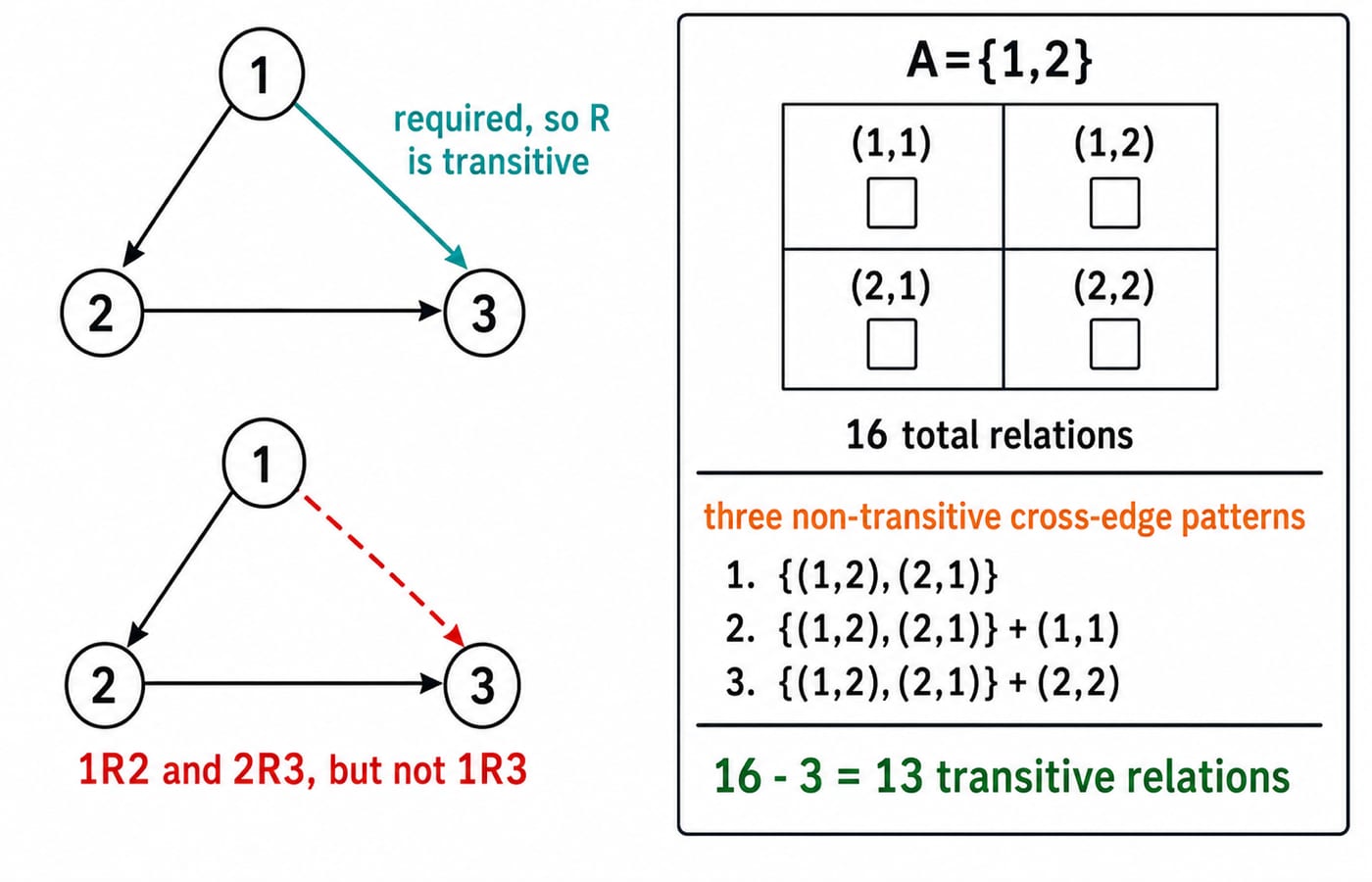
For A={1,2,3} and R={(1,2),(2,3),(1,3)}, the chain 1R2, 2R3 has its required shortcut 1R3, so the relation is transitive. Remove (1,3), and the chain fails. Test diagonal pairs through the same rule.
For A={1,2}, four possible ordered pairs produce 2^(2^2)=2^4=16 relations. Failure requires both (1,2) and (2,1) with at least one required loop missing. The failures are {(1,2),(2,1)}, that set plus (1,1), and that set plus (2,2). Thus 16-3=13 relations are transitive.
To audit, choose each middle element b. Match every incoming a->b with every outgoing b->c, then require a->c. One missing shortcut settles the result.
Definition and direct relation-audit MCQs 1-3
Question 1
What is a transitive relation?
A. A relation where if a is related to b and b is related to c, then a is related to c
B. A relation where if a is related to b and b is related to c, then a is not related to c
C. A relation where every element is related to itself
D. A relation where every element is related to every other element
Answer: A. A states (a,b),(b,c) in R => (a,c) in R. C is reflexivity, D is universal, and B denies the shortcut.
Question 2
Which of these relations is transitive?
A. R = {(1, 2), (2, 3), (1, 3)}
B. R = {(1, 2), (2, 3), (3, 1)}
C. R = {(1, 2), (2, 1), (3, 2)}
D. R = {(1, 2), (2, 1), (3, 3)}
Answer: A. A includes the shortcut (1,3) for 1->2->3. B lacks it; C and D contain 1->2->1 but omit (1,1).
Question 3
Set A = {a, b, c} A relation R is defined on A as R = {(a, a), (a, b), (a, c), (b, b), (b, c), (c, c)} Choose the correct option about R.
A. R is reflexive, symmetric, transitive
B. R is reflexive, not symmetric, not transitive
C. R is irreflexive, not symmetric, transitive
D. R is reflexive, not symmetric, transitive
Answer: D. The diagonal pairs make R reflexive, while (a,b) without (b,a) disproves symmetry. The chain (a,b),(b,c) has (a,c); loop-based chains reproduce existing pairs, so R is transitive.
Counterexample MCQs 4-6: OR conditions, common divisors and approximation
Question 4
A binary relation on is defined as follows: if or . Consider the following propositions: P: is reflexive Q: is transitive Which one of the following statements is TRUE?
A. Both P and Q are true.
B. P is true and Q is false.
C. P is false and Q is true.
D. Both P and Q are false.
Answer: B. Reflexivity follows from a<=a. Now (4,5)R(5,1) via 4<=5 and (5,1)R(2,3) via 1<=3, but the endpoint link fails because 4<=2 and 5<=3 are false. The two links used different sides of the OR.
Question 5
Let 𝑅 be the relation on the set of positive integers such that 𝑎𝑅𝑏 if and only if 𝑎 and 𝑏 are distinct and have a common divisor other than 1. Which one of the following statements about 𝑅 is true?
A. 𝑅 is symmetric and reflexive but not transitive
B. 𝑅 is reflexive but not symmetric and not transitive
C. 𝑅 is transitive but not reflexive and not symmetric
D. 𝑅 is symmetric but not reflexive and not transitive
Answer: D. Distinctness makes every aRa false, while common divisors are unchanged on reversal, so R is not reflexive but is symmetric. Also, 6R30 via 6 and 30R25 via 5, yet gcd(6,25)=1, so transitivity fails.
Question 6
Let ε = 0.0005 and let Re be the relation Re = { (x, y) ∈ R² : |x − y| < ε } Re could be interpreted as the relation "approximately equal". Re is: (A) Reflexive (B) Symmetric (C) Transitive Choose the correct answer from the options given below.
A. (A) and (B) only true
B. (B) and (C) only true
C. (A) and (C) only true
D. (A), (B) and (C) true
Answer: A. The identities |x-x|=0<0.0005 and |x-y|=|y-x| prove reflexivity and symmetry. For x=0, y=0.0004, z=0.0008, both adjacent gaps are 0.0004, but the endpoint gap is 0.0008. Transitivity fails.
Divisibility, disjointness and vacuous truth MCQs 7-9
Question 7
R is a relation defined over the set of integers Z as follows "aRb iff a is a factor of b". Then R is
A. Reflexive, Symmetric but not Transitive
B. Symmetric, Transitive but not Reflexive
C. Reflexive, Transitive but not Symmetric
D. Reflexive, Symmetric and Transitive
Answer: C. Every integer divides itself. From a|b and b|c, write b=ak, c=bm, hence c=a(km) and a|c. Symmetry fails because 2|4, but 4 does not divide 2.
Question 8
Let R be a non-empty relation on a collection of sets defined by A R B if and only if A ∩ B = ϕ. Then, (pick the true statement)
A. R is reflexive and transitive
B. R is symmetric and not transitive
C. R is an equivalence relation
D. R is not reflexive and not symmetric
Answer: B. Disjointness is symmetric because A intersection B equals B intersection A. For A={1}, B={2}, C={1}, the adjacent sets are disjoint but A intersection C={1}, disproving transitivity. Disjointness plays two different roles: Symmetric, Antisymmetric and Asymmetric Relation MCQs: 11 Solved Questions uses it to distinguish symmetry, antisymmetry and asymmetry; Q8 uses it to isolate the missing endpoint shortcut in a two-step chain.
Question 9
The binary relation S = ϕ (empty set) on set A = {1, 2, 3} is:
A. Neither reflexive nor symmetric
B. Symmetric and reflexive
C. Transitive and reflexive
D. Transitive and symmetric
Answer: D. Missing loops make S non-reflexive. Symmetry and transitivity hold vacuously because no pair can violate reversal and no two-pair chain can demand a shortcut. Empty does not mean property-free.
Finite relation MCQ 10: prove transitivity without checking 64 triples
Question 10
The binary relation R= { (1, 1), (2, 1), (2, 2), (2, 3), (2, 4), (3, 1), (3, 2), (3, 3), (3, 4) } on the set A(1, 2, 3, 4) is
A. Reflexive, symmetric and transitive
B. Neither reflexive, nor irreflexive but transitive
C. Irreflexive, symmetric and transitive
D. Irreflexive and anti-symmetric
Answer: B. Loops on 1, 2 and 3 are present but (4,4) is absent, so R is neither reflexive nor irreflexive. The successor sets are 1->{1}, 2->{1,2,3,4}, 3->{1,2,3,4}, 4->{}. Chains through 1 reproduce an endpoint, chains through 2 or 3 start in complete rows, and none continues through 4, so R is transitive.
Transitive-closure MCQs 11-12: repeated reachability and Warshall's rule
Question 11
Consider the binary relation: S = {(x, y) | y = x+1 and x, y ∈ {0, 1, 2, ...}} The reflexive transitive closure of S is
A. {(x, y) | y > x and x, y ∈ {0, 1, 2, ... }}
B. {(x, y) | y ≥ x and x, y ∈ {0, 1, 2, ... }}
C. {(x, y) | y < x and x, y ∈ {0, 1, 2, ... }}
D. {(x, y) | y ≤ x and x, y ∈ {0, 1, 2, ... }}
Answer: B. Repeated steps give x->x+k for k>=1; for example, 2->3->4->5 adds (2,5). Reflexive closure adds the zero-step pair (x,x), giving exactly y>=x.
Question 12
Find the zero-one matrix of the transitive closure of the relation given by the matrix :
A.
B.
C.
D.
Answer: A. Read rows as sources and columns as destinations. The paths 3->1->3 and 1->3->2 force (3,3) and (1,2). Since node 2 has only its loop, the closure rows are [1,1,1], [0,1,0], [1,1,1]. Warshall update sets w[i,j] to true when w[i,k] and w[k,j] are true. At k=1 it adds (3,3) through 3->1->3, and at k=3 it adds (1,2) through 1->3->2.
Transitive relation answer map, traps and the next practice step
Answers: 1-A; 2-A; 3-D; 4-B; 5-D; 6-A; 7-C; 8-B; 9-D; 10-B; 11-B; 12-A.
Trap | What goes wrong | Decisive check |
|---|---|---|
One chain suffices | Another may fail | Audit middle elements (Q2, Q3) |
OR uses one inequality | Links use different sides | Track witnesses (Q4) |
Symmetry means transitivity | Reversal does not complete chains | Test endpoints (Q5, Q6, Q8) |
Empty means no properties | Vacuous truth missed | Seek violations (Q9) |
Every triple needs checking | Structure gets hidden | Compare successor sets (Q10) |
Closures are identical | Zero steps disappear | Add equality (Q11) |
Arithmetic multiplication works | Closure asks reachability | Use Boolean reachability (Q12) |
Reproduce: 16-3=13 on {1,2}; failed endpoint (4,5)->(5,1)->(2,3); Q10 successor sets; Q12 additions (3,3), (1,2).
Next, solve Set Theory and Relations MCQs: 12 Solved. Use GATE Guidance by Sanchit Sir for Relations lessons and the GATE Test Series for timed mixed practice. Make every answer earn its shortcut or counterexample.
Keep learning

Graph Traversal MCQs: 12 Solved Questions on Walks, Paths, Trails, Circuits and Connectivity
Attempt 12 graph traversal and connectivity questions, then check each answer through definitions, reachability, degree conditions and edge-count arguments.
Updated 3 Oct 20267 min readDiscrete Mathematics MCQs
Planar Graphs MCQs: 12 Solved Questions on Kuratowski’s Theorem, Homeomorphism and Edge Bounds
Solve 12 planar graph questions, then check each answer through a forbidden-subdivision argument, a crossing-free redraw, or a short calculation.
Updated 28 Sep 20268 min readDiscrete Mathematics MCQs
Power Set and Cardinality MCQs: 12 Solved Questions with Explanations
Solve 12 power set questions, from direct enumeration and nested sets to inclusion chains, ordered pairs and recurrence-based counting.
25 Sep 20267 min readDiscrete Mathematics MCQs
Null Set, Universal Set, Subset and Proper Subset MCQs: 12 Solved Questions
Practise 12 MCQs on null sets, universal sets, subsets, proper subsets, complements and nested inclusion, with clear reasoning for every answer.
Updated 24 Sep 20267 min readDiscrete Mathematics MCQs