Predicate Logic and Quantifiers MCQs: 10 Solved Questions with Explanations
Witnesses, counterexamples, quantifier order, model size, and divisibility decide these predicate-logic MCQs over integer, real, and finite domains.
KnowledgeGate Team
Exam prep & CS education
Updated 19 Sep 20267 min read
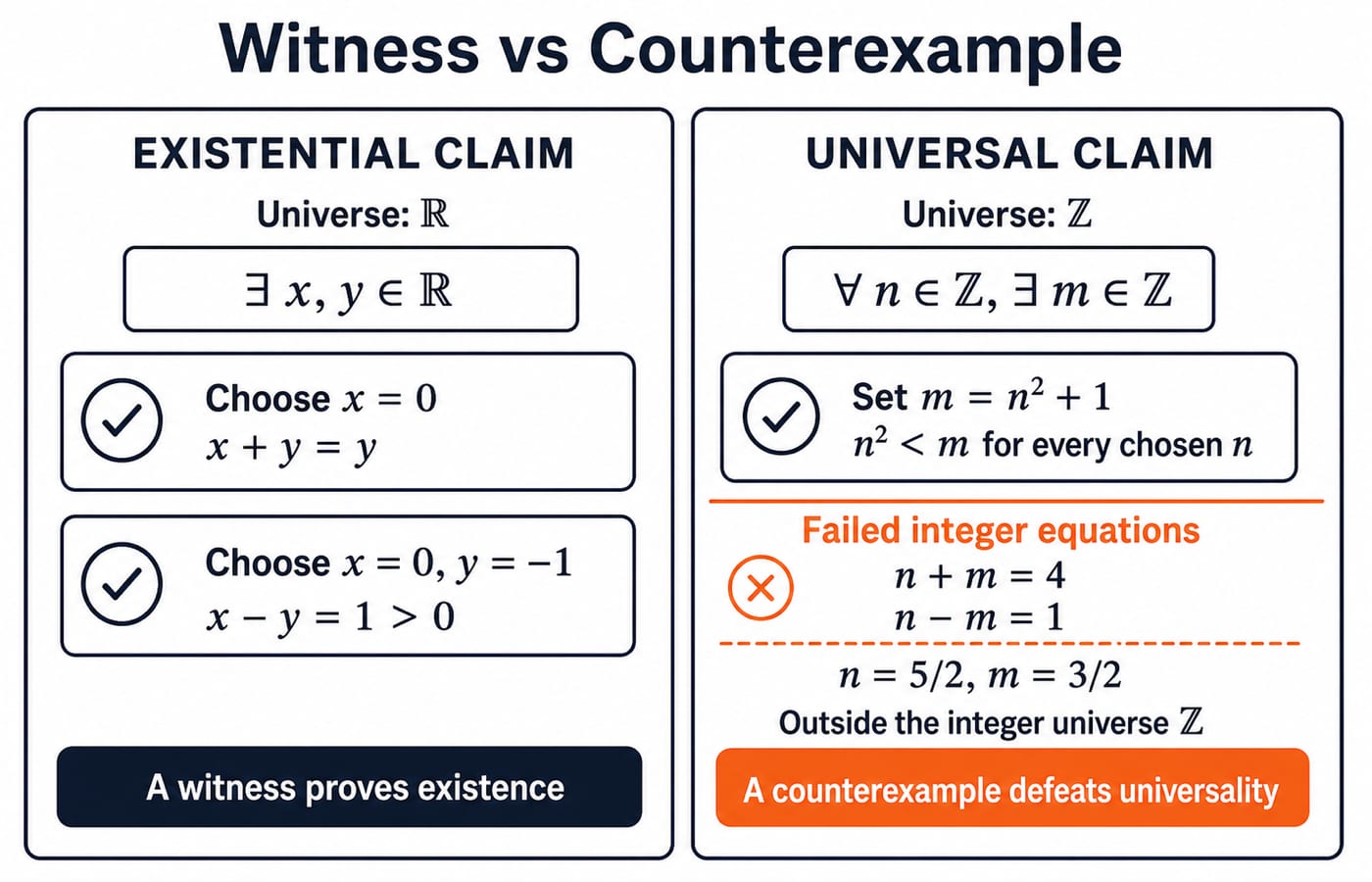
A witness proves an existential claim, while one counterexample defeats a universal claim. Quantifier order controls whether a witness may depend on another variable, and model size can constrain what a formula can express. For integers, reals, finite models, and divisibility, the decisive step is usually a witness, counterexample, or equivalence.
Read the universe, quantifier order, and connective first
Before solving:
Name the universe: integers, reals, or another domain.
Read quantifiers left to right. In
forall x exists y,ymay depend onx;exists y forall xneeds one commony.Try a witness for an existential claim and a counterexample for a universal claim.
Falsify
P -> Rwith truePand falseR; test both directions of a biconditional.
Remember: P -> R means not P or R, while P(c) or Q(c) proves neither disjunct alone.
Solved MCQs 1-3: integer truth values and function types
Q1. Truth statements over the integers
Which of the following statement are truth statements if universe of disclosure is set of integers :
(A) ∀n(n² ≥ 0)
(B) ∃n(n² = 2)
(C) ∀n(n² ≥ n)
(D) ∃n (n² < 0)
Choose the correct answer from the options given below :
A. (A) and (B) Only
B. (B) and (C) Only
C. (C) and (D) Only
D. (A) and (C) Only
Answer: D. Integer squares are non-negative, so (A) is true and (D) false; none equals 2, so (B) is false. For (C), n^2-n=n(n-1)>=0: every integer satisfies either n<=0 or n>=1.
Q2. Evaluate P(x) over the integers
The statement P(x): "x = x²". If the universe of disclosure consists of integers, which of the following have truth values :
(A) P(0)
(B) P(1)
(C) P(2)
(D) ∃x P(x)
(E) ∀x P(x)
Choose the correct answer from the options given below :
A. (A), (B) and (E) Only
B. (A), (B) and (C) Only
C. (A), (B) and (D) Only
D. (B), (C) and (D) Only
Answer: C. The predicate forces x(x-1)=0, so only x=0 and x=1 satisfy it. P(0), P(1), and the existential statement are therefore true, while P(2) and the universal statement are false.
Q3. Match quantified definitions of a function
Match the following in List-I and List-II, for a function f :
List-I: (a) ∀x ∀y (f(x)=f(y) → x=y); (b) ∀y ∃x (f(x)=y); (c) ∀x f(x)=k
List-II: (i) Constant; (ii) Injective; (iii) Surjective
Code :
A. (a)-(i), (b)-(ii), (c)-(iii)
B. (a)-(iii), (b)-(ii), (c)-(i)
C. (a)-(ii), (b)-(i), (c)-(iii)
D. (a)-(ii), (b)-(iii), (c)-(i)
Answer: D. Equal outputs forcing equal inputs makes (a) injective. Every y having a preimage makes (b) surjective. One fixed output k makes (c) constant: (a)-(ii), (b)-(iii), (c)-(i).
Solved MCQs 4-6: invalid inference and concrete witnesses
Q4. Find the invalid inference steps
Consider the following argument with premise ∀x(P(x) ∨ Q(x)) and conclusion (∀x P(x)) ∧ (∀x Q(x))
(A) ∀x (P(x) ∨ Q(x)) | Premise
(B) P(c) ∨ Q(c) | Universal instantiation from (A)
(C) P(c) | Simplification from (B)
(D) ∀x P(x) | Universal Generalization of (C)
(E) Q(c) | Simplification from (B)
(F) ∀x Q(x) | Universal Generalization of (E)
(G) (∀x P(x)) ∧ (∀x Q(x)) | Conjunction of (D) and (F)
A. This is a valid argument
B. Steps (C) and (E) are not correct inferences
C. Steps (D) and (F) are not correct inferences
D. Step (G) is not a correct inference
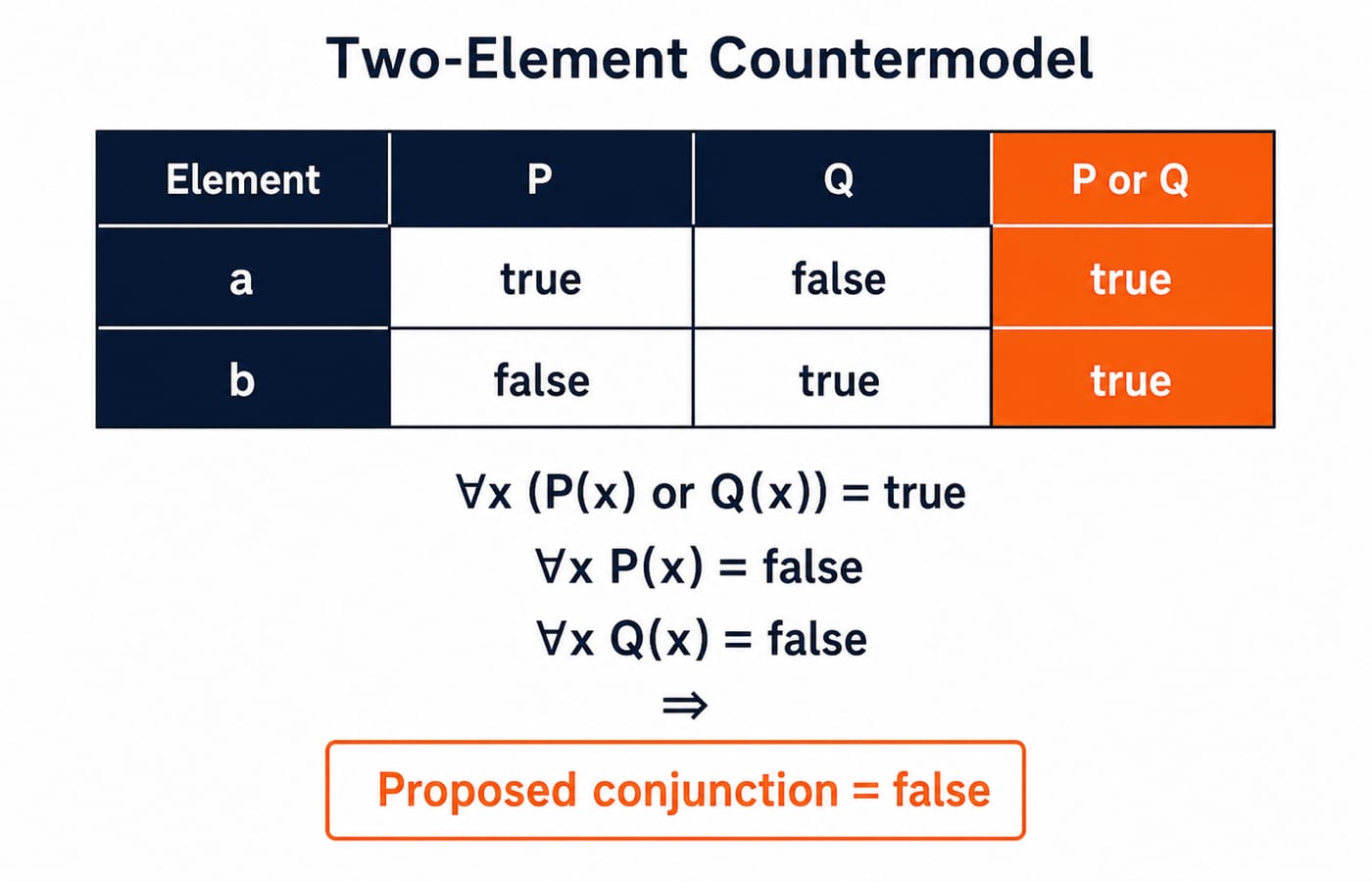
Answer: B. A disjunction gives neither disjunct alone. On {a,b}, set P(a)=true, Q(a)=false and P(b)=false, Q(b)=true. The premise holds everywhere, but both universal conclusions fail.
Q5. Test four quantified claims over the reals
If universe of disclosure are all real numbers, then which of the following are true ?
(A) ∃x ∀y (x + y = y)
(B) ∀x ∀y (((x ≥ 0) ∧ (y < 0)) → (x - y > 0))
(C) ∃x ∃y (((x ≤ 0) ∧ (y ≤ 0)) ∧ (x - y > 0))
(D) ∀x ∀y ((x ≠ 0) ∧ (y ≠ 0) ↔ (xy ≠ 0))
Choose the correct answer from the options given below :
A. (A) and (B) Only
B. (A), (C) and (D) Only
C. (A), (B) and (D) Only
D. (A), (B) ,(C) and (D) Only
Answer: D. Choose x=0 for (A). In (B), x-y=x+(-y)>0. For (C), x=0,y=-1 gives x-y=1>0. Statement (D) is the real zero-product property in both directions. All four are true.
Q6. Choose true integer statements by constructing values
If the universe of disclosure is set of integers, then which of the followings are TRUE ?
(A) ∀n ∃m (n² < m)
(B) ∃n ∀m (n < m²)
(C) ∃n ∀m (n m = m)
(D) ∃n ∃m (n² + m² = 6)
(E) ∃n ∃m (n + m = 4 ∧ n − m = 1)
Choose the correct answer from the options given below :
A. (A), (B) and (C) Only
B. (B) and (C) Only
C. (C), (D) and (E) Only
D. (C) and (E) Only
Answer: A. Use m=n^2+1 for (A), n=-1 for (B), and n=1 for (C). Squares {0,1,4,9,...} cannot sum to 6, so (D) fails. Equation (E) gives (n,m)=(5/2,3/2), not integers.
Solved MCQs 7-10: equivalence, small models, implication, and divisibility
Q7. Test whether quantifiers distribute across an implication
Which predicate formula is NOT logically valid? W has no free occurrence of x.
A. ∀x(P(x) ∨ W) ≡ (∀x P(x)) ∨ W
B. ∃x(P(x) ∧ W) ≡ (∃x P(x)) ∧ W
C. ∀x(P(x) → W) ≡ (∀x P(x)) → W
D. ∃x(P(x) → W) ≡ (∀x P(x)) → W
Answer: C. Let the domain be {a,b}, let W be false, set P(a) true, and set P(b) false. The left side becomes ∀x ¬P(x), which is false, while the right side becomes ¬∀x P(x), which is true. In A and B, W can move outside because it has no free x; in D, both sides reduce to ∃x ¬P(x) ∨ W on a non-empty domain.
Q8. Bound the size of a model
Consider the first-order logic sentence
𝜑 ≡ ∃𝑠∃𝑡∃𝑢∀𝑣∀𝑤∀𝑥∀𝑦 𝜓(𝑠,𝑡, 𝑢, 𝑣, 𝑤, 𝑥, 𝑦)
where 𝜓(𝑠,𝑡, 𝑢, 𝑣, 𝑤, 𝑥, 𝑦) is a quantifier-free first-order logic formula using only predicate symbols, and possibly equality, but no function symbols. Suppose 𝜑 has a model with a universe containing 7 elements.
Which one of the following statements is necessarily true?
A. There exists at least one model of 𝜑 with universe of size less than or equal to 3.
B. There exists no model of 𝜑 with universe of size less than or equal to 3.
C. There exists no model of 𝜑 with universe of size greater than 7.
D. Every model of 𝜑 has a universe of size equal to 7.
Answer: A. Let a,b,c be the existential witnesses. With no function symbols, restrict the model to the induced substructure on {a,b,c}; the universal suffix still holds. Its size is at most 3, or 1 or 2 if witnesses coincide.
Q9. Determine what follows from ∀x ∃y R(x,y)
Consider the first-order logic sentence F: ∀x(∃y R(x,y)). Assuming non-empty logical domains, which of the sentences below are implied by F ?
I. ∃y(∃x R(x,y))
II. ∃y(∀x R(x,y))
III. ∀y(∃x R(x,y))
IV. ¬∃x(∀y¬R(x,y))
A. IV only
B. I and IV only
C. II only
D. II and III only
Answer: B. A non-empty domain guarantees one related pair, so I follows. Quantifier-negation laws turn IV into F exactly. II demands one common y; III demands a preimage for every y. Neither follows.
Q10. Evaluate quantified divisibility statements
Let P(m,n) mean "m divides n", with both variables ranging over the positive integers. Determine the truth values:
(a) ∀m ∀n P(m,n)
(b) ∀n P(1,n)
(c) ∃m ∀n P(m,n)
A. (a) False, (b) True, (c) True
B. (a) True, (b) False, (c) False
C. (a) False, (b) False, (c) False
D. (a) True, (b) True, (c) True
Answer: A. Statement (a) is false because 2 does not divide 3. Statement (b) is true because every positive integer n equals 1 multiplied by n. Statement (c) is also true: m = 1 is a single witness that divides every positive integer.
Review and continue
For connective-heavy fundamentals and English translation, use Propositional and Predicate Logic MCQs: 12 solved questions with explanations. Quantifiers and Predicate Logic MCQs: 10 Practice Problems Explained owns distribution laws, uniqueness, English exceptions, and graph reachability. Quantifiers MCQs: 12 Solved Universal and Existential Questions focuses on translation, dependency, and quantifier movement. Here, the distinct practice is mathematical domains, invalid inference, small-model arguments, and divisibility.
Continue with GATE Guidance by Sanchit Sir or the wider GATE catalogue.
Keep learning
Graph Traversal MCQs: 12 Solved Questions on Walks, Paths, Trails, Circuits and Connectivity
Attempt 12 graph traversal and connectivity questions, then check each answer through definitions, reachability, degree conditions and edge-count arguments.
Updated 3 Oct 20267 min readDiscrete Mathematics MCQs
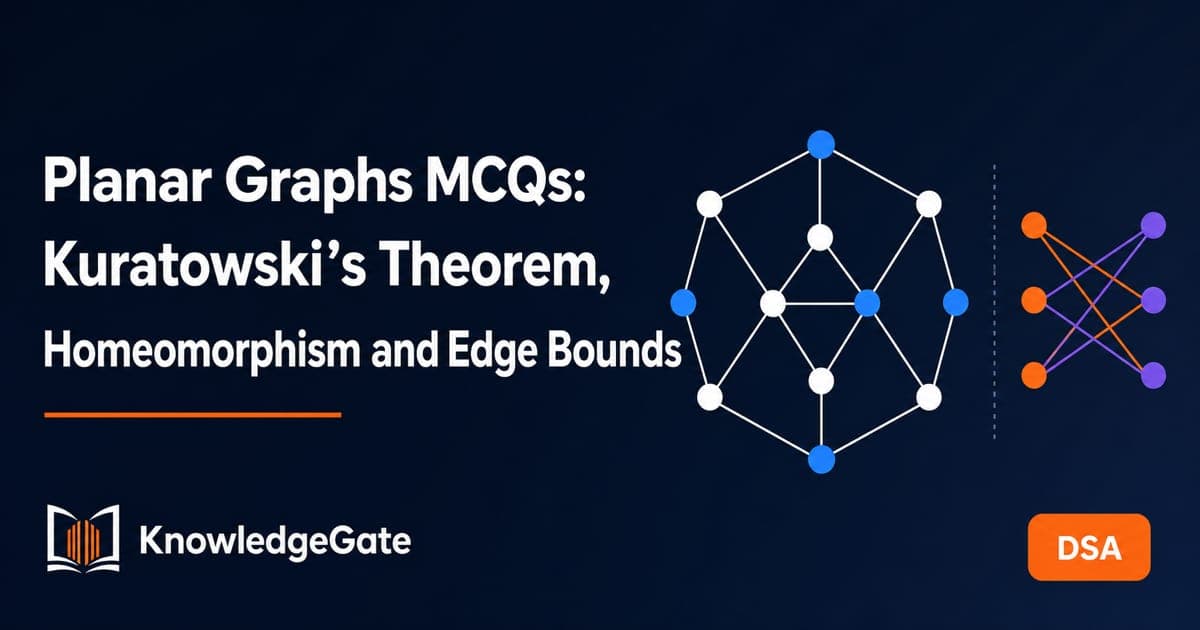
Planar Graphs MCQs: 12 Solved Questions on Kuratowski’s Theorem, Homeomorphism and Edge Bounds
Solve 12 planar graph questions, then check each answer through a forbidden-subdivision argument, a crossing-free redraw, or a short calculation.
Updated 28 Sep 20268 min readDiscrete Mathematics MCQs
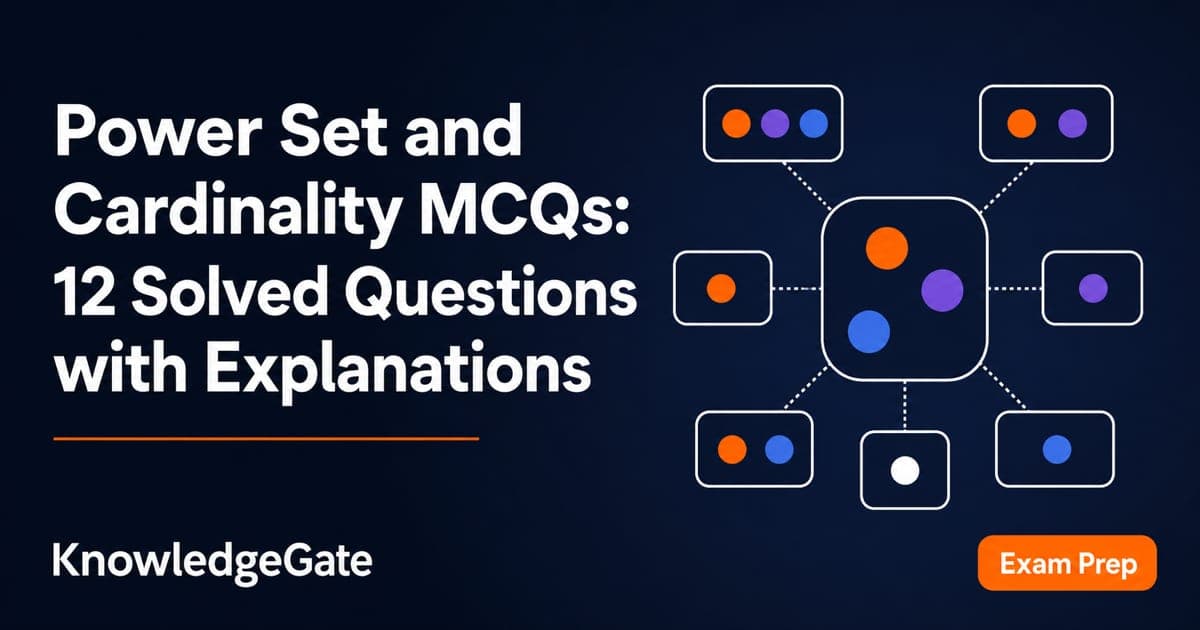
Power Set and Cardinality MCQs: 12 Solved Questions with Explanations
Solve 12 power set questions, from direct enumeration and nested sets to inclusion chains, ordered pairs and recurrence-based counting.
25 Sep 20267 min readDiscrete Mathematics MCQs
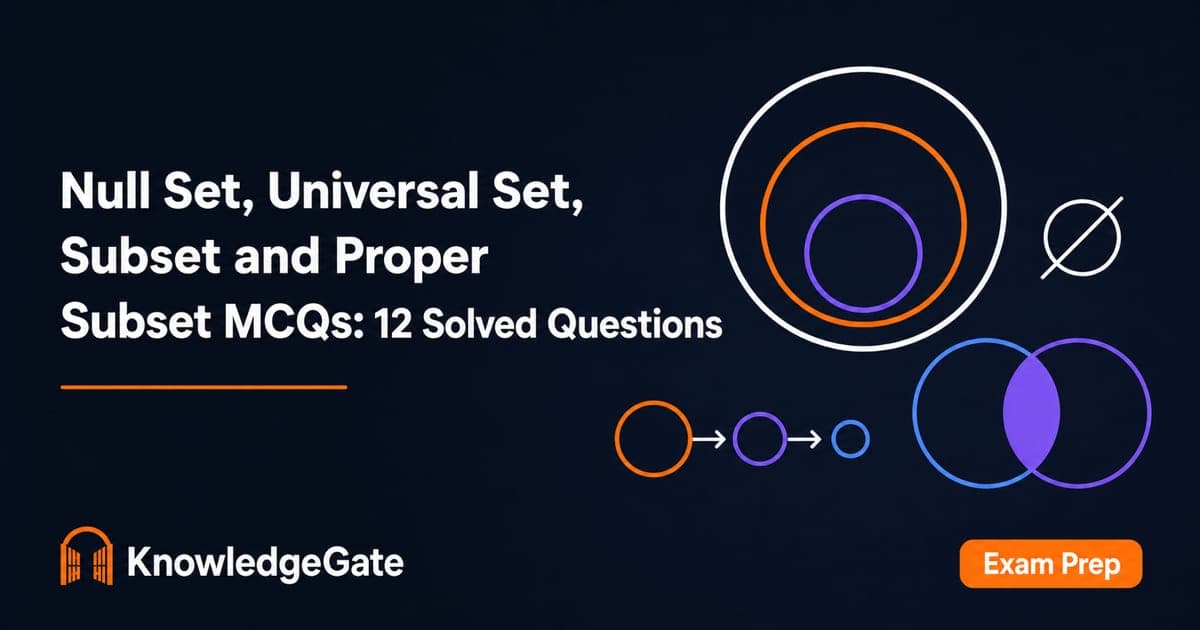
Null Set, Universal Set, Subset and Proper Subset MCQs: 12 Solved Questions
Practise 12 MCQs on null sets, universal sets, subsets, proper subsets, complements and nested inclusion, with clear reasoning for every answer.
Updated 24 Sep 20267 min readDiscrete Mathematics MCQs