

Python Tuples MCQs: 12 Solved Questions with Explanations
Attempt 12 representative Python tuple questions, then use the worked explanations to fix common mistakes with commas, mutability, slicing, and returned values.
KnowledgeGate Team
Exam prep & CS education
Updated 24 Nov 20267 min read
Tuple questions look simple until a missing comma turns a supposed tuple into a string, an immutable tuple contains a mutable list, or a list accepts a tuple on its right-hand side. Attempt every item before reading its explanation so that you catch the exact rule you are applying incorrectly. Use the Python Tuples Tutorial teaches packing, unpacking, methods and record examples. Choosing the correct option under exam conditions instead demands precise decisions about comma syntax, cross-sequence operations, slicing, nested mutation and returned values. The Python Output-Based Questions: Lists, Slicing and Mutability set develops free-response tracing across lists, aliasing and slice assignment; tuple MCQs instead train option elimination around tuple semantics.
1. Tuple identity and immutability: Questions 1-3
A tuple is an ordered sequence whose slots cannot be reassigned, added, or removed in place. Deleting its name with del is a separate operation.
Question 1 (HPSC PGT Computer Science 2023)
Tuples in Python are :A. mutable
B. immutable
C. modifiable
D. convertibleAnswer: B. immutable
A tuple's slots cannot be reassigned after creation. Objects held in those slots can still be mutable, as Question 10 shows. Practise Question 1.
Question 2 (HPSC PGT Computer Science 2024)
In Python, ........... is the type of sequence that resembles a list, except that, unlike a list, it is immutable.A. Vector
B. Object
C. Dictionary
D. TupleAnswer: D. Tuple
Lists and tuples are ordered sequences, but list elements can be reassigned while tuple slots cannot. Practise Question 2.
Question 3 (RSSB Senior Computer Instructor 2023)
Which of the given options best describes the truthfulness of the following statements?
i) A tuple is an immutable sequence of Python objects. The tuple course = ("i", "m", "n", "o") has four elements.
ii) To explicitly remove an entire tuple, use the drop statement.A. i-True, ii-True
B. i-False, ii-True
C. i-True, ii-False
D. i-False, ii-FalseAnswer: C. i-True, ii-False
The four comma-separated values make statement i true. Python has no drop statement; del course removes the name binding without mutating the tuple. Practise Question 3.
2. The comma makes the tuple: Questions 4-5
Parentheses can merely group an expression. The comma creates a tuple, so ('1') is the string '1', while ('1',) is a one-element tuple. Consequently, '1' * 3 == '111', but ('1',) * 3 == ('1', '1', '1'). For tuple concatenation, both operands must be tuples at that point.
Question 4 (RSSB Senior Computer Instructor 2023)
Find the correct output of the following Python program segment:
 T=('1')
print(T*3)A. 3 / 3
B. ('1','1','1') / ('1','1','1')
C. 111 / 111
D. ('3')Answer: C. 111 / 111
There is no comma in ('1'), so T refers to a string, not a tuple. String multiplication repeats its content three times, and print(T*3) therefore displays 111. The correct answer is C. Practise Question 4.
Question 5 (RSSB Senior Computer Instructor 2023)
Suppose a Python tuple TUP is declared as
 TUP=('A','B','C')
Which of the following command is invalid ?A. TUP=('D')
B. TUP=('D',)
C. TUP+=('D')
D. TUP+=('D',)Answer: C. TUP+=('D')
Options A and B are valid assignments, although A binds TUP to the string 'D'. Option C attempts ('A', 'B', 'C') + 'D', so tuple-plus-string raises TypeError. Option D adds ('D',) to produce ('A', 'B', 'C', 'D') and rebinds the name; the original tuple is not mutated. Practise Question 5.
3. Tuple methods versus sequence functions: Questions 6-7
Use a mutating-versus-observing test. insert, append, pop, and remove change a list, so they are not tuple methods. index only finds a position and works on both. Built-ins can read a tuple without mutating it: max((4, 9, 2)) is 9, while sorted((4, 9, 2)) returns the new list [2, 4, 9]. The return type can differ from the input type.
Question 6 (RSSB Senior Computer Instructor 2026)
Which out of the following Python functions/methods can never be used with tuple?A. max
B. insert
C. index
D. sortedAnswer: B. insert
insert is a list method that changes sequence membership. max and sorted are built-ins that accept a tuple iterable, while index is available as a tuple method. Practise Question 6.
Question 7 (RSSB Senior Computer Instructor 2026)
Which out of the following Python functions/methods is commonly used in list as well as tuple?A. append
B. pop
C. index
D. remove Answer: C. index
('red', 'blue', 'red').index('blue') == 1, and ['red', 'blue', 'red'].index('blue') == 1 as well. The same non-mutating lookup works on both sequence types. Practise Question 7.
4. When a list consumes a tuple: Questions 8-9
With L = [10, 20] and T = (30, 40), both L.extend(T) and, on a fresh list, L += T produce [10, 20, 30, 40]. A mutable list can consume a tuple iterable.
Question 8 (RSSB Senior Computer Instructor 2026)
Suppose L is a list and T is a tuple. Evaluate the following Python statement and choose the correct observation regarding its execution:
L.extend(T)A. Always valid
B. Always invalid
C. Always invalid
D. Valid only if data types match in both (e.g., all integers or all strings)Answer: A. Always valid
list.extend accepts any iterable, including a tuple. Its elements need not share one data type because lists can hold mixed types. Choices B and C repeat the same wording. Practise Question 8.
Question 9 (RSSB Senior Computer Instructor 2026)
Let T be a tuple and L be a list. Evaluate the validity of the following Python statement:
L += T
and select the most appropriate option based on Python’s rules for sequence operations and data types.A. Always valid
B. Always invalid
C. Valid only when list L and tuple T store similar data types
D. Results in a Type ErrorAnswer: A. Always valid
Read the operation from its left operand. List in-place addition consumes the tuple iterable, so [10, 20] += (30, 40) gives [10, 20, 30, 40]. In Question 5, tuple concatenation required another tuple. Practise Question 9.
5. An immutable tuple can contain mutable objects: Question 10
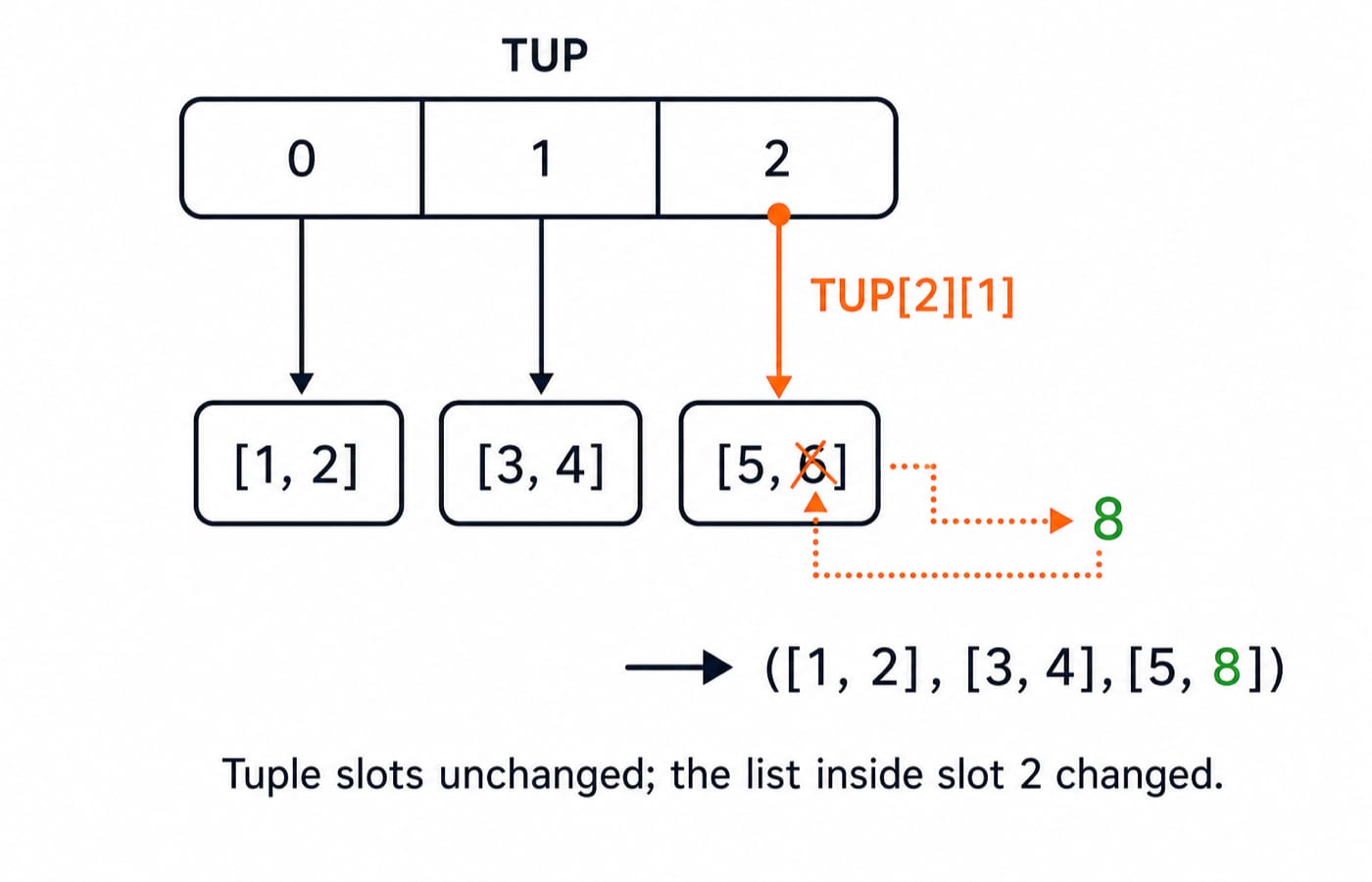
Tuple immutability does not freeze every reachable object. Trace whether the assignment changes a tuple slot or nested object.
Question 10 (RSSB Senior Computer Instructor 2023)
Identify the correct output of the Python code:
 TUP=([1, 2], [3, 4], [5, 6])
 TUP[2][1]=8
print(TUP)A. ([1, 2], [8, 4], [5, 6]) / ([1, 2], [8, 4], [5, 6])
B. ([1, 2], [3, 4], [8, 6]) / ([1, 2], [3, 4], [8, 6])
C. ([1, 2], [3, 4], [5, 8]) / ([1, 2], [3, 4], [5, 8])
D. will generate an error as a Tuple is immutableAnswer: C. ([1, 2], [3, 4], [5, 8]) / ([1, 2], [3, 4], [5, 8])
TUP[2] selects [5, 6]; the following [1] selects 6. Assigning 8 mutates that list to [5, 8], while the tuple keeps the same three list references. Practise Question 10.
6. Negative slicing without guesswork: Question 11
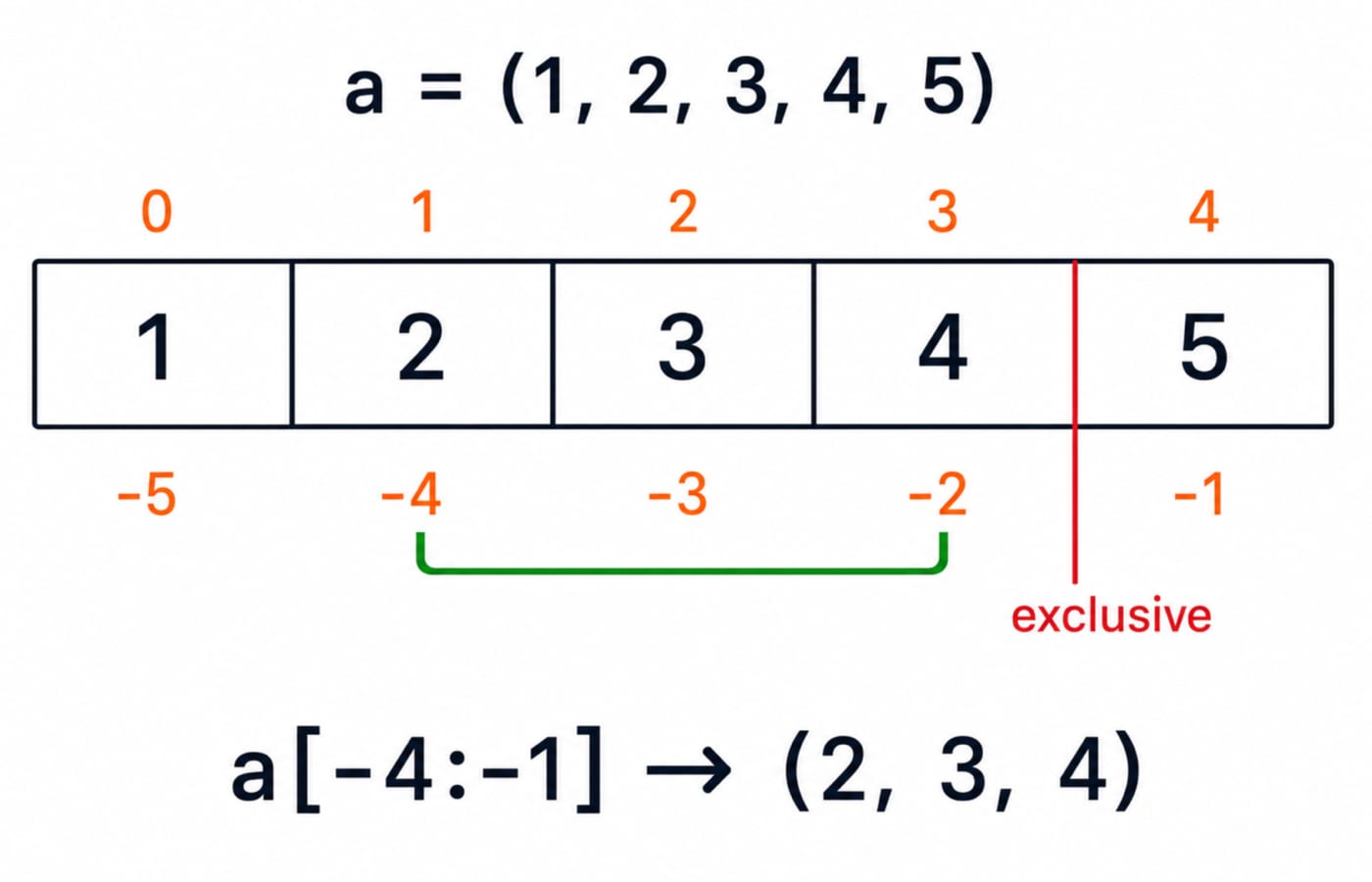
For a = (1, 2, 3, 4, 5), positive indices are 0, 1, 2, 3, 4, while negative indices are -5, -4, -3, -2, -1. A slice includes its start and excludes its stop.
Question 11 (IBPS SO IT Mains 2024)
What will be the output of the following Python code?
a = (1,2,3,4,5)
print(a[-4:-1])A. (2, 3, 4)
B. (3, 4, 5)
C. (2, 3, 4, 5)
D. (1, 2, 3)
E. (3, 4)Answer: A. (2, 3, 4)
Index -4 points to 2, so collection begins there and continues through 3 and 4. The stop index -1 points to 5, which is excluded. The positive-index cross-check is a[1:4], also (2, 3, 4). Practise Question 11.
7. sorted() returns a new list: Question 12 and the score diagnosis
sorted() returns a new list without modifying its input. An unused return value has no visible effect.
Question 12
Identify the correct output of the following Python code:
 TUP=(3,1,2,4)
 sorted(TUP)
print(TUP)A. (3, 1, 2, 4) / (3, 1, 2, 4)
B. (2) (1, 2, 3, 4) / (1, 2, 3, 4)
C. [3, 1, 2, 4] / [3, 1, 2, 4]
D. [1, 2, 3, 4] / [1, 2, 3, 4]Answer: A. (3, 1, 2, 4) / (3, 1, 2, 4)
sorted(TUP) returns [1, 2, 3, 4], but the list is unused. TUP remains (3, 1, 2, 4), so print(TUP) displays the original order. Question 12 is available through the Tuples practice hub.
Diagnose your score and choose the next step
Questions 1 to 3: revise immutability.
Questions 4 to 5: practise the one-element comma.
Questions 6 to 9: separate left operands, methods, and iterables.
Question 10: revise nested mutability.
Question 11: redraw index maps.
Question 12: track returned values.
Build foundations with Python Course: Concepts, MCQs & Coding, or practise algorithms with DSA Using Python. Browse Coding & DSA for the wider path.
The short version
Tuples are ordered and immutable at the slot level; most traps disappear when you check the comma, left operand, returned value, and nested mutability. Redo the missed pattern, then attempt a fresh Tuples set before moving into DSA.
Keep learning

Python Tuples Tutorial: Packing, Unpacking, Methods and Examples
Learn how Python tuples work through runnable examples, a fixed-record route program, precise error fixes and four predict-before-running exercises.
Updated 15 Aug 20266 min readPython
Python Data Structures: Lists, Tuples, Sets, Dictionaries
Choose among Python's four core containers by the operation you need most. See costs, hashability rules, a decision table and crisp interview answers.
Updated 30 Oct 20265 min readDSA & Algorithms

Binary Files MCQs and Python Practice: 12 Solved Questions with Explanations
Solve eight Python binary-file MCQs and four output or coding questions. Each answer explains pickle, file modes, sequential objects, EOF and updates.
Updated 23 Nov 20269 min readPython

Python List MCQs: 12 Solved Questions with Explanations
Test Python list tracing with 12 exam-attributed MCQs on syntax, indexing, slicing, mutation, nested pop calls and sorting, with worked answers.
Updated 22 Nov 20267 min readPython