Transmission Media MCQs: 12 Solved Questions on Fibre, Cable and Wireless Media
Use 12 solved MCQs to separate guided and unguided media, decode fibre and cable facts, and reason through radio, RFID and frequency-order traps.
KnowledgeGate Team
Exam prep & CS education
10 Sep 20268 min read
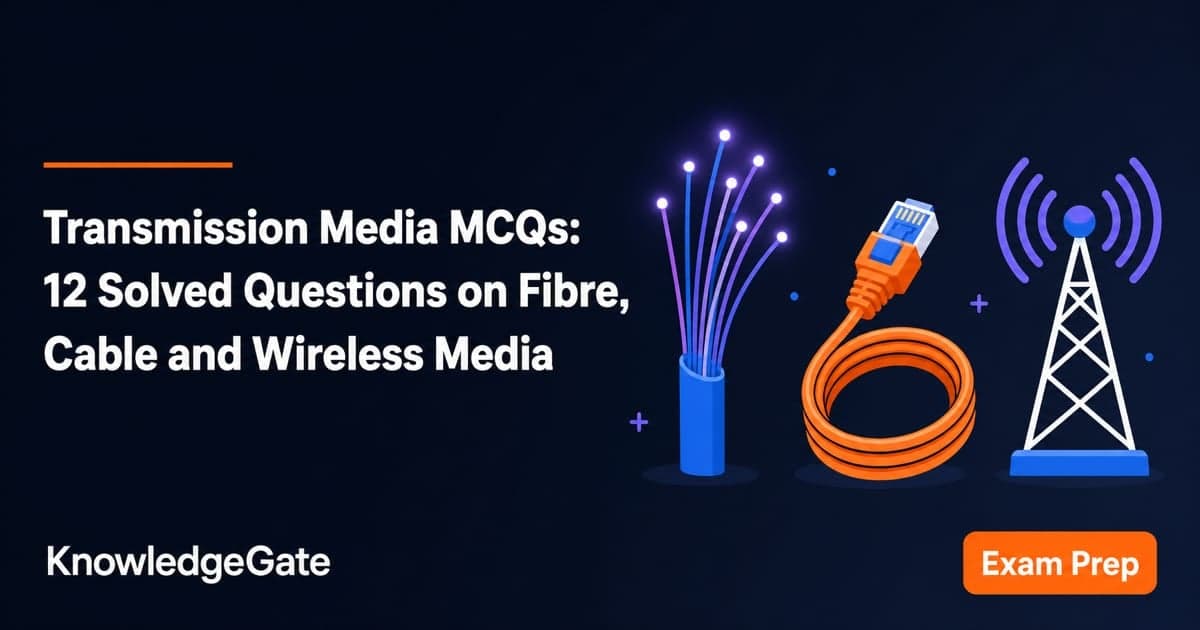
Transmission-media questions look like memory checks, but their distractors target four recurring confusions: guided versus unguided media, copper versus fibre, propagation method versus cable type, and a broad electromagnetic label versus the precise technology name. The reliable method is to classify the signal path first and recall one decisive property only after that.
Previous-year questions repeatedly combine guided and unguided media with fibre, cable types, propagation, RFID and frequency order. Classify the physical path, then use connector type, propagation mode or frequency order to eliminate distractors. Apply these distinctions in broader Computer Networks MCQs.
Transmission media MCQs: build the solving map first
Question clue | Put it in this bucket | Fast test |
|---|---|---|
twisted pair, coaxial, optical fibre | guided | signal follows a physical path |
radio, microwave, infrared, free-space light | unguided | electromagnetic wave crosses space without a conductor |
core-cladding and critical angle | optical fibre | total internal reflection requires incidence angle > critical angle |
VLF/LF | ground-wave propagation | wave follows the Earth's surface |
Two facts are useful for transmission-media questions: 100BASE-TX uses twisted-pair copper and has a maximum segment length of 100 m. 100BASE-TX = twisted-pair copper, maximum segment length 100 m. The increasing-frequency order is radio waves < microwaves < infrared < visible light. Use the medium, propagation mode and frequency chain together to eliminate distractors.
Use the GATE CS exam preparation route for broader study.
Fibre optics, Fast Ethernet and attenuation MCQs
Question 1
UGC NET, Computer Science, Paper 2 (December), 2019
Consider the following statements:
(a)  Fiber optic cable is much lighter than copper cable
(b)  Fiber optic cable is not affected by power surges or electromagnetic interference
(c)  Optical transmission is inherently bidirectional
Which of the statements is (are) correct?
(a) Only (a) and (b)(b) Only (a) and (c)(c) Only (b) and (c)(d) (a), (b) and (c)
Answer: (a) Only (a) and (b). Statement (a) is true because fibre is lighter than copper; (b) is true because its dielectric path is immune to electromagnetic pickup and does not conduct surge current like copper. Statement (c) is too strong: two-way communication needs two fibres or a deliberate bidirectional technique such as separate wavelengths. It is possible, not inherent.
Question 2
UGC NET, Computer Science, Paper 2 (August), 2016
In Fast Ethernet cabling, 100Base-TX uses ____ cable and has a maximum segment size of _____.(a) twisted pair, 100 metres(b) twisted pair, 200 metres(c) fibre optics, 1000 metres(d) fibre optics, 2000 metres
Answer: (a) twisted pair, 100 metres. Decode 100 as 100 Mb/s Fast Ethernet, BASE as baseband, and TX as the twisted-pair copper variant. The question's maximum segment length is 100 m, which rejects 200 metres directly.
Question 3
UGC NET, Computer Science, Paper 2 (June), 2016
Optical fiber uses reflection to guide light through a channel, in which angle of incidence is ________ the critical angle.(a) equal to(b) less than(c) greater than(d) less than or equal to
Answer: (c) greater than. Total internal reflection needs light to travel from the higher-index core towards the lower-index cladding, with incidence angle from the normal greater than the critical angle. At the critical angle, the refracted ray runs along the boundary, so equal to is insufficient.
Question 4
DSSSB, Computer Science, 2022
Which of the following statements is/are FALSE?
(i) Fibre optics provide faster data transmission than copper wires.
(ii) Shielded twisted pair does not suffer from attenuation.
(a) Only (i)(b) Only (ii)(c) Both (i) and (ii)(d) Neither (i) nor (ii)
Answer: (b) Only (ii). Fibre generally supports higher data rates over longer distances than copper, so statement (i) is true in this comparison. Shielding reduces electromagnetic interference, but signal strength still falls with distance. It does not remove attenuation, so statement (ii) is false.
Guided, unguided and coaxial-media MCQs
Question 5
DSSSB, Computer Science, TGT - Shift 4, 2021
Which of the following is not an example of Guided transmission media?(a) Fiber optic(b) Infrared wave(c) Twisted pair(d) Coaxial cable
Answer: (b) Infrared wave. Fibre, twisted pair and coaxial cable use a physical path, so they are guided. Free-space infrared is unguided; do not group it with optical fibre merely because both use electromagnetic energy.
Question 6
DSSSB, Computer Science, TGT - Shift 3, 2021
Which of the following is not an example of unguided transmission media?(a) Radio transmission(b) Microwave transmission(c) Coaxial cable(d) Light transmission
Answer: (c) Coaxial cable. It confines its electrical signal to a physical conductor, making it guided media. Here, Light transmission means free-space optical transmission; radio, microwave and free-space light cross space without a cable.
Question 7
MPPSC, Computer Science, 2025
Coaxial cable is important guided transmission media. It has higher bandwidth as compared to that of twisted pair cable. To connect coaxial cable to device, we need coaxial cable connector called.(a) BNC connector(b) RJ 50 connector(c) RJ 45 connector(d) MT-RJ 45 connector
Answer: (a) BNC connector. The required mapping is coaxial cable to BNC, while RJ45 is associated with common twisted-pair Ethernet cabling. This does not imply that every coaxial installation uses one connector family.
Question 8
DSSSB, Computer Science, TGT, 2024
Which type of guided transmission medium is commonly categorized by RG (Radio Guide) ratings in computer networking?(a) Fiber-Optic Cable(b) Coaxial Cable(c) Metallic Cable(d) Twisted-Pair Cable
Answer: (b) Coaxial Cable. RG-6 and RG-58 designations are commonly associated with coaxial cable types. Remember coaxial -> RG designation and BNC in the selected connector question; twisted-pair Ethernet instead suggests Cat 5e or Cat 6 and an RJ45-style connector.
Radio propagation, RFID and electromagnetic-frequency MCQs
Question 9
UGC NET, Computer Science, Paper 2 (December), 2013
The VLF and LF bands use _______ propagation for communication.(a) Ground(b) Sky(c) Line of sight(d) Space
Answer: (a) Ground. VLF spans 3-30 kHz, while LF spans 30-300 kHz. These waves can follow the Earth's surface, so the required label is ground-wave propagation, not line of sight.
Question 10
DSSSB, Computer Science, TGT, 2024
 Which of the following statement is correct regarding unguided media (wireless)?
I. Unguided media transport electromagnetic waves without using a physical conductor.
II. Unguided signals can travel from the source to destination in ground propagation way.
(a) Only II(b) Both I and II(c) Only I(d) Neither I nor II
Answer: (b) Both I and II. Statement I says no conductor guides the wave. Statement II says unguided signals can use ground-wave propagation, not that every wireless signal does. Question 9's VLF/LF case demonstrates this possibility.
Question 11
UGC NET, Paper I, June 2025
Identify the sequence of appropriate words A-D that correctly fills the blanks in the following paragraph:
Radio _________ Identification Systems use radio waves to read and capture information stored on a tag, which can be read from several metres away. The _________ is made up of a(n) _________ to store and process data, and a(n) _________ to receive and transmit data.
A. tag     B. frequency      C. antenna      D. microchip
Choose the correct answer from the options given below:
(a) B, D, A, C(b) C, A, D, B(c) B, A, D, C(d) A, C, B, D
Answer: (c) B, A, D, C. Fill the blanks as B = frequency, A = tag, D = microchip, and C = antenna. Completed: Radio frequency Identification Systems use radio waves to read and capture information stored on a tag, which can be read from several metres away. The tag is made up of a microchip to store and process data, and an antenna to receive and transmit data.
Question 12
UGC NET, Paper I, June 2025
Which of the following is the correct increasing order of frequency of electromagnetic waves?
A. Light wavesB. MicrowavesC. Infrared wavesD. Radio waves
(a) D, B, C, A(b) A, B, C, D(c) B, C, D, A(d) D, A, B, C
Answer: (a) D, B, C, A. Reconstruct the labels: D = radio waves, B = microwaves, C = infrared, and A = light waves. The increasing-frequency chain radio < microwave < infrared < visible light gives D, B, C, A.
Transmission-media answer map and recurring traps
Q | Correct answer | Decisive clue |
|---|---|---|
1 | (a) Only (a) and (b) | fibre is dielectric; bidirectionality is not inherent |
2 | (a) twisted pair, 100 metres | 100BASE-TX |
3 | (c) greater than | total internal reflection |
4 | (b) Only (ii) | shielding does not remove attenuation |
5 | (b) Infrared wave | no physical guide |
6 | (c) Coaxial cable | guided conductor |
7 | (a) BNC connector | coaxial connection |
8 | (b) Coaxial Cable | RG designation |
9 | (a) Ground | VLF/LF |
10 | (b) Both I and II | unguided plus possible ground propagation |
11 | (c) B, A, D, C | frequency, tag, microchip, antenna |
12 | (a) D, B, C, A | increasing frequency |
The recurring traps involve shielding versus attenuation, optical fibre as guided media, critical-angle equality, and electromagnetic-frequency order. Shielding reduces interference but does not remove attenuation. Optical fibre carries light yet remains guided media because the core and cladding provide a physical path. An incidence angle equal to the critical angle is not enough for total internal reflection. Radio, microwave, infrared and visible light must be ordered by frequency, not by how familiar their names seem.
Short version and the next practice step
Start by deciding whether the signal follows a physical path or crosses free space. Then identify the medium and apply one decisive property: 100BASE-TX -> twisted pair, 100 m; optical fibre -> incidence angle > critical angle; VLF/LF -> ground wave.
For a structured subject route, continue with GATE Guidance by Sanchit Sir. Use Subnetting MCQs: 12 Solved IP Addressing Questions as your next network-layer drill, then TCP and UDP MCQs: 12 Solved Transport Layer Questions for transport-layer practice. Finally, retry all 12 questions without looking at the answer table and write the decisive clue beside every miss.
Keep learning
Computer Networks Basics & Criteria MCQs: 12 Solved Questions with Explanations
Solve 12 Computer Networks questions, then use clear explanations and worked criteria checks to separate similar terms confidently.
3 Oct 20268 min readComputer Networks MCQs
TCP Timers, RTT Estimation & SWS: 10 Solved MCQs and NATs
Solve 10 TCP exam questions covering timer roles, Silly Window Syndrome, recursive RTT estimates, Jacobson/Karels RTO and Karn's rule.
Updated 28 Sep 20267 min readComputer Networks MCQs

RSA Algorithm MCQs: 12 Solved Questions with Step-by-Step Explanations
Practise RSA key generation, modular inverses, encryption, signatures and defining equations, with concise working for conceptual and numerical answers.
25 Sep 20268 min readComputer Networks MCQs

Firewall, VPN, IDS and IPS MCQs: 11 Network Security Questions Solved
Solve 11 previous-year questions on firewalls, VPNs, IDS and IPS. Learn rule filtering, connection state, DMZ design, IPsec modes, tunnels and signatures.
Updated 24 Sep 20267 min readComputer Networks MCQs