Data Transmission Modes and Connection Types: Simplex, Half-Duplex and Full-Duplex
Learn to classify simplex, half-duplex, full-duplex, point-to-point and multipoint links, then calculate completion time without relying on memorised examples.
KnowledgeGate Team
Exam prep & CS education
Updated 22 Oct 20265 min read
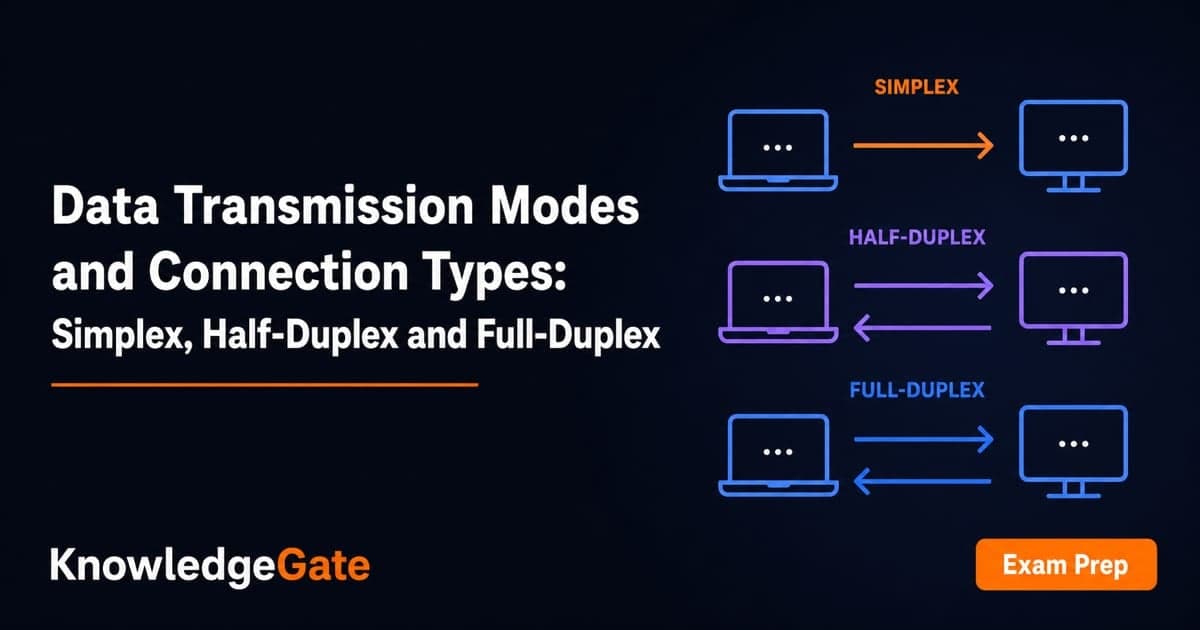
A link may connect exactly two devices yet operate in simplex, half-duplex or full-duplex mode. The confusion begins when connection type and direction of data flow are treated as the same classification. Use the two-question rule and worked network problems to solve both statement-based and timing questions without depending on memorised device examples.
Transmission mode and connection type are two different axes
Transmission mode describes the permitted direction and simultaneity of data flow on the stated communication link. Ask who may send, and whether both directions may operate at the same time.
Line configuration describes how many devices share that link. A point-to-point link is dedicated to exactly two devices. A multipoint link is shared by more than two devices.
Use this two-question test in every problem:
Who may send, and can opposite directions operate simultaneously?
Is the link dedicated to exactly two devices, or shared by more than two?
Answering one question does not answer the other. Words such as sender, receiver, direction and simultaneity belong to the first axis. Words such as dedicated link and shared link belong to the second.
Simplex, half-duplex and full-duplex from first principles
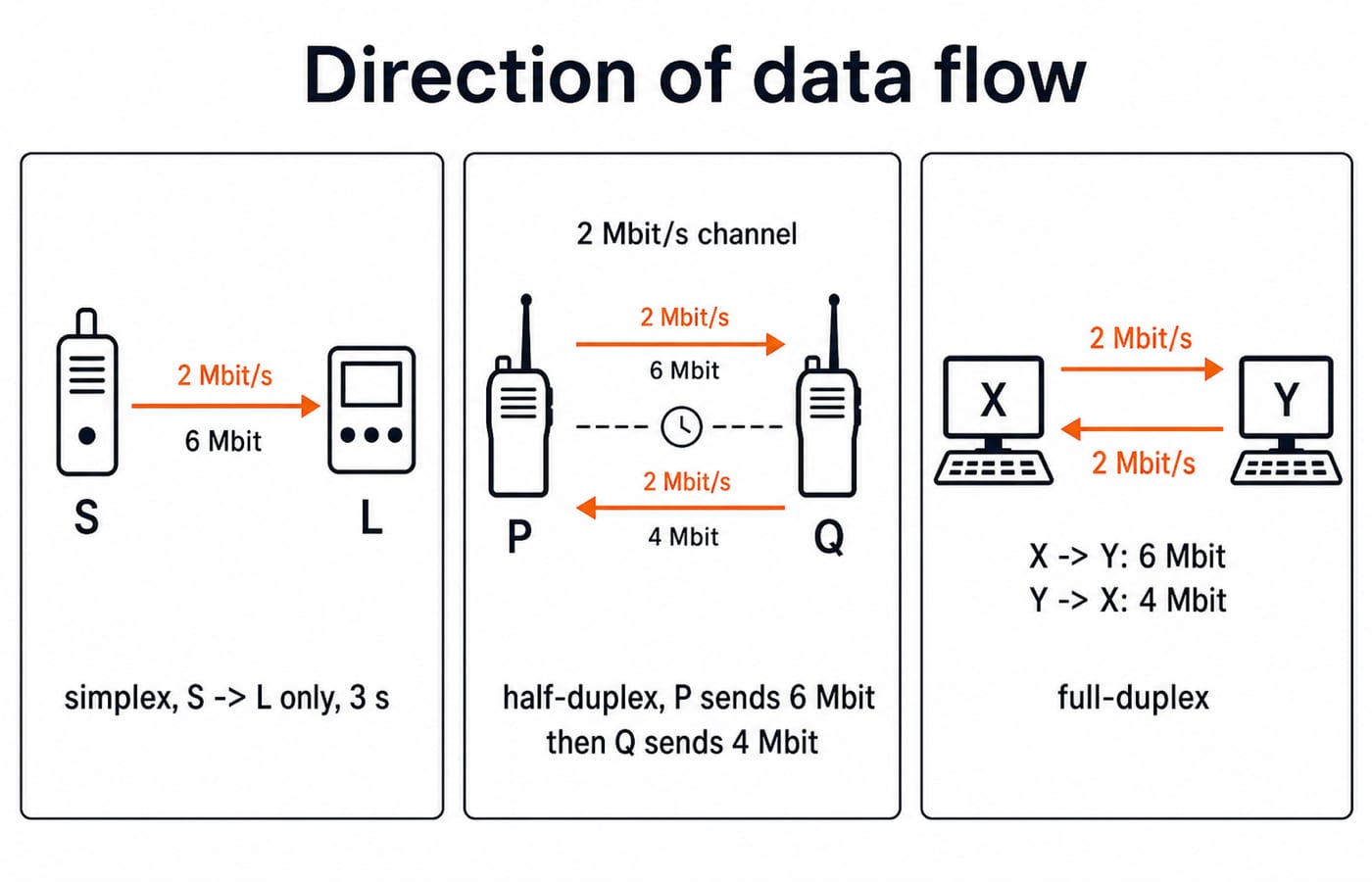
Simplex permits user data to flow in one direction only. Think of A -> B: A sends and B receives on the stated channel. A one-way sensor feed follows this rule.
Half-duplex permits both directions, but only one direction at a time. Think of A <-> B with a one-at-a-time condition. Two radios sharing one channel are half-duplex when one radio must stop transmitting before the other begins. Bidirectional does not automatically mean full-duplex.
Full-duplex permits both directions simultaneously. It requires two concurrent logical flows, such as independent forward and reverse channels. Before calculating throughput, check whether the quoted bit rate applies to each direction or is an aggregate shared between them.
Classify from the operating rule stated in the question. A familiar device can behave differently if the question gives different conditions.
Point-to-point and multipoint connections
A point-to-point link joins exactly two devices. It can be simplex, half-duplex or full-duplex, so device count does not reveal its transmission mode. The link S -> L, for example, is both simplex and point-to-point.
A multipoint link is shared by more than two devices. Access may be controlled by time or another rule. Do not divide the link rate equally unless the problem explicitly gives such an allocation. If one display server sends the same frame once to receivers R1, R2 and R3 on a shared one-way medium, the arrangement is simplex and multipoint.
Worked example: classify four links and compute completion time
Assume no propagation, processing, switching or protocol overhead. Mbit means megabits, and every stated rate is a usable data rate.
Case A: one-way sensor record
Sensor S sends a 6 Mbit record to logger L over a dedicated one-way link rated at 2 Mbit/s.
Mode: simplex
Configuration: point-to-point
Time:
6 Mbit / 2 Mbit/s = 3 s
Only one transfer occurs, so the link completes its task in 3 seconds.
Case B: alternating radio transmissions
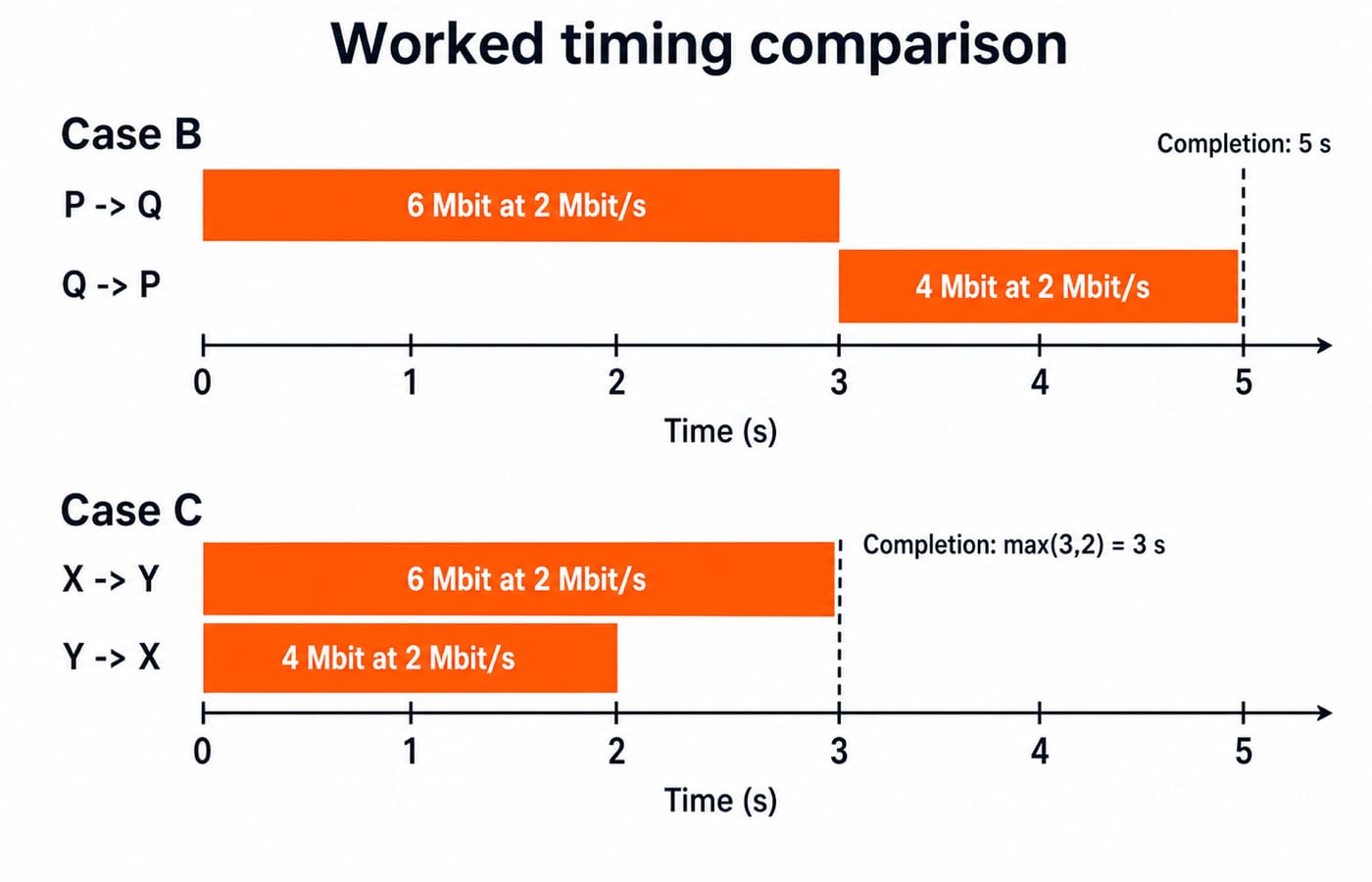
Radios P and Q share one dedicated 2 Mbit/s channel. P sends 6 Mbit first, then Q sends 4 Mbit. Simultaneous transmission is forbidden.
Mode: half-duplex
Configuration: point-to-point
P's time:
6 / 2 = 3 sQ's time:
4 / 2 = 2 sTotal:
3 + 2 = 5 s
The intervals are sequential, so their times must be added.
Case C: simultaneous terminal transfers
X and Y use a full-duplex point-to-point link rated at 2 Mbit/s in each direction. X sends 6 Mbit while Y sends 4 Mbit at the same time.
Forward time:
6 / 2 = 3 sReverse time:
4 / 2 = 2 sCompletion time:
max(3, 2) = 3 s
The transfers overlap. The whole task finishes when the slower direction finishes, so the answer is 3 seconds, not 5 seconds.
Case D: one broadcast to three receivers
Display server D broadcasts the same 12 Mbit frame once to R1, R2 and R3 over one 12 Mbit/s shared one-way medium.
Mode: simplex
Configuration: multipoint
Time:
12 Mbit / 12 Mbit/s = 1 s
All three receivers obtain that same broadcast frame in 1 second. The frame is not sent three separate times, and the rate is not automatically divided by three.
Case | Transmission mode | Connection type | Completion time |
|---|---|---|---|
A | Simplex | Point-to-point | 3 s |
B | Half-duplex | Point-to-point | 5 s |
C | Full-duplex | Point-to-point | 3 s |
D | Simplex | Multipoint | 1 s |
Exam traps that change the answer
Trap 1: calling every two-way link full-duplex. Apply the simultaneity test. Alternating directions mean half-duplex; overlapping directions mean full-duplex.
Trap 2: equating point-to-point with full-duplex. Count devices and classify direction separately. Likewise, a multipoint link is not automatically half-duplex.
Trap 3: mixing megabits and megabytes. One byte contains 8 bits, so 6 MB = 48 Mbit. At 2 Mbit/s, the time is 48 / 2 = 24 s, not 3 s.
Trap 4: assuming every full-duplex rate is per direction. Case C works because the rate is explicitly 2 Mbit/s in each direction. If a question gives an aggregate rate, it must also state how that rate is allocated before a unique time can be calculated.
Trap 5: mixing line configuration with transport service. Point-to-point describes how devices share a physical or logical link. TCP being connection-oriented is a different classification at a different layer. The TCP vs UDP transport-layer explainer handles that distinction directly.
How exam questions test modes and connections
Questions commonly ask you to select the valid definition from similar statements, match a described link to both axes, or calculate elapsed time for sequential and simultaneous transfers. Draw the arrows before touching the arithmetic.
Try this quick check: Which worked cases finish in 3 seconds, and why? Cases A and C do. Case A contains one 6 Mbit transfer at 2 Mbit/s. Case C contains two overlapping transfers, and the slower direction takes 3 seconds.
Test the same distinctions in the Computer Networks MCQ collection for broader practice after you understand the classification rule.
Short version and the next practice step
Simplex is one-way.
Half-duplex is two-way but alternating.
Full-duplex is two-way and simultaneous.
Point-to-point versus multipoint counts the devices sharing the link.
For a 30-second self-check, draw arrows, mark whether opposite arrows overlap, count the devices sharing the link, then calculate data / rate. Add sequential intervals and take the maximum of simultaneous intervals.
The GATE category is the broader preparation route. Use GATE Guidance by Sanchit Sir for structured concept study, then apply the rules under time pressure with the GATE Test Series.
Keep learning
Computer Networks Interview Questions: Trace OSI, TCP/IP and Routing Step by Step
Follow one synthetic web request across DNS, ARP, TCP, NAT and longest-prefix routing, then turn each step into a strong interview answer.
Updated 18 Oct 20266 min readComputer Networks

Basics of Cyber Security: CIA Triad, Risks and a Worked Defence
Learn a consistent security vocabulary, connect common attack paths to suitable controls, and calculate how two defensive layers reduce account takeovers.
Updated 14 Oct 20266 min readComputer Networks

Cyber Threats and Attacks Explained: Types, Worked DDoS Example and Exam Traps
Learn to separate threats, vulnerabilities, vectors and attacks, then apply the distinctions to a calculated DDoS scenario and exam-style questions.
Updated 10 Oct 20266 min readComputer Networks
Computer Networks Hardware Basics: Devices, Domains and Worked Examples
Learn what hubs, switches, routers, gateways and access points actually do, then count network domains and trace frames through a two-LAN topology.
Updated 6 Oct 20266 min readComputer Networks