CSMA/CA (Wireless) MCQs: 10 Solved Questions with Explanations
Solve ten CSMA/CA questions covering wireless LAN standards, contention, RTS/CTS, NAV, interframe spaces and service sets, with a careful note on one misnamed calculation.
KnowledgeGate Team
Exam prep & CS education
Updated 8 Aug 20268 min read79 views
CSMA/CA questions mix simple recall, such as IEEE 802.11 and BSS/ESS, with mechanisms you must trace, such as RTS/CTS, NAV, interframe spaces and a frozen backoff counter. Attempt each question below before opening its answer, then compare your reasoning with the explanation rather than memorising an option. The three mistakes that cost the most marks are treating RTS/CTS as collision detection, resetting a backoff counter that should only freeze, and applying a round-trip frame-size formula that belongs to wired Ethernet.
1. CSMA/CA facts to fix before attempting the set
Start with the distinctions that decide most answers.
Learning anchor | What to remember |
|---|---|
IEEE 802.11 | The wireless LAN family |
CSMA/CA | Tries to reduce collisions before data transmission |
Backoff | Listen, wait the required interframe space, choose a random backoff, count down only through idle slots, and freeze when the medium becomes busy |
RTS/CTS | An optional collision-avoidance exchange, not collision detection |
ACK | A unicast data frame is followed by an acknowledgement |
NAV | Virtual carrier sensing based on duration information |
The previous-year items here come from ISRO, GATE, UGC NET, RPSC and CDAC CCAT, so the phrasing you meet is the phrasing examiners actually use. For the wider preparation path, see the GATE CS exam category and the Computer Networks sequence in GATE Guidance by Sanchit Sir.
Most stems ask you to identify one of four things: a standard name, a control-frame purpose, a timing order, or a number. The words detect and avoid settle several options on their own, so read them slowly. Q8 is the exception: its arithmetic is sound, but the protocol its stem names is not the protocol the formula belongs to.
2. Identify the wireless standard and access method (Q1-Q2)
Q1. IEEE 802.11 standard (ISRO 2007; BEL 2007)
IEEE 802.11 is standard for
(a) Ethernet
(b) Bluetooth
(c) Broadband Wireless
(d) Wireless LANs
Answer: (d) Wireless LANs.
802.11 identifies the wireless LAN family. For elimination, remember 802.3 for Ethernet, 802.15 for Bluetooth and personal area networks, and 802.16 for broadband wireless, without forcing every modern name into one amendment.
Q2. IEEE 802.11 media access (ISRO 2017 (May))
Which media access control protocol is used by IEEE 802.11 wireless LAN?
(a) CDMA
(b) CSMA/CA
(c) ALOHA
(d) None of the above
Answer: (b) CSMA/CA.
Wi-Fi cannot listen reliably for a collision while transmitting, so its shared-medium logic uses avoidance. CDMA is channelisation, while ALOHA is an earlier random-access protocol.
3. RTS/CTS, hidden terminals and acknowledgements (Q3-Q4)
Q3. True statements about 802.11 MAC (GATE 2016, Set 2)
For the IEEE 802.11 MAC protocol for wireless communication, which of the following statements is/are TRUE? I. At least three non-overlapping channels are available for transmissions. II. The RTS-CTS mechanism is used for collision detection. III. Unicast frames are ACKed.
(a) All I, II, and III
(b) I and III only
(c) II and III only
(d) II only
Answer: (b) I and III only.
Statement I refers to the common 2.4 GHz channel plan, typically channels 1, 6 and 11, which do not overlap; other bands and regulatory domains differ. Statement II is false because RTS/CTS avoids collisions and rescues hidden nodes rather than detecting collisions. Statement III is true because unicast data expects an ACK.
Q4. Hidden terminals and RTS/CTS overhead
Practise this one in the Computer Networks module of GATE Guidance by Sanchit Sir.
Which of the following is true? S1: Hidden terminals can be handled using RTS/CTS. S2: RTS/CTS exchanges help to reduce collisions, but they use more channel resources and so do not use the channel efficiently.
(a) S1 only
(b) S2 only
(c) both S1 and S2
(d) none of the above
Answer: (c) both S1 and S2.
RTS and CTS can make a hidden station defer, so S1 is true. Their control frames and waiting intervals consume airtime, so S2 is also true; they help when an avoided collision costs more than the overhead.
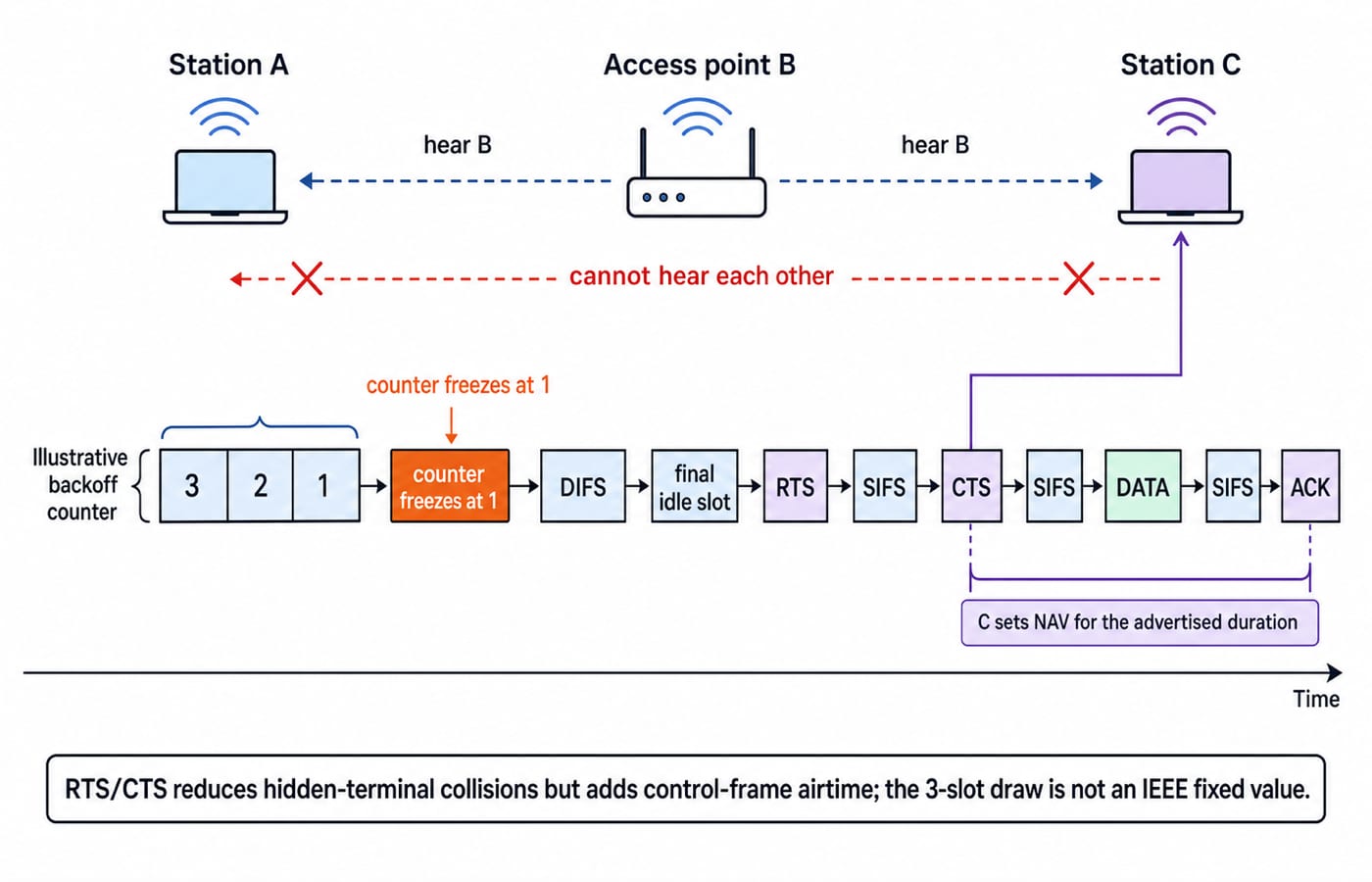
Teaching example: A and C cannot hear each other, but both hear access point B. A waits DIFS, draws a 3-slot backoff and counts two idle slots before a busy medium freezes it at 1. After the medium is idle and DIFS passes, A counts the last slot and exchanges RTS -> SIFS -> CTS -> SIFS -> DATA -> SIFS -> ACK with B. C hears CTS and defers for its duration.
4. Contention windows, NAV and interframe priority (Q5-Q7)
Q5. Contention window (select all that apply)
Drill contention-window behaviour in the same Computer Networks module.
Which of the following is true regarding contention window?
(a) The number of slots in window does not change according to binary exponential back-off strategy.
(b) Station needs to sense the channel after each time slot.
(c) It stops the timer if the channel is found busy and restarts when the channel is sensed as idle.
(d) All of the above.
Answer: (b) and (c).
Binary exponential backoff changes the window size, so (a) and (d) are false. The station checks each slot, decrements on idle and freezes on busy. In (c), "restarts" means resuming the remaining counter, not resetting it.
Q6. Network Allocation Vector (RPSC 2024, Programmer - Paper 1)
Network Allocation Vector (NAV) is associated with which of the following MAC technologies?
(a) CSMA/CD
(b) Bluetooth
(c) Wi-Fi
(d) Ethernet
Answer: (c) Wi-Fi.
NAV is the 802.11 virtual-carrier-sense timer. The duration field of an RTS, CTS or data frame tells every other station how long to treat the medium as busy, which is how a station that cannot physically hear the sender still defers.
Q7. Interframe intervals (UGC NET 2025, Paper 2 (December))
Arrange the following interframe time intervals in increasing order. A. PIFS (PCF Interframe Spacing) B. DIFS (DCF Interframe Spacing) C. SIFS (Short Interframe Spacing) D. EIFS (Extended Interframe Spacing)
(1) A, B, C, D
(2) B, C, A, D
(3) D, A, B, C
(4) C, A, B, D
Answer: (4) C, A, B, D.
The order is SIFS < PIFS < DIFS < EIFS, so C comes first, then A, then B, then D. SIFS is shortest because ACK and CTS must get on the medium before anyone else contends. PIFS lets point-coordinated traffic in ahead of ordinary DCF contention. DIFS is the wait before normal contention, and EIFS is the longest because it follows a frame that arrived in error.
5. Work the propagation calculation, then catch the naming problem (Q8)
Q8. Minimum frame size (NAT)
Work more frame-sizing numericals in the same Computer Networks module.
Consider building a CSMA/CA network running at 1 Gbps over a 1-km cable with no repeaters. The signal speed in the cable is 200,000 km/sec. What is the minimum frame size in bytes?
Accepted answer: 1250 bytes.
Work from propagation time, keeping every unit visible:
One-way propagation delay =
1 km / 200,000 km/s = 0.000005 s = 5 microseconds.Round-trip delay =
2 x 5 microseconds = 10 microseconds.Bits sent in one round trip =
1,000,000,000 bit/s x 10 x 10^-6 s = 10,000 bits.Frame size =
10,000 bits / 8 = 1,250 bytes.
Read the protocol label carefully. This round-trip rule is the classic CSMA/CD minimum-frame-size calculation: a sender must still be transmitting when the earliest possible collision reaches it, so the frame has to last two propagation delays. CSMA/CA never listens for a collision mid-transmission, so 1,250 bytes is not a CSMA/CA requirement at all. Answer the item as set, and remember which protocol the formula really describes.
6. Service sets and the CSMA/CD versus CSMA/CA transfer check (Q9-Q10)
Q9. BSS and ESS (CDAC CCAT 2017)
Revise service sets in the same Computer Networks module.
_______ and _______ are the 2 services defined by the IEEE 802.11 standard for wireless LANs.
(a) ESS, SSS
(b) BSS, ESS
(c) BSS, ASS
(d) BSS, DCF
Answer: (b) BSS, ESS.
A Basic Service Set is one 802.11 cell. An Extended Service Set joins BSSs through a distribution system for wider coverage. "Service-set structures" is more precise than "services"; DCF is a coordination function, while SSS and ASS are distractors.
Q10. CSMA/CD and CSMA/CA (short answer)
Write this one out longhand first, then check it against the Computer Networks module.
What are CSMA/CD and CSMA/CA, and what are the key differences between them?
Model answer:
Both mechanisms begin by sensing a shared carrier.
CSMA/CD transmits and monitors the medium. If it detects a collision, it stops, sends a jam signal and backs off before retrying, an approach historically suited to shared wired Ethernet.
CSMA/CA first waits an interframe space and a random backoff. It may reserve airtime through RTS/CTS and expects ACKs, which suits wireless LANs where a station cannot reliably detect a collision while transmitting.
Both manage contention probabilistically. Neither guarantees that a collision can never occur, but each responds to the limits of its medium.
7. Common traps, how the topic is examined and the next practice step
Keep these correction pairs ready:
RTS/CTS = avoidance, not detectionbusy during backoff = freeze and resume, not resetNAV = virtual carrier sensing in Wi-FiSIFS < PIFS < DIFS < EIFSBSS/ESS = service-set structuresround-trip minimum frame = a CSMA/CD calculation, whatever Q8's stem calls it
Re-attempt Q3, Q5, Q7 and Q8 without the answers. The same handful of skills recurs across these papers: standard identification in ISRO and BEL 2007 and ISRO 2017, statement evaluation in GATE 2016, NAV recall in RPSC 2024, interframe ordering in UGC NET 2025, and service-set vocabulary in CDAC CCAT 2017.
Continue with GATE Guidance by Sanchit Sir for the concept sequence, then use the GATE Test Series for timed topic-wise practice. Choose Subnetting MCQs: 12 Solved IP Addressing Questions for calculations or TCP and UDP MCQs: 12 Solved Transport Layer Questions for another protocol comparison.
The short version: separate avoidance from detection, trace backoff slot by slot, and check whether a numerical belongs to the named protocol.
Keep learning
Computer Networks Basics & Criteria MCQs: 12 Solved Questions with Explanations
Solve 12 Computer Networks questions, then use clear explanations and worked criteria checks to separate similar terms confidently.
3 Oct 20268 min readComputer Networks MCQs
TCP Timers, RTT Estimation & SWS: 10 Solved MCQs and NATs
Solve 10 TCP exam questions covering timer roles, Silly Window Syndrome, recursive RTT estimates, Jacobson/Karels RTO and Karn's rule.
Updated 28 Sep 20267 min readComputer Networks MCQs
RSA Algorithm MCQs: 12 Solved Questions with Step-by-Step Explanations
Practise RSA key generation, modular inverses, encryption, signatures and defining equations, with concise working for conceptual and numerical answers.
25 Sep 20268 min readComputer Networks MCQs
Firewall, VPN, IDS and IPS MCQs: 11 Network Security Questions Solved
Solve 11 previous-year questions on firewalls, VPNs, IDS and IPS. Learn rule filtering, connection state, DMZ design, IPsec modes, tunnels and signatures.
Updated 24 Sep 20267 min readComputer Networks MCQs