Symmetric, Antisymmetric and Asymmetric Relation MCQs: 11 Solved Questions
Solve 11 relation MCQs with clear tests for symmetry, antisymmetry and asymmetry. Each answer identifies the exact pair, loop or implication that decides it.
KnowledgeGate Team
Exam prep & CS education
26 Jul 20268 min read75 views
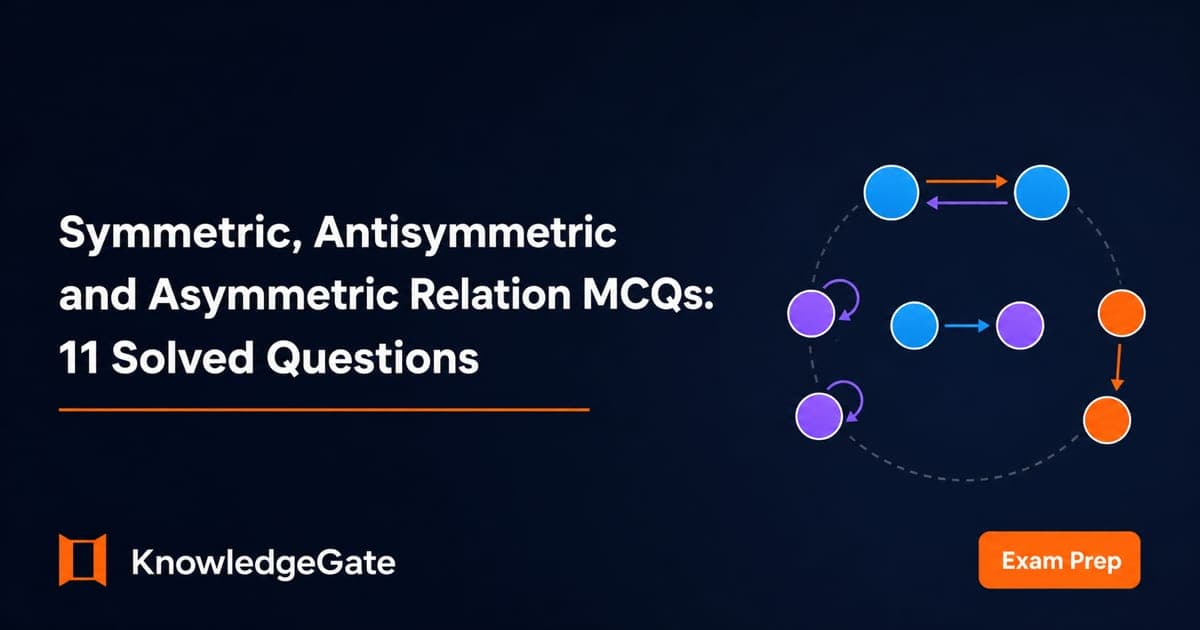
Symmetric, antisymmetric, and asymmetric are three separate implications, not three points on one scale. A diagonal pair such as (a, a) is allowed by antisymmetry but forbidden by asymmetry, and that distinction flips several answers below.
Five of the eleven questions below come from previous years: GATE 1996, GATE 2009, GATE 2015, UGC NET 2012 and UGC NET 2020. The other six are the definition checks those papers assume you have already done. Work each relation out from its ordered pairs before you look at the options, then compare your reasoning with the explanation underneath. If the definitions need a reset first, read Set Theory and Relations for GATE. To attempt the whole set untimed instead, open the relations practice hub.
Related reading: sets and Cartesian products and quantifier and predicate checks.
Symmetric, antisymmetric, and asymmetric relations: use three separate tests
Property | Test | What happens to diagonal pairs? |
|---|---|---|
Symmetric | If (a, b) ∈ R, then (b, a) ∈ R. | Allowed |
Antisymmetric | If (a, b) ∈ R and (b, a) ∈ R, then a = b. | Allowed |
Asymmetric | If (a, b) ∈ R, then (b, a) ∉ R. | Forbidden |
Test the definitions on A = {1, 2}. For R₁ = {(1, 2), (2, 1)}, both directions exist. It is symmetric, but the mutual pair between distinct elements violates antisymmetry and asymmetry.
For R₂ = {(1, 1), (1, 2)}, no distinct reverse pair occurs, so it is antisymmetric. The loop blocks asymmetry, while the missing (2, 1) blocks symmetry. For R₃ = {(1, 2)}, the reverse and every loop are absent. It is asymmetric and antisymmetric, but not symmetric.
The empty relation satisfies all three definitions vacuously because there is no included pair that can make any implication fail. For mixed practice, use these Set Theory and Relations MCQs.
Relation MCQs 1-3: definitions and a direct asymmetric example
Question 1
What is an antisymmetric relation?
A relation where if a is related to b, then b is not related to a
A relation where if a is related to b and b is related to a, then a must equal b
A relation where every element is related to itself
A relation where every element is related to every other element
Answer: Option 2. The precise test is that (a, b) ∈ R and (b, a) ∈ R together force a = b. Option 1 is too strong because an antisymmetric relation may contain (a, a). For example, R = {(1, 1), (1, 2)} is antisymmetric even though it has a loop.
Question 2
What is a symmetric relation?
A relation where if a is related to b, then b is related to a
A relation where if a is related to b, then b is not related to a
A relation where every element is related to itself
A relation where every element is related to every other element
Answer: Option 1. Symmetry checks the reverse of every included pair. In R = {(1, 2), (2, 1)}, both directions occur, so R is symmetric even without (1, 1) or (2, 2). It need not be reflexive or contain every possible pair.
Question 3
Which of the following relations is asymmetric?
R = {(1, 2), (2, 1), (3, 3)}
R = {(1, 2), (3, 4)}
R = {(1, 1), (2, 2), (3, 3)}
R = {(1, 2), (2, 1), (3, 2)}
Answer: Option 2. Its two reverse pairs, (2, 1) and (4, 3), are absent, and it has no loop. Option 1 fails through both a mutual pair and (3, 3), Option 3 fails through its loops, and Option 4 fails through (1, 2) with (2, 1).
Relation MCQs 4-6: count symmetric relations and combine properties
Question 4 (UGC NET 2012)
How many relations are there on a set with n elements that are symmetric and a set with n elements that are reflexive and symmetric?
2^[n(n+1)/2] and 2^n · 3^[n(n-1)/2]
3^[n(n-1)/2] and 2^[n(n-1)]
2^[n(n+1)/2] and 3^[n(n-1)/2]
2^[n(n+1)/2] and 2^[n(n-1)/2]
Answer: Option 4. A symmetric relation has n independent diagonal choices and n(n−1)/2 independent unordered off-diagonal choices, giving 2^[n+n(n−1)/2] = 2^[n(n+1)/2]. Reflexivity fixes every diagonal pair as present, leaving 2^[n(n−1)/2] choices. For n = 3, the counts are 2^6 = 64 and 2^3 = 8.
Open the full solution for this counting question.
Question 5
If a relation R is both symmetric and anti-symmetric, what can be said about R?
R must contain no elements
R must contain all possible elements
R must contain only elements of the form (a, a)
R must contain only elements of the form (a, b) where a ≠ b
Answer: Option 3. If an off-diagonal (a, b) occurs, symmetry forces (b, a), while antisymmetry then forces a = b, a contradiction. Thus R is a subset of the diagonal, not necessarily the whole diagonal or the empty set. On {1, 2, 3}, R = {(1, 1), (3, 3)} satisfies both properties.
Question 6
The number of a relation(s) which is/are symmetric and asymmetric on a set of cardinality n is,
0
1
2^[(n²-n)/2]
Data insufficient
Answer: Option 2. Symmetry would require the reverse of every off-diagonal pair, while asymmetry would forbid that reverse. Asymmetry also forbids every loop. The only possible relation is therefore ∅, and it satisfies both implications vacuously, so the count is exactly one for every n.
Relation MCQs 7-8: inverse unions and pair-by-pair auditing
Question 7
Let R₁ be an antisymmetric relation and R₂ is inverse of R₁. Find the R₁ U R₂ ?
Symmetric Relation
Antisymmetric relation
Asymmetric Relation
None of the above
Answer: Option 1. If (a, b) lies in R₁, then (b, a) lies in R₂ = R₁⁻¹, and the argument also works from R₂ back to R₁. For R₁ = {(1, 1), (1, 2)} and R₂ = {(1, 1), (2, 1)}, the union contains every required reverse. In fact, R ∪ R⁻¹ is symmetric for any relation R.
Question 8 (GATE 2009)
Consider the binary relation R = {(x, y), (x, z), (z, x), (z, y)} on the set {x, y, z}. Which one of the following is TRUE?
R is symmetric but NOT antisymmetric
R is NOT symmetric but antisymmetric
R is both symmetric and antisymmetric
R is neither symmetric nor antisymmetric
Answer: Option 4. Symmetry fails because (x, y) ∈ R but (y, x) ∉ R. Antisymmetry fails for a separate witness: both (x, z) and (z, x) occur while x ≠ z. A relation can fail both tests for different reasons.
Open the full solution and attempt the follow-ups.
Relation MCQs 9-10: test a listed relation and an equation-defined relation
Question 9 (UGC NET 2020)
Consider the following properties:
A. Reflexive
B. Antisymmetric
C. Symmetric
Let 𝐴 = {𝑎,𝑏,𝑐,𝑑,𝑒,𝑓,𝑔} and 𝑅={(𝑎,𝑎),(𝑏,𝑏),(𝑐,𝑑),(𝑐,𝑔),(𝑑,𝑔),(𝑒,𝑒),(𝑓,𝑓),(𝑔,𝑔)} be a relation on 𝐴. Which of the following property (properties) is (are) satisfied by the relation 𝑅?
Only A
Only C
Both A and B
B and not A
Answer: Option 4. Reflexivity fails because (c, c) and (d, d) are missing. Symmetry fails because (c, d) occurs but (d, c) does not. Antisymmetry holds because no distinct elements occur in both directions, and the existing diagonal pairs are legal.
Open the full solution for this property-matching question.
Question 10 (GATE 2015)
Let R be a relation on the set of ordered pairs of positive integers such that ((p, q), (r, s)) ∈ R if and only if p − s = q − r. Which one of the following is true about R?
Both reflexive and symmetric
Reflexive but not symmetric
Not reflexive but symmetric
Neither reflexive nor symmetric
Answer: Option 3. Reflexivity would require p − q = q − p, hence p = q. The element (1, 2) is therefore not related to itself. For symmetry, p − s = q − r and the reversed test r − q = s − p both rearrange to p + r = q + s. With ((1, 2), (3, 2)), the original test gives −1 = −1 and the reverse gives 1 = 1.
Open the full solution for this equation-defined relation.
Relation MCQ 11: disjointness is symmetric but not transitive
Question 11 (GATE 1996)
Let R be a relation on a non-empty collection of sets. It is defined as A R B if and only if A intersection B is the empty set. Which statement is true?
R is reflexive and transitive
R is symmetric and not transitive
R is an equivalence relation
R is not reflexive and not symmetric
Answer: Option 2. Symmetry follows from A ∩ B = B ∩ A. For transitivity, take the collection {{1}, {2}} and choose A = C = {1}, B = {2}. Then A ∩ B = ∅ and B ∩ C = ∅, but A ∩ C = {1}, so transitivity fails. Also, A R A fails for any non-empty A because A ∩ A = A.
Open the full solution for this disjointness question.
Symmetric and asymmetric relation traps: the one-minute revision
Antisymmetric does not mean "not symmetric."
A diagonal pair is legal in an antisymmetric relation but illegal in an asymmetric one.
To disprove symmetry, one pair without its reverse is enough.
To disprove antisymmetry, find both directions between two distinct elements.
R ∪ R⁻¹ is symmetric, while R ∩ R⁻¹ contains exactly the pairs already present in both directions.
Empty relations make universal implications true vacuously.
Now classify these relations on {1, 2} without looking back: R₁ = {(1, 2)}, R₂ = {(1, 2), (2, 1)}, R₃ = {(1, 1), (2, 2)}, and R₄ = ∅. The answers are: R₁ is asymmetric and antisymmetric only; R₂ is symmetric only; R₃ is symmetric and antisymmetric but not asymmetric; R₄ is symmetric, antisymmetric, and asymmetric.
For practice across the rest of the syllabus, continue to Discrete Mathematics MCQs. If you would rather have the concepts and previous-year drills sequenced for you, GATE Guidance by Sanchit Sir teaches this unit in order.
Redo Questions 4, 8, 9, and 10 closed-book. Together they test counting, separate witnesses for symmetry and antisymmetry, a complete ordered-pair audit, and an equation-defined relation.
Keep learning

Graph Traversal MCQs: 12 Solved Questions on Walks, Paths, Trails, Circuits and Connectivity
Attempt 12 graph traversal and connectivity questions, then check each answer through definitions, reachability, degree conditions and edge-count arguments.
Updated 3 Oct 20267 min readDiscrete Mathematics MCQs
Planar Graphs MCQs: 12 Solved Questions on Kuratowski’s Theorem, Homeomorphism and Edge Bounds
Solve 12 planar graph questions, then check each answer through a forbidden-subdivision argument, a crossing-free redraw, or a short calculation.
Updated 28 Sep 20268 min readDiscrete Mathematics MCQs
Power Set and Cardinality MCQs: 12 Solved Questions with Explanations
Solve 12 power set questions, from direct enumeration and nested sets to inclusion chains, ordered pairs and recurrence-based counting.
25 Sep 20267 min readDiscrete Mathematics MCQs
Null Set, Universal Set, Subset and Proper Subset MCQs: 12 Solved Questions
Practise 12 MCQs on null sets, universal sets, subsets, proper subsets, complements and nested inclusion, with clear reasoning for every answer.
Updated 24 Sep 20267 min readDiscrete Mathematics MCQs