Python vs C for TCS NQT: Which Language to Pick for the Coding Section
Choose Python or C for TCS NQT by comparing input speed, code length, execution and your existing practice, then lock the choice with a focused three-week routine.
KnowledgeGate Team
Exam prep & CS education
Updated 24 Jul 20265 min read
Before the TCS NQT coding section, candidates keep asking the same question: should I code in C or Python? The honest answer depends on your background and the problem. A fashionable choice is useless if it makes you slower at reading input, handling strings or finding bugs.
Language choice is about how quickly you can produce correct code under test conditions. Check which languages your test interface offers, decide on the evidence of your own solved problems, then stop switching and practise one choice deeply.
TCS NQT coding: the real question is speed to a correct answer
Execution speed matters, but it is only one part of the clock. You also spend time parsing input, translating the idea into syntax, compiling or running, reading errors and checking edge cases. A shorter program that you understand can beat a faster language in which you make two boundary mistakes.
Ask a practical question: in which language can you take an unfamiliar array or string problem from statement to accepted output with fewer corrections? Your solved-problem history is better evidence than a friend's preference. The shapes that recur in placement coding rounds are small anyway: read a value or an array, transform it, print one result. In that space, parsing and typing speed decide the outcome far more often than raw execution speed does.
The TCS NQT preparation guide can help you place coding practice beside the other sections. Language choice should support that plan, not consume it.
Python and C side by side on input handling
Use the same task in both languages: read N, then read N integers and print their sum.
Input:
3
10 20 30
Expected output:
60In C:
#include <stdio.h>

int main(void) {
    int n, x, sum = 0;
    scanf("%d", &n);
    for (int i = 0; i < n; i++) { scanf("%d", &x); sum += x; }
    printf("%d\n", sum);
    return 0;
}
In Python:
n = int(input())
print(sum(int(x) for x in input().split()))
Both produce 60 because 10 + 20 + 30 = 60. Python expresses the task in two lines and delegates summation to a built-in. C needs a header, a main function, an explicit loop and an accumulator, which is more typing but also makes every input step visible.
The important catch is the input harness. The Python version assumes the N integers arrive on one line separated by spaces. If values arrive across multiple lines, you need a token-reading approach that matches that format. The C loop reads whitespace-separated integers regardless of spaces or line breaks. Always test against the statement's sample and remove assumptions that the sample does not guarantee.
Where Python wins and where C wins
Python is strong when:
You already solve problems fluently in it.
The task is logic-heavy or uses strings, tokenisation, dictionaries or sets.
Shorter code reduces your typing and off-by-one risk.
Values may grow large, because Python integers expand beyond fixed machine-word sizes.
Its trade-off is execution overhead. Extremely heavy pure-Python loops can time out under a tight limit, so choose an efficient algorithm first and avoid unnecessary work inside loops.
C is strong when:
Your DSA practice and debugging habits are already in C or C++.
The problem performs substantial low-level iteration.
You are comfortable with arrays, indices, character buffers and fixed-width numeric types.
The cost is more manual work. Input loops, string handling, bounds and numeric overflow create more places for a test-day bug. C++ with the Standard Template Library is often the real competitor to Python because it combines compiled execution with ready-made strings, vectors, sorting and hash containers.
Do not confuse language speed with algorithmic complexity. An O(n^2) solution in C can still lose to an O(n log n) or average O(n) solution in Python as input grows.
Python or C: a concrete decision rule
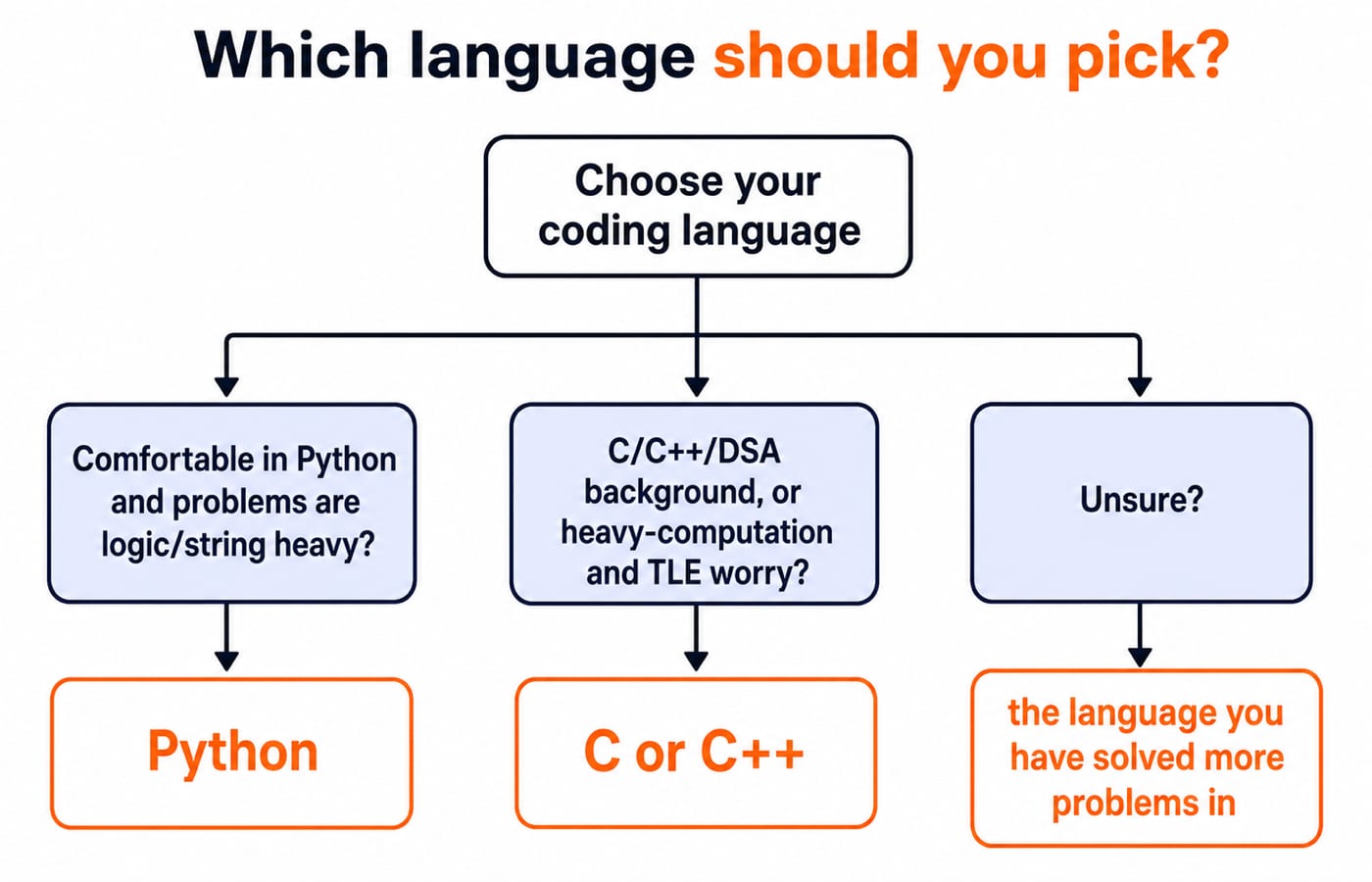
Choose Python if you are comfortable with it and the practice set is dominated by logic, strings or straightforward collection work. Choose C or C++ if that is where your DSA muscle memory lives, or if the expected workload makes runtime overhead a genuine concern.
If you are unsure, count the problems you have solved cleanly in each language during the last few weeks. Pick the language with more completed, timed solutions. Do not switch midway through the test merely because one question looks unfamiliar. The unfamiliar part is usually the problem, not the syntax.
A three-week TCS NQT coding practice model
Adjust the daily split around college or work, but keep the timed solving intact. The clock is the part of this routine that transfers to the test.
Week 1: Solve 30 easy problems in your chosen language. Cover one value, arrays, matrices and strings, with several input layouts. At roughly four or five problems a day, the set fits a week with one lighter catch-up day. Spend about 1 to 1.5 hours daily and save every input mistake in a small error log.
Week 2: Solve 20 medium problems on loops, strings, basic maths and patterns. Give each first attempt 20 minutes. That is 400 timed minutes in total, or 6 hours 40 minutes, before review. The goal is not to force every solution inside 20 minutes. It is to notice where understanding, implementation or debugging consumes the time.
Week 3: Attempt full NQT-style mock sections, then classify every failure. Was the cause input parsing, wrong complexity, a missed edge case or output formatting? Re-solve failures without looking at the old code. Use TCS NQT Coding Questions to keep the practice close to recurring problem shapes.
If you miss days, protect the timed-mock slot and reduce new theory first. A smaller completed loop of attempt, review and re-attempt is more useful than an impressive problem count with no correction.
Common test-day mistakes
Wrong input parsing: translate every input line into variables before writing the algorithm.
Extra output: remove prompts, debug prints and decorative text; print only the requested result.
Missed edge cases: test
N = 0andN = 1when the stated constraints allow them.Late time-limit awareness: estimate complexity before coding and watch for nested loops over the full input.
Last-minute language switching: keep a tested template for input and output in your chosen language.
Exact formats and supported languages can change, so follow the instructions shown for your test rather than an old screenshot or forwarded message.
Short version and next step
Choose by background and problem type, then lock the choice. Python gives concise input, strings and collections. C gives compiled speed and direct control, but asks you to manage more details. Neither rescues a poor algorithm or an untested parser.
Follow the TCS Live Preparation course, then rehearse full placement sections with the Mera Placement Hoga Anushasan bundle. The Placement Preparation catalogue gives the wider path. KnowledgeGate's question bank also carries about 2,700 TCS previous-year questions, so you can rehearse on the shapes that actually recur. Pick, practise, review and stay with the language you can trust.
Keep learning
Pandas Basics in Python: Build, Clean and Analyse a DataFrame Step by Step
Follow one student dataset from its first DataFrame to a clean city summary, while learning how selection, missing values and vectorised calculations really work.
Updated 24 Sep 20265 min readPython
Python Operators and Expressions: Precedence, Types and Worked Output Traces
Trace Python expressions without guessing. This guide connects operator families, precedence, types, short-circuiting and exact output through worked examples.
Updated 23 Sep 20266 min readPython
CSV Files Explained: Parsing Rules, Worked Records and Exam Traps
Learn why commas and newlines are not always boundaries, trace a quote-aware parser, validate text fields with a schema, and calculate processing costs.
Updated 22 Sep 20265 min readPython
Polymorphism and Dunder Methods in Python: Runnable Examples and Exercises
See how one Python operation supports different types, then build a Vector2D class with readable output, addition, magnitude and equality. Includes runnable code, protocol failures and exercises.
Updated 21 Sep 20265 min readPython