TCS NQT Foundation vs Advanced: Your 8-Week Prep Split
Stop dividing preparation time equally by habit. This score-led eight-week plan shows when to repair Foundation weaknesses and when to increase Advanced practice.
KnowledgeGate Team
Exam prep & CS education
Updated 25 Aug 20264 min read
Ten study hours a week should not default to five each for Foundation and Advanced: one weak Foundation strand can hide inside a decent average while coding consumes Advanced practice. Use a 120-minute diagnostic and fixed checkpoints to choose the track split that matches your bottleneck. The diagnostic uses planning thresholds, not an official TCS paper format or cutoff.
Give Foundation and Advanced different jobs
Foundation practice covers verbal, numerical, and reasoning. Advanced practice covers higher-difficulty quantitative and reasoning work plus coding. Your current TCS drive notice or call letter determines which components apply; these labels organise preparation time.
Check the TCS preparation hub for the broad course path and the TCS NQT exam structure guide for section orientation. Confirm the components required for your drive against the current TCS communication.
Run a 120-minute diagnostic before choosing a split
Build a custom diagnostic: 30 Foundation questions in 45 minutes, split into 10 verbal, 10 numerical, and 10 reasoning; 10 Advanced aptitude and reasoning questions in 20 minutes; two coding tasks in 50 minutes; and a five-minute error log. Each Foundation answer, Advanced aptitude answer, and passed coding test earns one point. With 10 fixed tests per coding task, both Foundation and Advanced are scored out of 30.
Task A asks for the maximum contiguous subarray sum of [3, -2, 5, -1, 6, -3]. Task B asks for the first non-repeating character in "swiss", expected output w. Each task's 10 hidden tests must cover the smallest input, all-negative or all-repeating input, duplicates, ties, and a larger input.
Tag errors C for an unknown concept, M for failed execution of a known method, and T for a correct method that exceeded the time box. Record Foundation strands separately because 21/30 can conceal a 5/10 strand.
Choose 70:30, 55:45, or 40:60 from the bottleneck
Apply the rules in order:
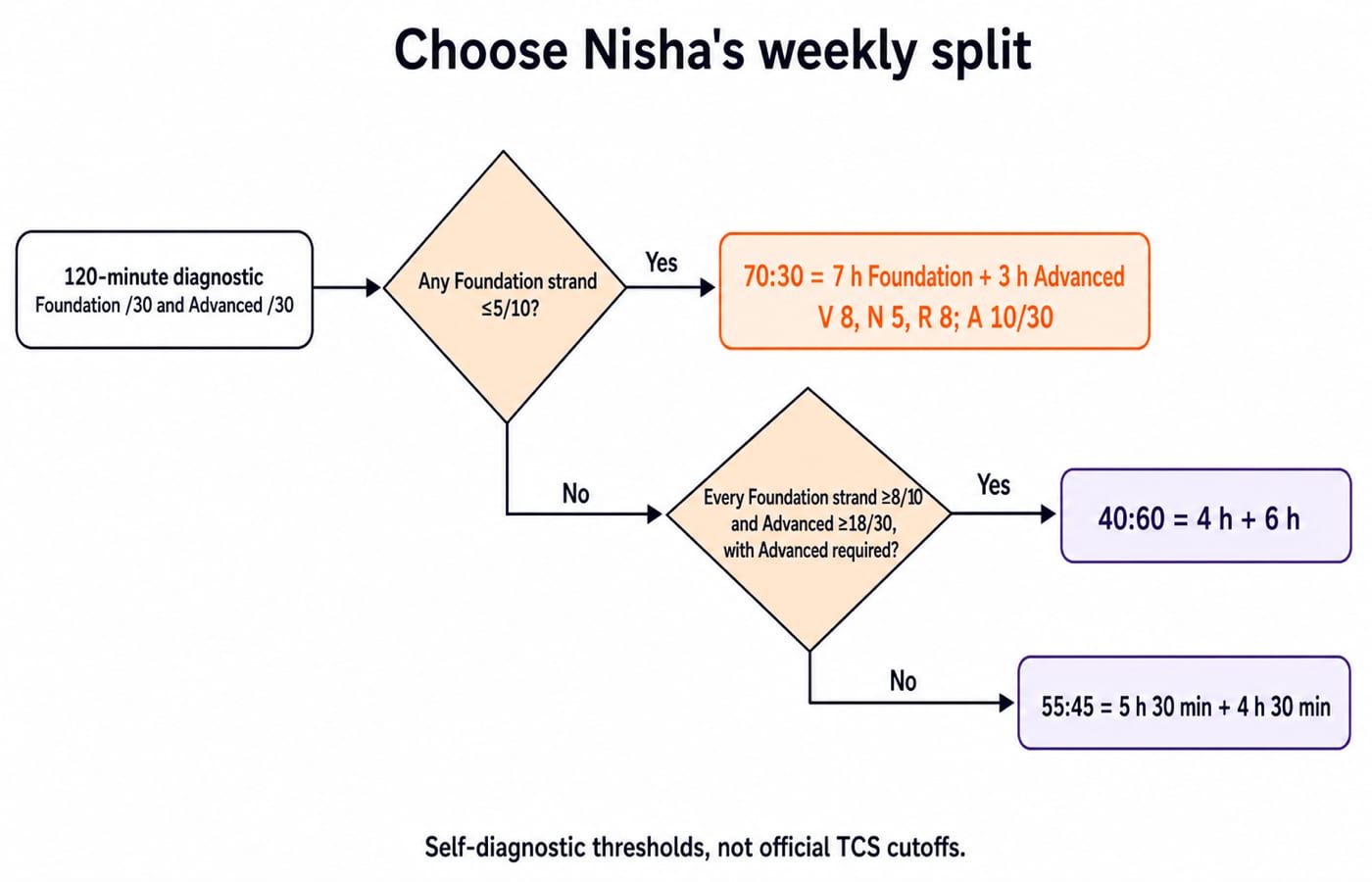
Use Foundation:Advanced = 70:30 if any Foundation strand is 5/10 or lower.
Use 55:45 if every strand is at least 6/10, but one is below 8/10 or Advanced is below 18/30.
Use 40:60 only if every strand is at least 8/10, Advanced is at least 18/30, and your current TCS communication requires Advanced.
Nisha scores verbal 8/10, numerical 5/10, and reasoning 8/10, so Foundation is 8 + 5 + 8 = 21/30 = 70%. Her Advanced result is aptitude 6/10 plus coding passes of 3/10 and 1/10: 6 + 3 + 1 = 10/30 = 33.3%, rounded.
The numerical 5/10 triggers 70:30 despite the average. 10 h x 70% = 7 h for Foundation and 10 h x 30% = 3 h for Advanced. Foundation gets 3 hours numerical, 1.5 reasoning, 1.5 verbal, and 1 hour error review. Advanced gets 2 hours coding and 1 advanced aptitude and reasoning.
Move from the split decision to the eight-week execution plan
Once the diagnostic selects 70:30, 55:45, or 40:60, carry that allocation into TCS NQT Preparation: An 8-Week Aptitude and Coding Plan. This post decides which track needs more time and when the evidence justifies changing that split. The linked plan carries the week-by-week topic order, simulations, buffer, and missed-day recovery.
Use a different practice loop inside each bucket
For a Foundation numerical drill, suppose A completes a job in 12 days and B in 18 days. Their one-day rates add:
1/12 + 1/18 = 3/36 + 2/36 = 5/36.
The time for one complete job is the reciprocal, 36/5 = 7.2 days. Solve it untimed, explain why rates add, retry it in 90 seconds, then tag any error as concept, method, or time.
Advanced coding needs a code-and-test loop. For [3, -2, 5, -1, 6, -3], Kadane's algorithm gives current/best pairs 3/3, 1/3, 6/6, 5/6, 11/11, and 8/11. The maximum sum is therefore 11, produced by [3, -2, 5, -1, 6].
Then test [-4, -2, -7]. The answer must be -2; starting the best sum at zero would hide a bug. After tracing the algorithm, continue with the TCS NQT coding questions guide.
Reallocate every Sunday using scores, not mood
After week 2, Nisha scores verbal 9/10, numerical 7/10, and reasoning 8/10: 9 + 7 + 8 = 24/30 = 80%. Advanced is aptitude 7/10 plus coding 4/10 and 3/10: 7 + 4 + 3 = 14/30 = 46.7%, rounded.
Every strand is at least 6, but numerical is below 8 and Advanced below 18, so week 3 becomes 55:45. After week 5, Foundation is 9 + 8 + 8 = 25/30 and Advanced is 8 + 6 + 5 = 19/30. She moves to 40:60 only if her drive requires Advanced.
Limit each reallocation to 15 percentage points. If any Foundation strand falls below 7/10 on two fresh timed sets, restore at least 55% of weekly time to Foundation.
The short version
Diagnose, choose from the weakest strand, retest every two weeks, and change one step at a time. Use the linked TCS hub to learn, the eight-week plan to execute the chosen split, and the test series for timed practice.
Keep learning

TCS NQT Eligibility: Check Backlogs, Gaps and Degree Rules
Use a closed TCS hiring notice as a worked checklist for degree, backlog, course-duration and academic-gap rules, then verify the current drive.
Updated 2 Sep 20264 min readIT Recruitment Exams

CoCubes Preparation Plan: Six Weeks for Campus Hiring Tests
Build a practical six-week CoCubes study plan around the modules in your own test invitation, your diagnostic results, and 72 hours of focused work.
Updated 1 Sep 20266 min readIT Recruitment Exams

eLitmus Retake Decision: Read Section Percentiles Before Testing Again
Do not retake eLitmus on disappointment alone. Use your section pattern, target-job evidence, and fresh timed practice to decide whether to go, wait, or rebuild.
Updated 30 Aug 20264 min readIT Recruitment Exams

eLitmus Mock Analysis: Diagnose Knowledge Gaps and Attempt Errors
A worked mock-review method to separate concept gaps from calculation, reading and decision errors, recover marks, and plan the next four weeks.
Updated 29 Aug 20265 min readIT Recruitment Exams