CoCubes Preparation Plan: Six Weeks for Campus Hiring Tests
Build a practical six-week CoCubes study plan around the modules in your own test invitation, your diagnostic results, and 72 hours of focused work.
KnowledgeGate Team
Exam prep & CS education
Updated 1 Sep 20266 min read

Preparing aptitude, language, programming, coding, and domain basics together can make today's study hour hard to assign. Start with the module list in your test invitation, then use diagnostic evidence to decide what deserves time across six weeks.
CoCubes preparation starts with the assessment you were actually assigned
The IT Recruitment Exam Preparation category groups CoCubes with standardised recruitment assessments and lists aptitude, reasoning, and English as common areas. Your campus assessment may differ.
Copy the employer or campus invitation's module names into three columns: confirmed, unclear, and not listed. Candidate A's hypothetical invitation names Quantitative Aptitude, Logical Reasoning, English Usage, Computer Fundamentals, and Coding. All five go under confirmed.
If Coding is absent, move its hours to the weakest confirmed lane instead of practising it blindly. For a module-led assessment without coding, use the earlier AMCAT Preparation Plan: Six-Week 72-Hour Module Schedule. A CoCubes invitation that includes programming fundamentals or coding needs a different split: Weeks 3 and 4 reserve 13 hours for programming and coding, while coding disappears entirely when the invitation omits it.
CoCubes diagnostic: convert one practice sitting into priorities
Start with an illustrative baseline, not an official CoCubes mock. Candidate A attempts four objective sections plus two coding tasks:
Practice lane | Correct | Wrong | Unattempted | Attempted accuracy |
|---|---|---|---|---|
Quantitative, 20 questions | 11 | 5 | 4 |
|
Reasoning, 10 questions | 7 | 2 | 1 |
|
Verbal, 10 questions | 6 | 3 | 1 |
|
Programming fundamentals, 10 questions | 4 | 4 | 2 |
|
One coding task passes fully, while the other fails on edge cases. Across the 50 objective questions, Candidate A has 11 + 7 + 6 + 4 = 28 correct and 16 + 9 + 9 + 8 = 42 attempts. Attempted accuracy is 28 / 42 = 66.67%, while attempt rate is 42 / 50 = 84%.
This produces the next 12-hour split: 4 hours for programming fundamentals, 3 for quant, 2 for verbal, 1.5 for reasoning, and 1.5 for error-log review. Unequal time is deliberate: allocate by weakness, not neatness.
CoCubes six-week schedule: 72 honest hours with a recovery slot
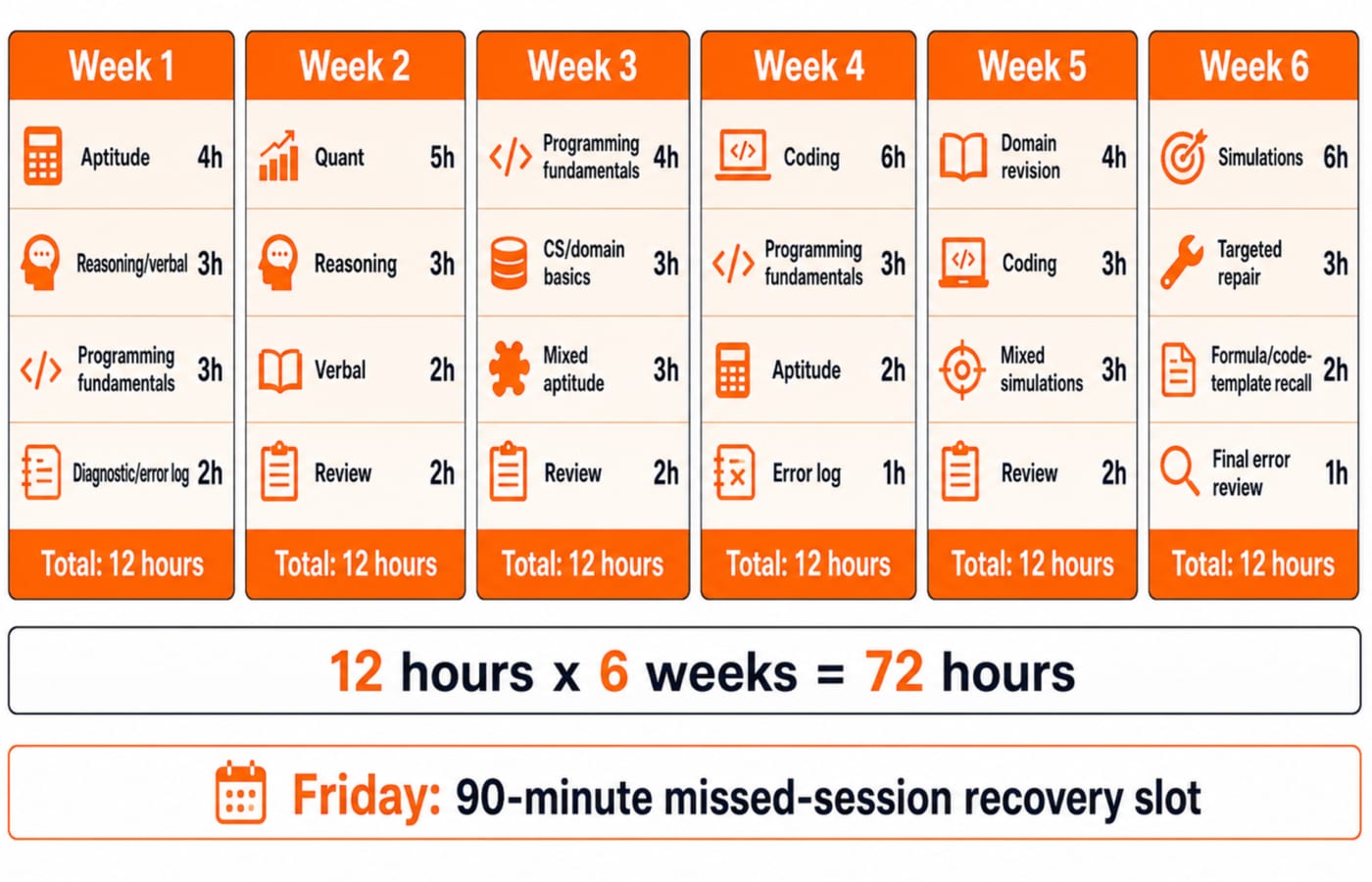
Plan four 90-minute sessions from Monday to Thursday, totalling 6 hours. Keep Friday as a 90-minute recovery slot for a missed weekday session, not as extra planned time. Add 3 hours on Saturday and 3 on Sunday. The load is 6 + 3 + 3 = 12 hours per week and 12 x 6 = 72 hours overall.
Week | 12-hour allocation | Output |
|---|---|---|
1 | Aptitude 4h; reasoning/verbal 3h; programming fundamentals 3h; diagnostic/error log 2h | One baseline sheet and top five errors |
2 | Quant 5h; reasoning 3h; verbal 2h; review 2h | Four timed practice sets plus corrections |
3 | Programming fundamentals 4h; CS/domain basics 3h; mixed aptitude 3h; review 2h | Two concept sheets and 60 corrected questions |
4 | Coding 6h; programming fundamentals 3h; aptitude 2h; error log 1h | Six coding problems with saved test cases |
5 | Domain revision 4h; coding 3h; mixed simulations 3h; review 2h | Two mixed scorecards |
6 | Simulations 6h; targeted repair 3h; formula/code-template recall 2h; final error review 1h | Three reviewed simulations and a one-page final checklist |
The CoCubes Preparation Course organises CoCubes-focused concepts and test practice. KnowledgeGate also offers more than 500 CoCubes questions in its practice bank.
CoCubes weeks 1 and 2: build aptitude accuracy before chasing speed
Divide each 90-minute practice block into 15 minutes of recall, 30 minutes for a self-imposed 20-question set, and 45 minutes checking every wrong or skipped item. The 30-minute limit is a training constraint, not an official section time.
Suppose set 1 has 11 correct, 5 wrong, and 4 skipped. There are 11 + 5 = 16 attempts, so attempted accuracy is 11 / 16 = 68.75%. By set 4, Candidate A has 15 correct, 3 wrong, and 2 skipped. Now there are 15 + 3 = 18 attempts and accuracy is 15 / 18 = 83.33%. The useful gain is two fewer wrong answers and better review, not merely two extra attempts.
Keep an error ledger with four tags: concept gap, calculation slip, misread condition, and time choice. Each row records the topic, tag, corrected method, and revisit date.
CoCubes weeks 3 and 4: connect programming concepts to code
For your chosen language, make one 90-minute concept loop: 25 minutes on arrays and strings or functions, 20 minutes tracing five short snippets, 35 minutes implementing one problem, and 10 minutes writing edge cases. Use a language required by your assessment if one is specified.
Try this 60-minute drill: write a function that returns the second-largest distinct value. Spend 10 minutes clarifying what "distinct" means, 25 implementing, 10 testing, and 15 reviewing.
For
[4, 9, 9, 2, 7], the distinct values in descending order are[9, 7, 4, 2], so the answer is7.For
[5, 5], only one distinct value exists, so there is no second-largest distinct value.For
[-3, -1, -2], descending order is[-1, -2, -3], so the answer is-2.
Save these cases with the solution. Coding Round Strategy: Triage, Time-Box, Bank Marks gives a broader method for analysing, implementing, testing, and reviewing tasks.
CoCubes week 5: revise domain basics through mixed, measurable practice
Use four 60-minute blocks for the confirmed domains in Candidate A's illustrative plan: DBMS, operating systems, computer networks, and object-oriented programming. Each block uses 35 minutes for active recall, 15 for five questions, and 10 for corrections. Replace any unconfirmed label, but keep the method.
Take a non-official 60-minute mixed set: 10 quant, 8 reasoning, 6 verbal, and 6 programming-fundamentals items, 30 in total. Candidate A gets 21 correct, 5 wrong, and 4 skipped. Attempts are 21 + 5 = 26, attempted accuracy is 21 / 26 = 80.77%, and attempt rate is 26 / 30 = 86.67%.
Repair the five errors in 120 minutes. Give two concept gaps 45 minutes each, two misreads one combined 20-minute condition-marking drill, and the calculation slip 10 minutes: 90 + 20 + 10 = 120 minutes.
CoCubes week 6: simulate, repair, and survive missed days
Run three simulations with the module mix, duration, and scoring rules printed in your invitation. Review wrong and skipped items as carefully as correct ones. An unconfirmed cutoff or negative-marking rule cannot support a useful simulation.
Measure readiness, not selection probability. Baseline: 28 correct from 42 attempts, or 28 / 42 = 66.67%. A final 50-question set has 37 correct, 5 wrong, and 8 skipped: 37 + 5 = 42 attempts, 37 / 42 = 88.10% accuracy, and 42 / 50 = 84% attempt rate. That means cleaner decisions at the same attempt volume. Call a topic stable after two consecutive simulations without the same concept-gap error.
Move one missed 90-minute session to Friday. After two misses, recover one on Friday and compress the other into a 45-minute recall-and-correction block. Never double tomorrow's load. If the week collapses, keep 6 hours of coding, 3 on the weakest lane, and 3 of mixed practice. Drop low-priority new material.
CoCubes preparation plan: the short version and next step
Confirm assigned modules, diagnose your gaps, complete 72 honest hours across six weeks, review every error, and simulate the assigned mix. Repeatable accuracy at that module mix is a readiness signal, not a prediction of a hiring cutoff. If aptitude, reasoning, and verbal ability are your only serious gaps, use the Aptitude Course for Placement and reserve coding or domain time for confirmed modules.
Keep learning

TCS NQT Eligibility: Check Backlogs, Gaps and Degree Rules
Use a closed TCS hiring notice as a worked checklist for degree, backlog, course-duration and academic-gap rules, then verify the current drive.
Updated 2 Sep 20264 min readIT Recruitment Exams

eLitmus Retake Decision: Read Section Percentiles Before Testing Again
Do not retake eLitmus on disappointment alone. Use your section pattern, target-job evidence, and fresh timed practice to decide whether to go, wait, or rebuild.
Updated 30 Aug 20264 min readIT Recruitment Exams

eLitmus Mock Analysis: Diagnose Knowledge Gaps and Attempt Errors
A worked mock-review method to separate concept gaps from calculation, reading and decision errors, recover marks, and plan the next four weeks.
Updated 29 Aug 20265 min readIT Recruitment Exams

eLitmus Data Interpretation: Choose the Right Set and Control Accuracy
Learn a repeatable DI routine: score each set before solving, compress the data into one scratch table, protect every percentage base, and verify results early.
Updated 27 Aug 20266 min readIT Recruitment Exams