eLitmus Mock Analysis: Diagnose Knowledge Gaps and Attempt Errors
A worked mock-review method to separate concept gaps from calculation, reading and decision errors, recover marks, and plan the next four weeks.
KnowledgeGate Team
Exam prep & CS education
Updated 29 Aug 20265 min read
An eLitmus mock result is useful only when it sends you back to a specific section, error cause and next-attempt rule. Use eLitmus pH Test Pattern: Sections, Percentile and Attempt Quality to separate the pH Score, percentile and section profile. Then classify your own practice evidence: what you knew, what failed in execution, what you should have left and what you can recover without learning a new topic.
An eLitmus mock score is a symptom, not the diagnosis
Before opening solutions, record correct, wrong, unattempted and time used. Calculate:
attempt accuracy = correct / (correct + wrong)
Accuracy cannot distinguish wise leaves from missed opportunities. Consider a simulated 30-question, 60-minute practice mock using +3, -1 and 0. This is an illustrative practice rule, not an eLitmus rule.
Profile | Correct | Wrong | Unattempted | Score | Attempt accuracy | Time |
|---|---|---|---|---|---|---|
A | 16 | 7 | 7 |
|
| 60 min |
Profile A has 16 correct, 7 wrong and 7 unattempted. Its section view shows that Logical Reasoning has the best attempt accuracy, while Verbal Ability contributes three of the seven wrong answers:
Section | Correct | Wrong | Unattempted | Score | Accuracy |
|---|---|---|---|---|---|
Quantitative Aptitude | 5 | 3 | 2 | 12 | 62.5% |
Logical Reasoning | 5 | 1 | 4 | 14 | 83.33% |
Verbal Ability | 6 | 3 | 1 | 15 | 66.67% |
Total | 16 | 7 | 7 | 41 | 69.57% |
Label every wrong and skipped question by cause
Give each question one primary code and an optional secondary note:
K, knowledge: no concept or method, even without a timer.C, calculation: valid method, failed arithmetic or transcription.R, reading: missed qualifier, unit, sign or comparison.D, decision: wrong set, too long, or no evidence.
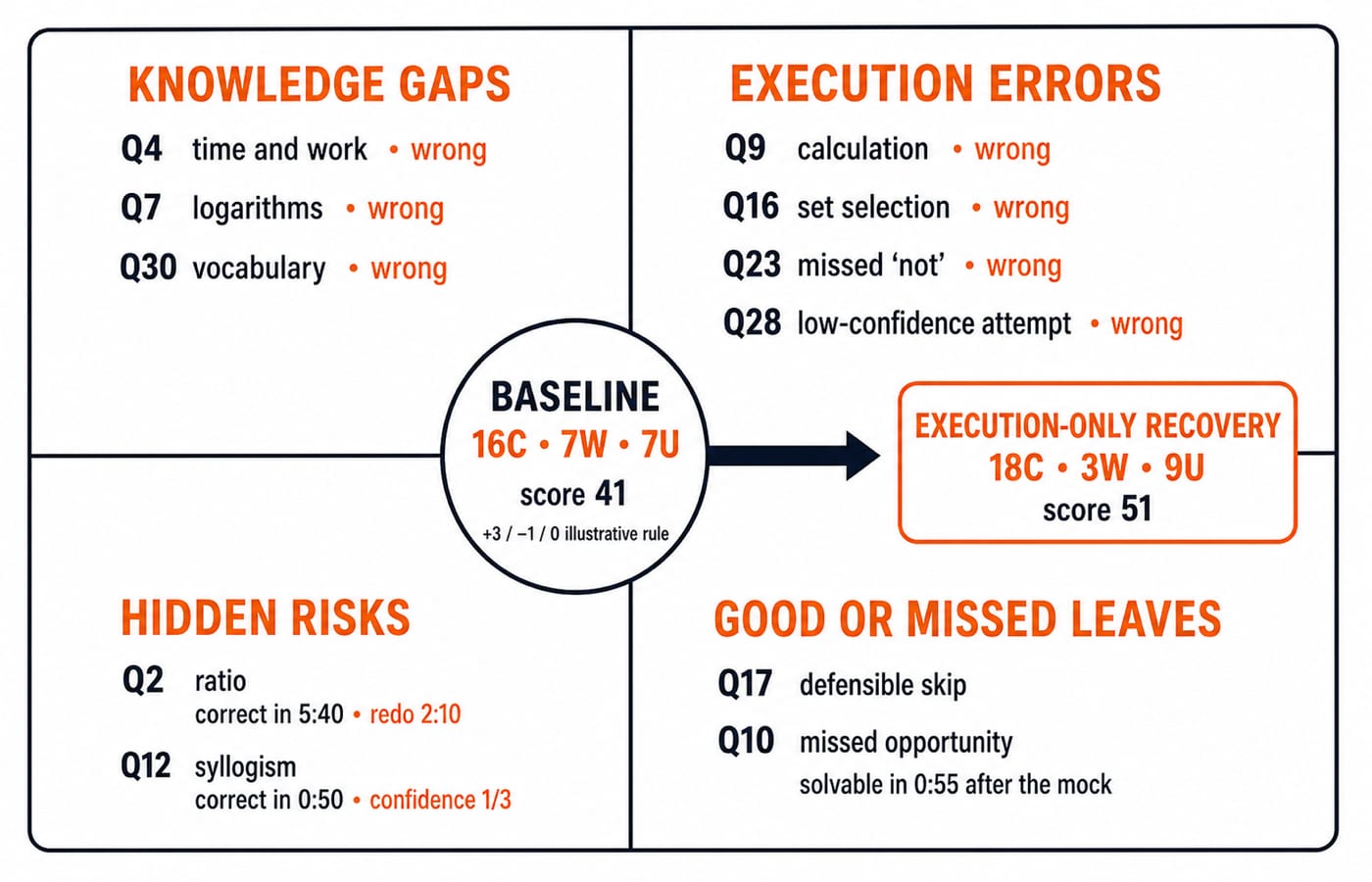
Profile A's seven wrong answers become a usable log. Q4 (time and work) is K: rates were subtracted, not added. Q7 (logarithms) is K: the product identity was not recalled. Q30 (vocabulary) is K: the word was unknown. Q9 (averages) is C: 37 x 24 became 868, not 888. Q16 (circular arrangement) is D: 6:40 without a stable diagram. Q23 (sentence correction) is R: not was missed. Q28 (inference) is D: 0:35 at confidence 1/3, with no supporting line or complete elimination.
Audit skips too. Q10, solved in 0:55 afterwards, was a missed opportunity. Q17, dependent on the unfinished arrangement set, was defensible. Q25, an unknown word, was another K. Unattempted does not automatically mean poor time management.
Recalculate the score recoverable without a new topic
Split the wrongs into three K errors (Q4, Q7, Q30) and four attempt errors (Q9, Q16, Q23, Q28). Fixing Q9 and Q23 changes each from -1 to +3, gaining 4 twice. Skipping Q16 and Q28 gains 1 twice.
The baseline is 16C, 7W, 7U = 16 x 3 - 7 = 41. The execution-only version is 18C, 3W, 9U = 18 x 3 - 3 = 51. Accuracy rises from 16/23 = 69.57% to 18/21 = 85.71%. This 10-mark recoverable execution score is a counterfactual, not a promised exam improvement. It arrives before teaching time and work, logarithms or vocabulary.
AMCAT needs a different diagnostic because its adaptive path changes the evidence. AMCAT Mock Analysis: Review an Adaptive Test Without Guesswork separates the adaptive report from comparable fixed follow-up sets. In this fixed practice model, convert two execution errors, leave two weak attempts and teach three concepts.
Review correct answers for slow methods and lucky guesses
Add time and confidence from 1 to 3. Confidence 3 means every step is defensible, 2 means one uncertain step, and 1 means a guess or weak elimination. These are personal labels.
Q2, ratio, was correct in 5:40 at confidence 3. A clean redo takes 2:10, exposing 3:30 of procedural drag.Q12, syllogism, was correct in 0:50 at confidence 1 but cannot be justified on redo. Treat it as unresolved, not a strength.Q20, reading comprehension, was correct in 1:15 at confidence 3 and is reproducible. It needs no repair block.
Reattempt flagged questions without solutions after at least 20 minutes. Still wrong means teach the concept. Correct but over twice your clean benchmark means shorten the method. Correct, fast and explainable means close the entry.
Convert each diagnosis into one next-mock rule
Turn labels into actions. For K, do 25 minutes of repair plus three fresh questions. For C, write a checkpoint, such as 37 x 24 = 37 x (6 x 4) = 222 x 4 = 888. For R, box the qualifier and write the direction, such as South over North. For D, define a leave-or-return rule.
Profile A can test three adjustable training rules:
Leave a set if 90 seconds produces neither a stable representation nor one reachable question.
Do not submit a confidence-1 answer without written evidence or a complete elimination path.
Reserve the final 4 minutes of this 60-minute simulation for marked arithmetic and qualifiers.
If K labels are spread across fundamentals, use aptitude for placements across quant, reasoning and verbal to organise the repair.
Run a four-week, 6.5-hour eLitmus mock-review cycle
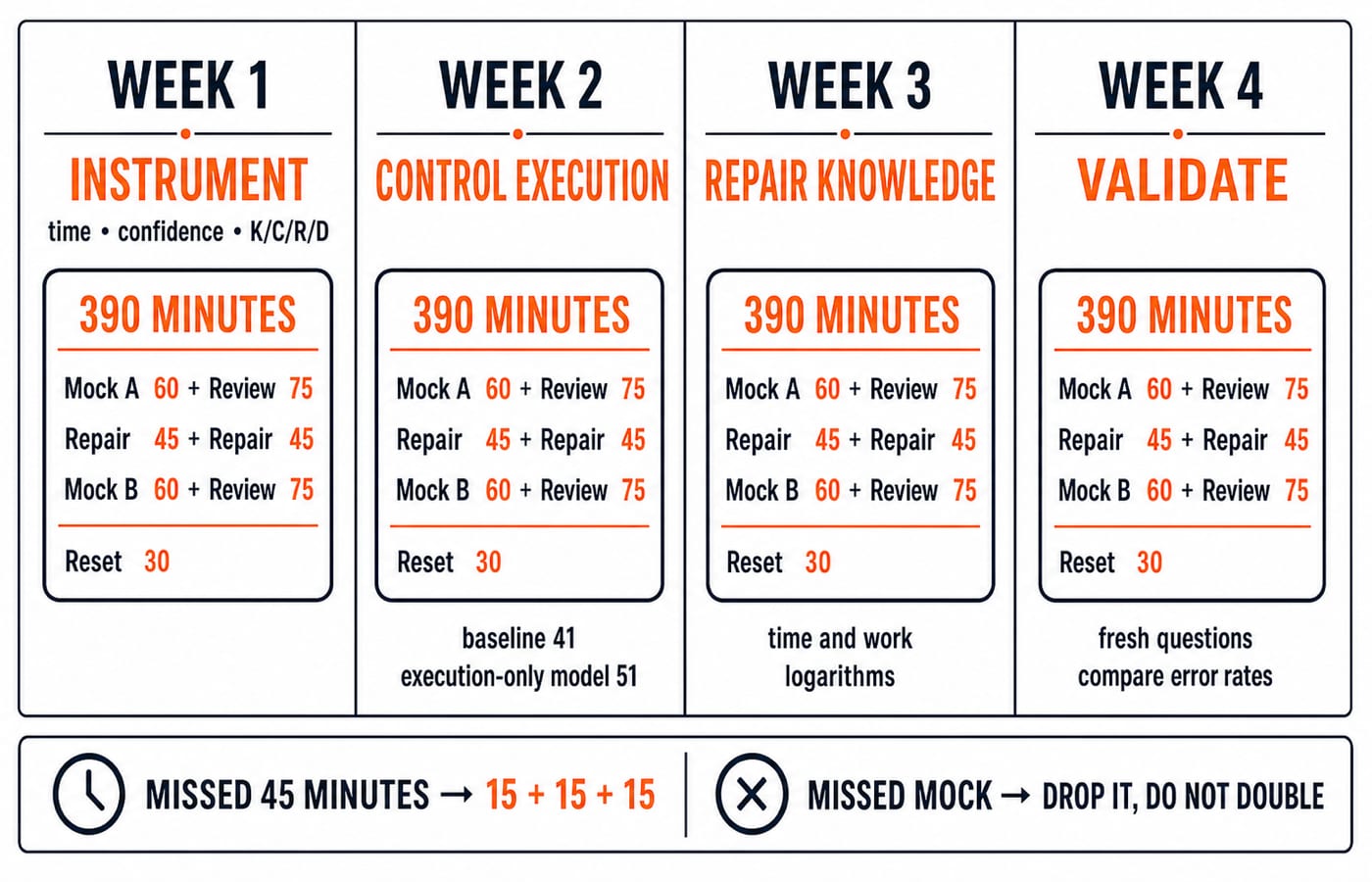
Each week: Mock A 60 plus review 75; repairs 45 + 45; Mock B 60 plus review 75; reset 30. Total: 60 + 75 + 45 + 45 + 60 + 75 + 30 = 390 minutes = 6 hours 30 minutes. Never stack both mocks because analysis must change the second attempt.
Week | Focus | Work within the same 390-minute frame |
|---|---|---|
1 | Instrument | Capture section totals, time, confidence and K/C/R/D |
2 | Control execution | Prioritise C/R/D and test movement from 41 towards 51 |
3 | Repair knowledge | Use each 45-minute block for 25 minutes of concept work and 20 minutes of fresh questions, starting with time and work plus logarithms |
4 | Validate | Use new questions and compare error rates, not remembered answers |
Miss a 45-minute repair block? Add 15 minutes to the next three study days. Miss a mock day? Keep the next mock and its 75-minute review, but drop the extra mock. Below three hours, preserve one 60-minute mock, one 75-minute analysis and one 45-minute repair block, then resume next week.
Judge the next eLitmus practice mock by error rates
After the next comparable simulation, record K errors / questions seen, C+R errors / attempts, D errors / attempts, accuracy and reachable skips. Profile A's practice target is to cut C/R/D wrongs from 4 to at most 2 while keeping K visible. This private threshold does not map to a percentile or employer requirement.
If K remains at 3 but C/R/D falls from 4 to 2, keep the selection rules and shift one repair block to concepts. If C/R/D remains at 4, repeat error control instead of adding topic coverage. If wrong answers fall but reachable skips rise from 1 to 5, loosen the leave rule carefully rather than celebrating accuracy alone.
The short routine is: record, label, redo, calculate the recoverable score, write one rule and retest. Complete eLitmus Preparation offers a focused study route. To compare eLitmus with AMCAT, CoCubes or CDAC C-CAT, use the IT Recruitment Exams category.
Keep learning

TCS NQT Eligibility: Check Backlogs, Gaps and Degree Rules
Use a closed TCS hiring notice as a worked checklist for degree, backlog, course-duration and academic-gap rules, then verify the current drive.
Updated 2 Sep 20264 min readIT Recruitment Exams

CoCubes Preparation Plan: Six Weeks for Campus Hiring Tests
Build a practical six-week CoCubes study plan around the modules in your own test invitation, your diagnostic results, and 72 hours of focused work.
Updated 1 Sep 20266 min readIT Recruitment Exams
eLitmus Retake Decision: Read Section Percentiles Before Testing Again
Do not retake eLitmus on disappointment alone. Use your section pattern, target-job evidence, and fresh timed practice to decide whether to go, wait, or rebuild.
Updated 30 Aug 20264 min readIT Recruitment Exams

eLitmus Data Interpretation: Choose the Right Set and Control Accuracy
Learn a repeatable DI routine: score each set before solving, compress the data into one scratch table, protect every percentage base, and verify results early.
Updated 27 Aug 20266 min readIT Recruitment Exams