eLitmus Retake Decision: Read Section Percentiles Before Testing Again
Do not retake eLitmus on disappointment alone. Use your section pattern, target-job evidence, and fresh timed practice to decide whether to go, wait, or rebuild.
KnowledgeGate Team
Exam prep & CS education
Updated 30 Aug 20264 min read
A disappointing result can make another eLitmus attempt feel urgent, but that impression is not enough evidence. One low section is not automatically fatal. Decide from three inputs: your section pattern, target-role needs, and improvement across fresh timed practice sets.
1. eLitmus percentiles: read relative standing, not percentage marks
The official eLitmus score page says a section percentile shows relative standing among test takers and may move as the comparison pool changes. An 88th percentile does not mean 88% marks or 88% correct answers.
Consider this hypothetical report:
Score-report section | Percentile |
|---|---|
Quantitative | 92 |
Problem Solving or Analytical | 61 |
Verbal | 84 |
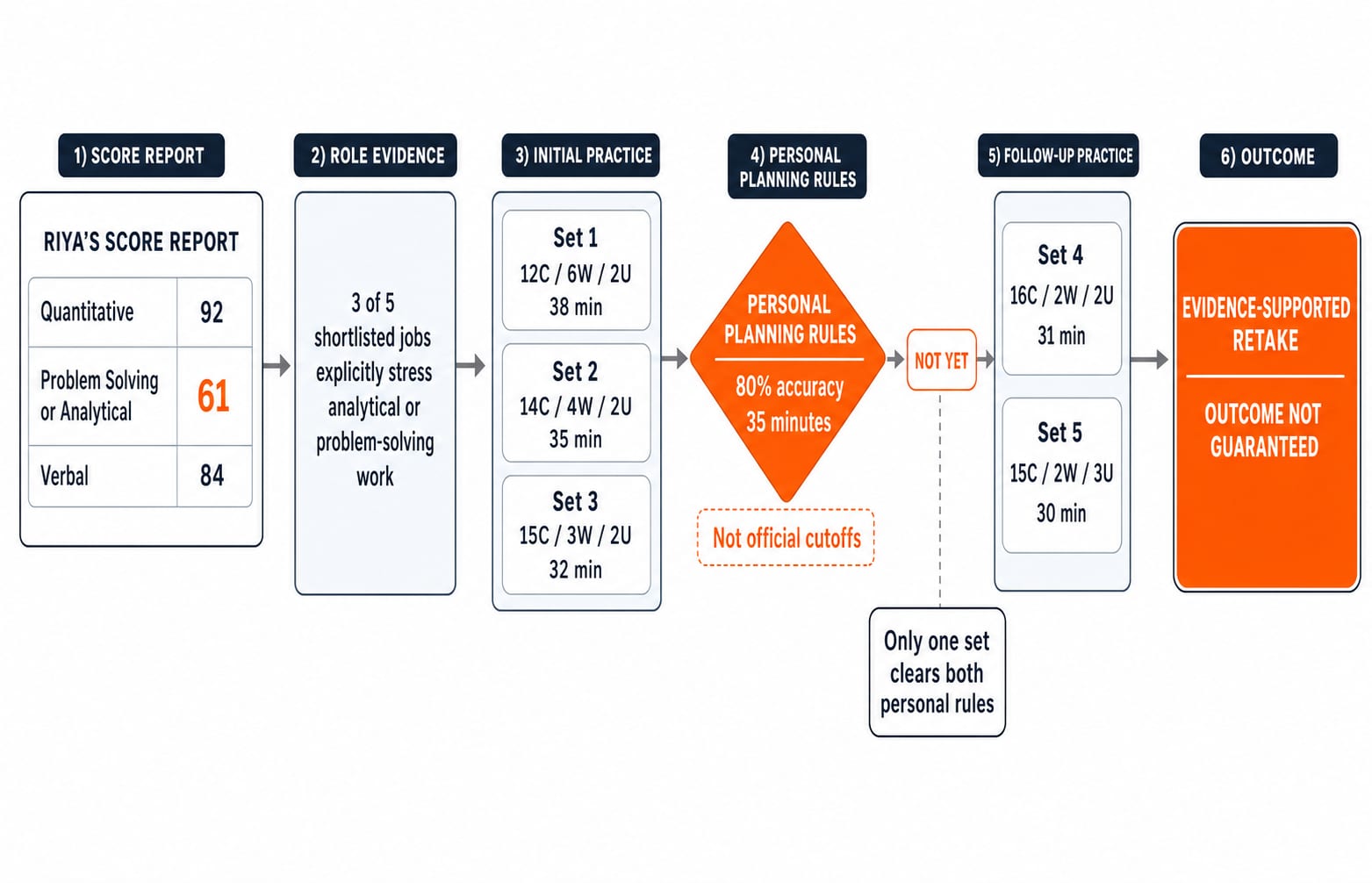
The naive mean is (92 + 61 + 84) / 3 = 237 / 3 = 79. It is not an official overall score and hides two gaps: 92 - 61 = 31 points from Quantitative, and 84 - 61 = 23 from Verbal, to Problem Solving.
Observation: one section is much lower. Inference: it may block relevant roles. Test that inference next.
2. eLitmus retake decisions start with target roles, not a universal cutoff
eLitmus says shortlisting varies with job profiles and employer preferences, so a universal cutoff table misleads. AMCAT scorecard analysis can rank fixed module scores against target roles and set a retake threshold. eLitmus needs a different first step: treat each section percentile as moving relative standing, then test whether the weak section matters to your roles and has improved on fresh timed sets.
Riya reviews five current shortlisted job descriptions:
Wording in her shortlist | Listings | Closest report section |
|---|---|---|
Explicit analytical or problem-solving work | 3 | Problem Solving or Analytical |
Client communication | 1 | Verbal |
General aptitude only | 1 | Unclear |
Her 61 matters to three targets. This is her shortlist evidence, not a general claim.
Copy exact wording from 5 to 10 live target listings. Map it to a report section only when explicit; otherwise mark "unclear." Browse standardised assessments in IT Recruitment Exams.
3. eLitmus retake worked example: move from "not yet" to evidence-supported
Riya uses five fresh, non-repeated 20-question problem-solving sets. These hypothetical values are not an official format or scoring formula. C, W, and U mean correct, wrong, and unattempted.
Set | C/W/U | Time | Attempted accuracy |
|---|---|---|---|
1 | 12/6/2 | 38 min |
|
2 | 14/4/2 | 35 min |
|
3 | 15/3/2 | 32 min |
|
4 | 16/2/2 | 31 min |
|
5 | 15/2/3 | 30 min |
|
Her personal guardrails are 80% attempted accuracy within 35 minutes. She does not book after Set 3 because only one set clears both. After Sets 3, 4, and 5 clear both, a retake is evidence-supported if her target roles remain relevant. These are planning rules, not official cutoffs, and they cannot predict a percentile.
4. eLitmus retake preparation: a 14-day, 17-hour proof plan
Phase | Hours | Work |
|---|---|---|
Days 1-3 | 3 | Classify errors; repair two weak concepts |
Days 4-8 | 6 | Targeted drills; fresh 20-question sets on Days 4, 6, and 8 |
Days 9-11 | 4.5 | Mixed Quantitative, Problem Solving, and Verbal |
Days 12-13 | 2.5 | Two fresh timed sets plus review |
Day 14 | 1 | Light recall and final decision |
Total | 17 | 3 + 6 + 4.5 + 2.5 + 1 = 17 |
The Aptitude for Placements guide introduces the three-strand split. For study work, use Quantitative Aptitude, Problem Solving & Reasoning, and Verbal Ability. For percentiles, preserve your report's labels.
Never double the next load after a missed day. Move one drill to the Day 11 buffer, protecting the fresh set and its 30-minute review. After two missed days, extend the proof window.
5. An eLitmus error log must show what changed
An error log must show whether learning, not merely more attempts, caused improvement.
Date | Set | Question family | Result | Error type | Correction | Repeat result |
|---|---|---|---|---|---|---|
Day 4 | 1 | Mixed | 12C/6W/2U | 4 concept, 1 method choice, 1 careless execution | Repair concepts; compare methods; check | Set 3: 1 concept error |
Day 8 | 3 | Mixed | 15C/3W/2U | 1 concept, 2 question selection | Revise; set skip rule | Set 5: 0 concept errors |
Day 13 | 5 | Mixed | 15C/2W/3U | 2 question selection | Review skips | Next fresh set |
Concept errors fell from 4 to 1 to 0. Accuracy and error mix indicate readiness, but home sets do not reproduce official scoring or relative standing and cannot yield an eLitmus percentile.
6. When an eLitmus retake is the wrong next move
Repeated questions and other placement preparation mistakes create false confidence. Classify the decision first:
Decision | Evidence | Next move |
|---|---|---|
Go | Riya's 92, 61, 84 pattern, role relevance, and five-set trend | Retake is evidence-supported after Sets 3, 4, and 5 |
Wait | Percentiles 90, 59, 86; last three fresh weak-section sets at 11/20, 11/20, 12/20 correct; no fall in concept errors | Use fresh sets and wait for the error mix to change |
Rebuild | Percentiles 74, 70, 72; mixed accuracy 70%, 72%, 71% | Use a balanced four-to-six-week rebuild because weakness is broad |
Do not chase a round number. Use fresh sets, distinguish better selection from more attempts, and check whether listings make the weaker area relevant.
7. The short version: retake only when three signals agree
Retake when three signals agree: a meaningful section gap, relevance across your target roles, and three consecutive fresh timed sets clearing prewritten accuracy and time guardrails. If one is missing, decide "not yet," not "never."
The eLITMUS Superset is a structured next step when your log shows gaps across Quantitative Aptitude, Problem Solving & Reasoning, or Verbal Ability. If you only need readiness proof, fresh timed sets and disciplined review may suffice.
A better process can justify another attempt, but no preparation plan can guarantee a percentile or an employer shortlist.
Keep learning

TCS NQT Eligibility: Check Backlogs, Gaps and Degree Rules
Use a closed TCS hiring notice as a worked checklist for degree, backlog, course-duration and academic-gap rules, then verify the current drive.
Updated 2 Sep 20264 min readIT Recruitment Exams

CoCubes Preparation Plan: Six Weeks for Campus Hiring Tests
Build a practical six-week CoCubes study plan around the modules in your own test invitation, your diagnostic results, and 72 hours of focused work.
Updated 1 Sep 20266 min readIT Recruitment Exams
eLitmus Mock Analysis: Diagnose Knowledge Gaps and Attempt Errors
A worked mock-review method to separate concept gaps from calculation, reading and decision errors, recover marks, and plan the next four weeks.
Updated 29 Aug 20265 min readIT Recruitment Exams

eLitmus Data Interpretation: Choose the Right Set and Control Accuracy
Learn a repeatable DI routine: score each set before solving, compress the data into one scratch table, protect every percentage base, and verify results early.
Updated 27 Aug 20266 min readIT Recruitment Exams