Structured Knowledge Representation Models: Semantic Networks, Frames, Scripts and Worked Inheritance
Learn how structured knowledge models store relations, attributes and events. Trace defaults and exceptions through one exact Bird, Penguin and Pingu example.
KnowledgeGate Team
Exam prep & CS education
Updated 11 Aug 20266 min read

Semantic networks, frames and scripts look simple, but marks are lost when an edge or slot is misread. The chain Bird -> Penguin -> Pingu can be stored as labelled edges, as slots on a frame, or as scenes in a script, and each store answers a different question. What settles an answer is never the drawing, it is the policy that says which value wins when a class default and an instance value disagree.
1. What makes a knowledge representation model structured
A structured representation organises knowledge as nodes, classes, instances, slots, relations or event schemas. Compare flat facts such as Bird(Pingu), HasLegs(Pingu, 2) and HasCovering(Pingu, feathers) with Pingu INSTANCE-OF Penguin, Penguin IS-A Bird, and common properties stored once on Bird.
Inspect the stored structure, each label's meaning, and the inference policy. A picture alone defines no inference.
Semantic networks foreground relations, frames bundle attributes, scripts organise expected event sequences, and conceptual dependency uses primitive actions. Propositional and Predicate Logic is the formal contrast, centred on truth-bearing formulas and quantifiers.
2. Semantic networks: read nodes, labelled edges and direction
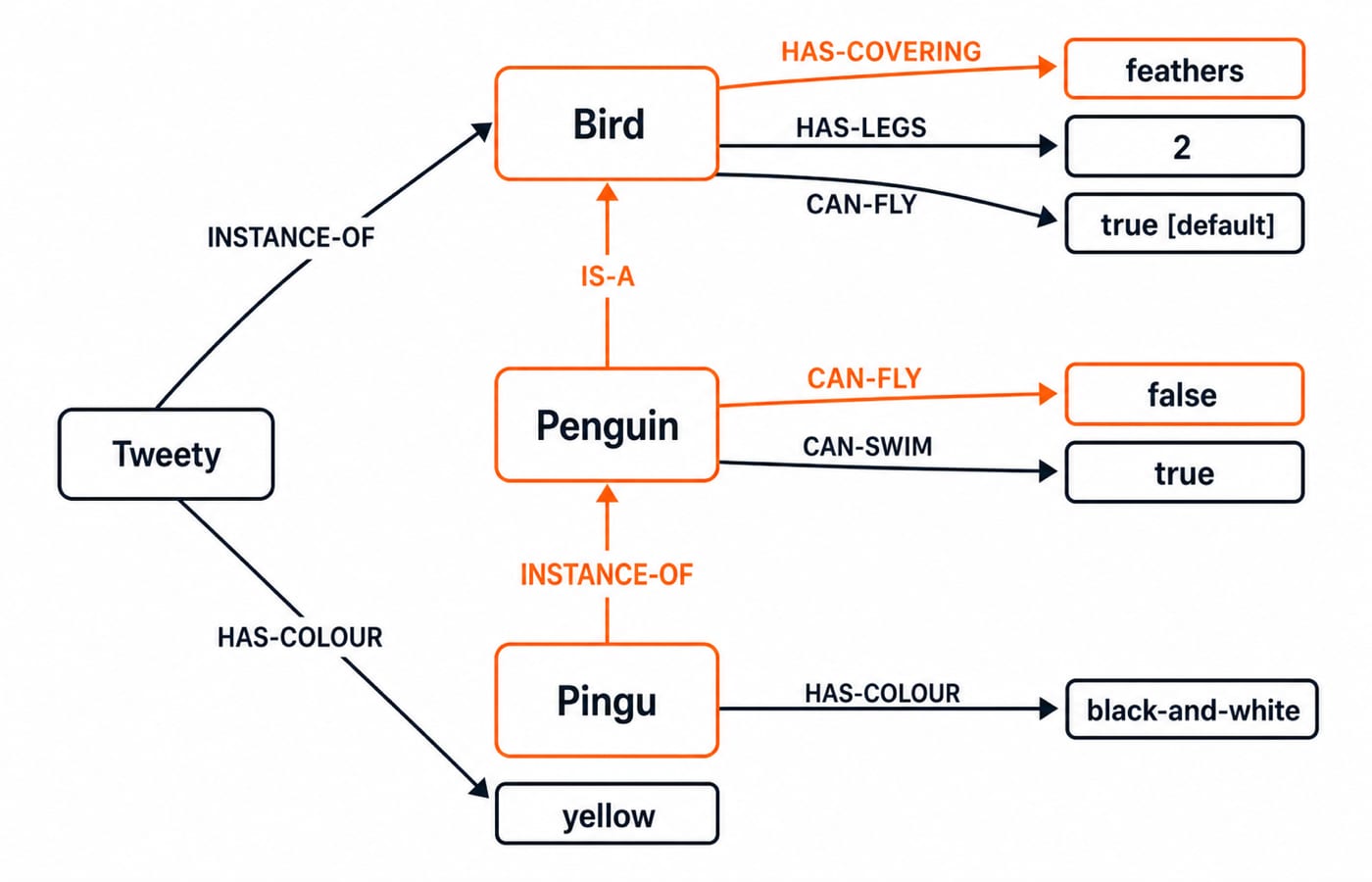
A semantic network is a labelled directed graph. Our network stores these edges:
Penguin -IS-A-> Bird;Pingu -INSTANCE-OF-> Penguin;Tweety -INSTANCE-OF-> BirdBird -HAS-COVERING-> feathers;Bird -HAS-LEGS-> 2;Bird -CAN-FLY-> true [default]Penguin -CAN-FLY-> false;Penguin -CAN-SWIM-> truePingu -HAS-COLOUR-> black-and-white;Tweety -HAS-COLOUR-> yellow
Direction carries meaning. Penguin IS-A Bird does not license Bird IS-A Penguin; Pingu INSTANCE-OF Penguin does not make Penguin INSTANCE-OF Pingu; Bird HAS-LEGS 2 differs from 2 HAS-LEGS Bird. Graph Theory for GATE CS: Euler, Coloring, Worked Formulas reviews the graph foundation, but labels determine valid inference.
Our policy follows INSTANCE-OF and then IS-A upward for a missing property. The nearest explicit value overrides a default. Other notations may differ.
3. Frames: bundle classes, instances, slots and facets
A frame is a named record with slots and fillers. A facet annotates a filler instead of replacing it: the [default] facet on Bird.canFly = true marks that value as overridable, which is why Penguin.canFly = false sits under it without contradicting it. Here, AKO means "a kind of" between classes, while INSTANCE-OF links an individual to a class. Textbooks vary in spelling, so follow the declared meaning.
Frame | Stored slots |
|---|---|
|
|
|
|
|
|
|
|
Pingu.colour is local; Pingu.covering comes through Penguin from Bird. Bird.canFly = true is available only without a nearer value. Penguin.canFly = false overrides it for penguin instances. Inheritance retrieves values without physically duplicating every slot.
4. Worked inheritance: resolve four queries step by step
Query | Lookup path | Values encountered | Answer | Reason |
|---|---|---|---|---|
|
| missing, missing, |
| Two inheritance links reach the first filler. |
|
| missing, missing, |
| The same two-link path reaches |
|
| missing, |
| The nearest explicit value stops the search before the Bird default. |
|
| missing, |
| One inheritance link reaches an unblocked default. |
For Query 1, link 1 reaches Penguin, which lacks covering; link 2 reaches Bird and returns feathers. Query 2 uses those two links for 2. Query 3 stops at Penguin.canFly = false. Query 4 reaches the unblocked Bird default in one link and returns true.
Add Pingu.canFly = true locally and Query 3 becomes true, because the instance is nearest. The two class values remain unchanged.
5. Scripts and conceptual dependency represent events
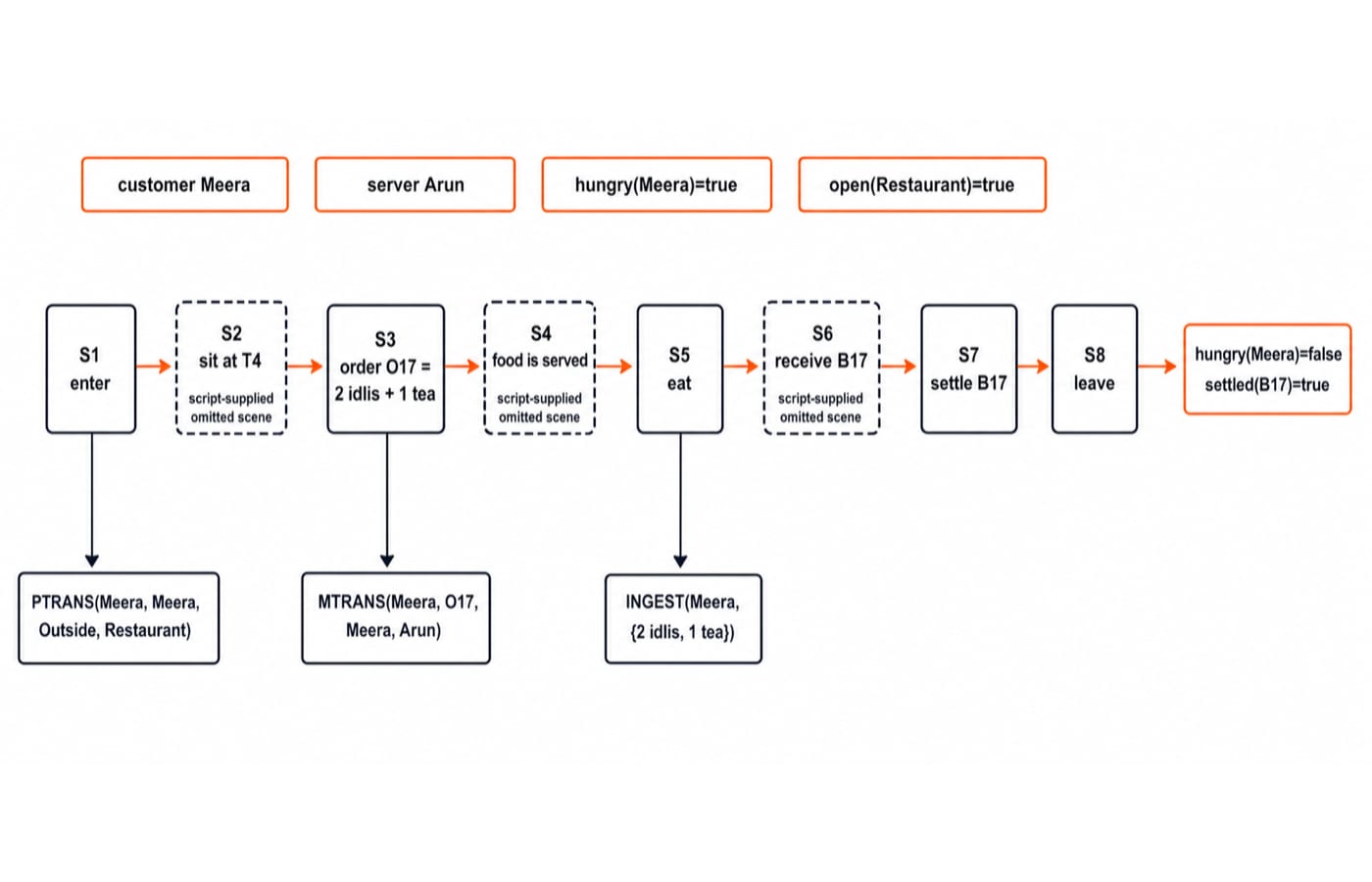
A script is a schema for a stereotyped sequence. RestaurantVisit has roles customer = Meera, server = Arun; props table = T4, order = O17, bill = B17; entry conditions hungry(Meera) = true, open(Restaurant) = true; scenes S1 enter, S2 sit at T4, S3 order 2 idlis and 1 tea, S4 food is served, S5 eat, S6 receive B17, S7 settle B17, S8 leave; results hungry(Meera) = false, settled(B17) = true.
For "Meera entered the restaurant, ordered 2 idlis and 1 tea, ate, settled B17 and left," the script supplies sit at T4, food is served, and receive B17. They are expected defaults, not certain history.
Conceptual dependency maps sentences to primitives. Entering is PTRANS(actor=Meera, object=Meera, from=Outside, to=Restaurant). Placing O17 is MTRANS(actor=Meera, information=O17, from=Meera, to=Arun). Eating is INGEST(actor=Meera, object={2 idlis, 1 tea}). PTRANS changes location; ATRANS transfers possession or control.
6. Choose the model by the question it must answer
Model | Basic unit | Best question | Exact example | Main caution |
|---|---|---|---|---|
Semantic network | Labelled node-edge-node triples | How is Pingu related to Bird? |
| Declare edge semantics. |
Frame | Slots and fillers around a class or instance | What is Pingu's covering? |
| Exceptions need an override policy. |
Script | Ordered scenes and roles | What likely occurred between ordering and eating? |
| Expected is not guaranteed. |
Conceptual dependency | Primitive acts with roles | Was this movement, information transfer or ingestion? |
| Do not guess primitives from everyday words alone. |
Models can combine. Bird taxonomy fits edges or frames. The restaurant account needs temporal scenes, which can receive conceptual-dependency encodings. Choose for the required inferences, not for a universal winner.
A labelled edge is a binary relation over ordered pairs. (Pingu, Penguin) in INSTANCE-OF does not imply (Penguin, Pingu).
7. Common question forms and traps to correct
Tasks may ask you to identify a model, separate IS-A from INSTANCE-OF, trace a slot, resolve an exception, supply a script scene, or match a primitive. Rapid checks: covering(Pingu) = feathers; deleting only Penguin.canFly = false makes canFly(Pingu) = true; ordering to eating implies food is served; Outside to Restaurant is PTRANS.
Correct these traps:
Reversed
IS-Aedge: follow its arrow.Class confused with instance:
Penguinis a class;Pinguis an instance.Default treated as exceptionless: a nearer explicit value wins.
Parent searched first: start at the instance and move upward.
Every graph path accepted: check each edge label.
Script scene called certain history: call it expected.
ATRANSused for movement: usePTRANS.
Practise those forms on sets you can check against a key. The GATE CS Exam Preparation Courses & Test Series page gives the wider route, and the GATE Test Series is one place to attempt them under timing.
8. The short version and the next representation to build
Keep this five-line retrieval summary:
Semantic networks store labelled relations.
Frames bundle slots around a class or instance.
Inheritance searches from the most specific node upward.
Scripts supply expected event scenes.
Conceptual dependency rewrites events with primitives and role fillers.
The worked answers are Pingu.covering = feathers, Pingu.legs = 2, Pingu.canFly = false, and Tweety.canFly = true.
Add Ostrich {AKO: Bird; canFly: false; movement: run} and Ollie {INSTANCE-OF: Ostrich; colour: brown}. Draw the two links, then resolve covering(Ollie), legs(Ollie), canFly(Ollie), and movement(Ollie). Answers: feathers, 2, false, run.
Redraw Bird -> Penguin -> Pingu as edges and frames, then explain why the nearest value wins. Continue with GATE Guidance by Sanchit Sir for the wider sequence.
Keep learning
Functions in C: Syntax, Parameters and Worked Examples
Learn how C declarations, calls, and definitions fit together. Compile two complete programs, follow their values, and trace composition and recursion.
Updated 6 Oct 20266 min readC Programming & Data Structures
Smart Pointers in C++: unique_ptr, shared_ptr and weak_ptr with Worked Examples
Learn who owns a C++ object, when it is destroyed, and how to choose among unique_ptr, shared_ptr, weak_ptr and a borrowed raw pointer.
Updated 1 Oct 20265 min readC Programming & Data Structures
Pointers in C: Addresses, Arrays and Functions with Worked Examples
Build a practical pointer model with runnable C programs for dereferencing, arrays, swapping, dynamic memory and common tracing questions.
Updated 26 Sep 20265 min readC Programming & Data Structures
Pointers and Arrays in C: Decay, Indexing and Worked Examples
Separate arrays from pointers with runnable traces covering indexing, one-past boundaries, function parameters, two-dimensional arrays and declaration traps.
Updated 24 Sep 20265 min readC Programming & Data Structures