

Structured Knowledge Representation Models: Semantic Networks, Frames and a Worked Inference
Learn how semantic networks, frames and conceptual dependency represent knowledge, then follow Meera through a four-query inference trace.
KnowledgeGate Team
Exam prep & CS education
Updated 29 Oct 20266 min read
You may be able to recite “semantic network” and “frame” but still get stuck when asked to build one or follow inheritance. The important step is to see what each model stores and what it lets you infer. Semantic networks, frames, slot-filler structures and conceptual dependency store different information and support different inferences.
Structured knowledge representation models: what they organise
Knowledge representation chooses entities, categories, relations, attributes and inference paths so a system can store facts and derive answers. A stored fact is not the same as an inference. Meera INSTANCE-OF ResearchStudent may be stored, while “Meera is a Student” is derived through the class hierarchy.
The vocabulary must stay precise:
A class describes a category, while an instance is a particular member.
An
IS-AorAKOlink joins a narrower class to a broader class.INSTANCE-OFjoins an individual to its class.A slot names an attribute, and its filler gives the value.
A default is an assumed value that may be overridden.
A constraint restricts acceptable values.
Inheritance passes suitable values down a hierarchy, while an exception replaces a general value in a specific case.
Therefore, ResearchStudent IS-A Student and Meera INSTANCE-OF ResearchStudent express different relations.
Structured models expose entities, links and attributes. Formal logic focuses on formulas, truth conditions, quantifiers and inference rules. A semantic network does not automatically have the same semantics as first-order logic. Read Propositional and Predicate Logic: Truth Tables, Quantifiers and Inference for that formal view.
For the broad comparison across logic, semantic networks, frames and production rules, including resolution and inheritance, use Knowledge Representation in Artificial Intelligence: Logic, Semantic Networks, Frames and Rules with Worked Examples. The Meera university model keeps one domain constant so graph links, frame overrides, constraints and conceptual dependency can answer distinct query types.
Semantic networks: nodes, labelled arcs and inheritance
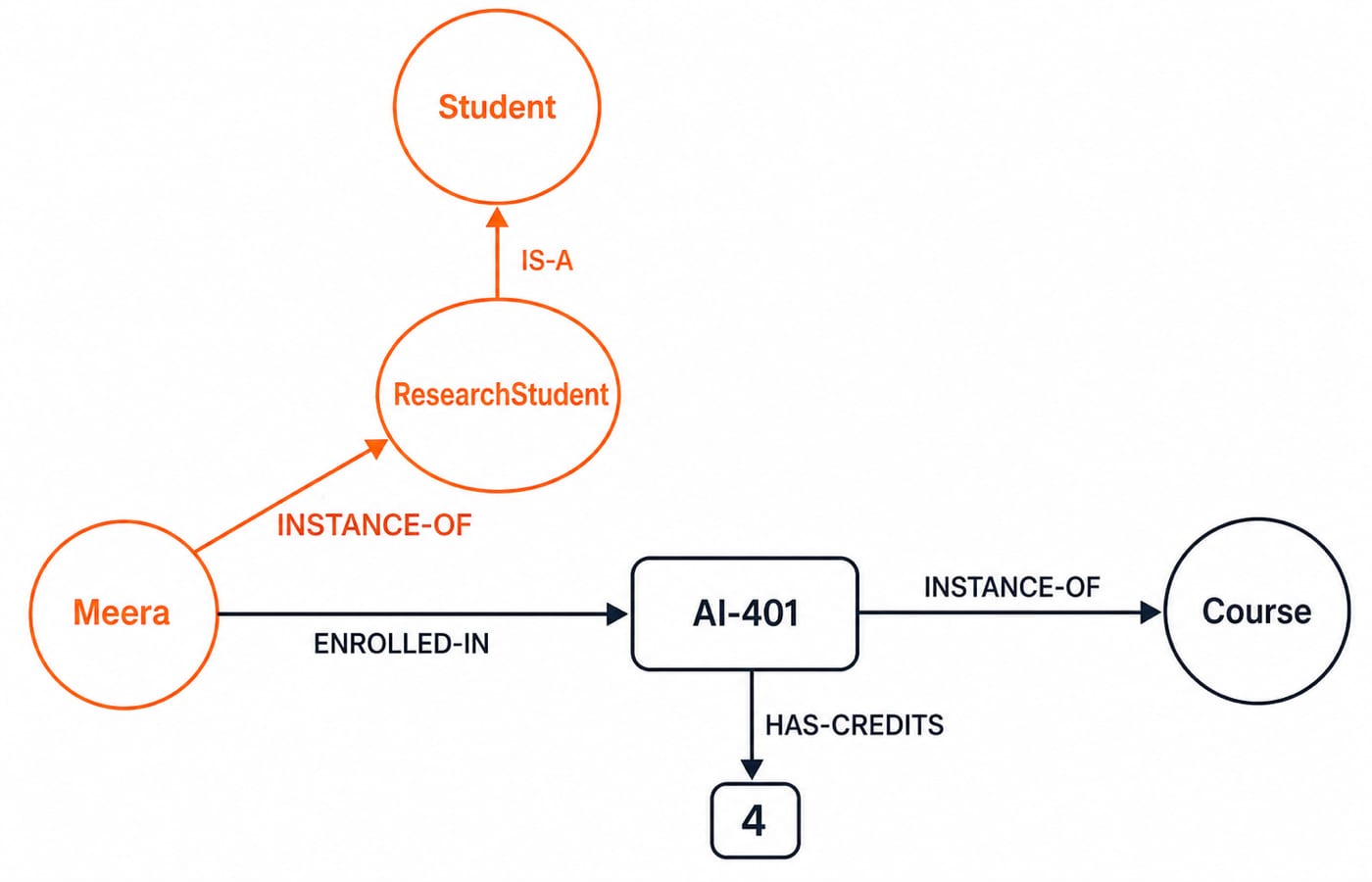
A semantic network is a directed labelled graph. Nodes represent entities or categories, and arcs state relations.
Our network has five nodes: Student, ResearchStudent, Meera, AI-401 and Course. It contains these arcs:
ResearchStudent IS-A StudentMeera INSTANCE-OF ResearchStudentAI-401 INSTANCE-OF CourseMeera ENROLLED-IN AI-401AI-401 HAS-CREDITS 4
To ask whether Meera is a Student, start at Meera INSTANCE-OF ResearchStudent, then follow ResearchStudent IS-A Student. This path establishes membership of Student. Meera ENROLLED-IN AI-401 is only a direct relation. It creates no class link.
Relations and inheritance paths are visually inspectable. However, authors can give an arc different meanings unless its semantics are specified.
Frames and slot-filler structures: defaults, constraints and overrides
A slot-filler structure is the general attribute-value idea. A frame packages a stereotyped entity or class. Its slots may carry fillers, defaults, type restrictions, cardinalities or procedures, and may be inherited or overridden.
The Student frame has defaults active=true and libraryLoanLimit=4, plus the constraint minimumSemesterCredits=20. ResearchStudent is a kind of Student. It inherits active=true and minimumSemesterCredits=20, overrides libraryLoanLimit with 8, and adds supervisorRequired=true as a default.
Meera is an instance of ResearchStudent, with explicit registeredCredits=16 and proposed course AI-401. The AI-401 course frame has explicit credits=4.
An explicit instance value beats a class default, and the nearest subclass value beats a general inherited default. A default is defeasible, not an exceptionless truth. Meera’s loan limit is 8, not 4 + 8 = 12, because 8 replaces 4.
Structured knowledge representation worked example: answer four queries
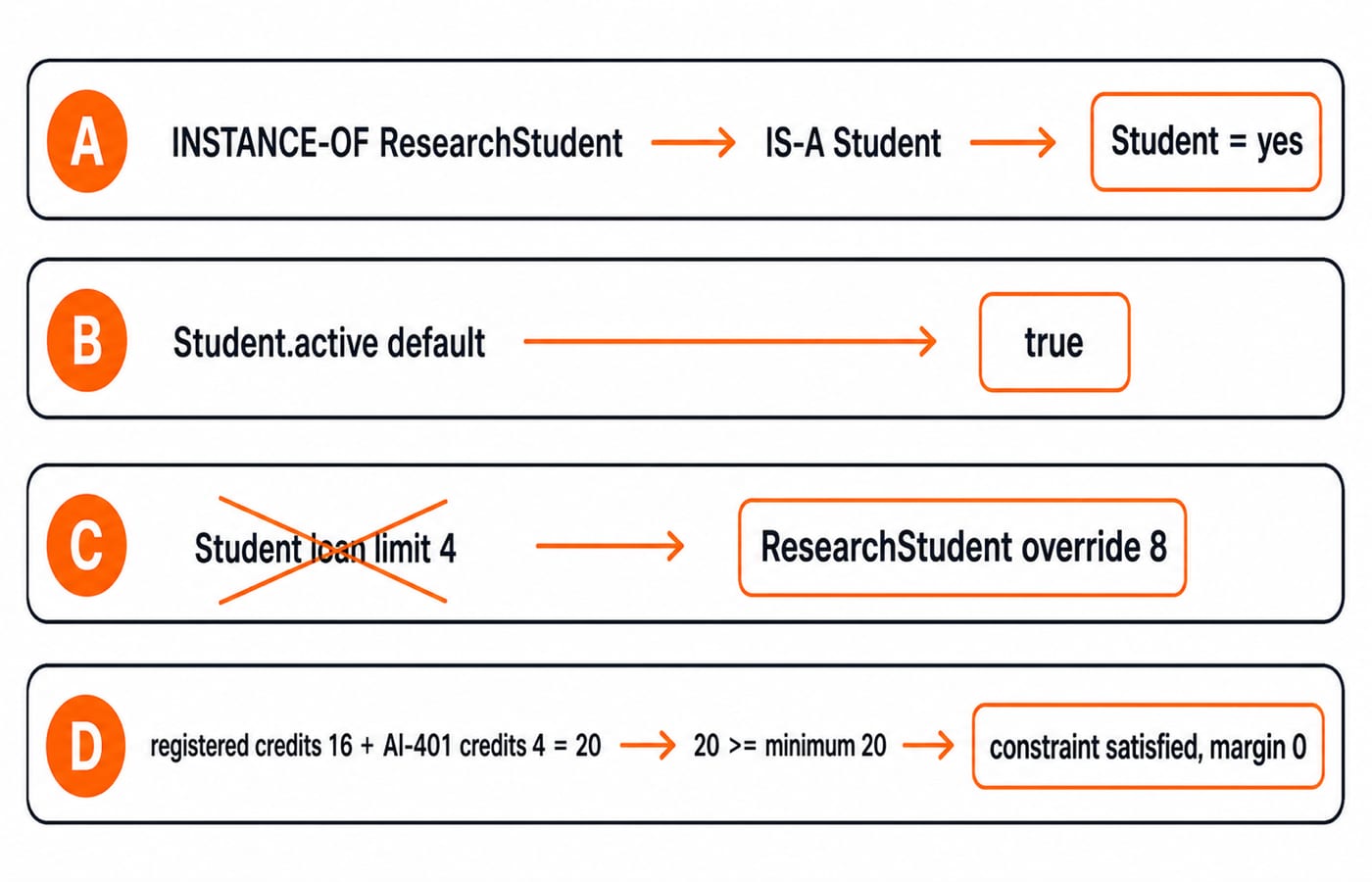
The four queries are resolved by tracing membership, inheritance, overrides and constraints.
Is Meera a Student? Traverse
Meera INSTANCE-OF ResearchStudentandResearchStudent IS-A Studentto getStudent=yes.Is Meera active? Neither Meera nor
ResearchStudenthas an explicit filler. TheStudentdefault suppliesactive=trueby inheritance.What is Meera’s library loan limit?
Studentsupplies4, but the nearerResearchStudentoverride supplies8. Select8.Does the proposed course meet the minimum-semester-credit constraint? Meera has
registeredCredits=16, andAI-401contributescredits=4. The proposed load is16 + 4 = 20. The inherited constraint isminimumSemesterCredits=20. Compare them:20 >= 20, so the constraint is satisfied exactly. The margin is20 - 20 = 0credits.
The fillers 16, 4 and minimum 20 are stored. Student membership, active=true, loan limit 8 and eligibility at load 20 are derived through traversal, inheritance, override selection or a constraint check.
Conceptual dependency: represent the action beneath the sentence
Conceptual dependency normalises different wordings into primitive actions and role slots. It seeks a structure independent of surface wording, although selecting primitives and resolving context can be difficult.
“Meera gave Ravi Book-7” and “Book-7 was given to Ravi by Meera” describe the same possession transfer:
ATRANS(object=Book-7, from=Meera, to=Ravi, actor=Meera)
Active and passive forms do not change the roles. In contrast, “Meera told Ravi that AI-401 carries 4 credits” transfers information:
MTRANS(information=AI-401 credits 4, from=Meera, to=Ravi, actor=Meera)
ATRANS changes possession, while MTRANS transfers information. Conceptual dependency is not merely another name for a semantic-network edge.
Semantic networks vs frames vs conceptual dependency
Model and basic unit | Best use | How the university example appears | Main limitation |
|---|---|---|---|
Semantic network: nodes and labelled arcs | Relation topology and inheritance |
| Arc meanings need explicit semantics. |
Frame or slot-filler structure: frames, slots and fillers | Defaults, typed attributes and exceptions |
| Precedence must be resolved. |
Conceptual dependency: primitive actions and roles | One meaning for different sentence forms |
| Primitives and context can be difficult to choose. |
Use a semantic network when relation topology carries the load. Use frames when defaults, typed attributes and exceptions matter. Use conceptual dependency when differently worded actions must map to one representation. A real knowledge base can combine all three.
A script represents an expected sequence of events and sits beside these models, but this example concerns structured entities, inheritance and action primitives rather than an event sequence.
Structured knowledge representation exam patterns and traps
Questions may ask you to trace an INSTANCE-OF plus IS-A chain, select a slot after override, or map a sentence to ATRANS or MTRANS. Reuse Student=yes, active=true, loan limit 8, and 16 + 4 = 20.
Watch for these traps:
Reversing an
IS-Aarrow. The narrower class points to the broader class.Treating an instance as a subclass. Meera is an instance, not a kind of
ResearchStudent.Adding default
4and override8to obtain12. The effective value is8.Treating
active=trueas an explicit Meera fact. It is inherited fromStudent.Saying
20is greater than minimum20. It is equal, so the margin is0.Confusing possession transfer with information transfer. Use
ATRANSfor the book andMTRANSfor the credits message.
For broader subject planning, use UGC NET Computer Science Syllabus Areas: Paper 2. Cycle-specific marks and weightage belong to the official UGC NET notification.
Structured knowledge representation: the short version and next step
Semantic networks expose labelled relations. Frames organise inherited slots, defaults and exceptions. Conceptual dependency normalises actions into primitive-role structures, while the example establishes that Meera is a Student, inherits active=true, receives loan limit 8, and reaches the minimum because 16 + 4 = 20.
The Zero to Hero Complete CS Course teaches Artificial Intelligence, Knowledge Representation and Structured Knowledge Representation Models. AI & ML for Placements takes a separate practical AI and ML route. Skill Development Courses compares wider AI and technical-skills paths.
Keep learning
Model Tracking: How to Record Experiments, Metrics and Artefacts
Build a reproducible model tracking record from one constructed churn experiment. Learn which fields, metrics, artefacts and promotion rules make a run trustworthy.
Updated 6 Nov 20266 min readML & Data Science
GATE DA Machine Learning Revision Map: From Probability to Neural-Network Calculations
Connect five machine-learning note sets through four worked problems and a complete neural-network forward pass, with a focused 90-minute revision loop.
Updated 5 Nov 20265 min readML & Data Science
Neural Network Architectures: Layers, Forward Passes and Worked Examples
Learn to read dense, convolutional and recurrent network diagrams as calculations. Count parameters, follow an exact 2-2-1 forward pass, and see what sharing changes.
Updated 4 Nov 20266 min readML & Data Science
Silhouette Score vs Inertia: Compare Clustering Quality with a Worked Example
Follow one dataset through two partitions to see why lower inertia and higher silhouette can support different choices, then learn how to compare them fairly.
Updated 3 Nov 20266 min readML & Data Science