

SSC JE Last 60 Days Plan: Revision and Mock Strategy
Repeated mocks help only when their mistakes get repaired. Build a 60-day SSC JE revision routine around branch recall, reviewed tests, recovery time and a lighter final stretch.
KnowledgeGate Team
Exam prep & CS education
Updated 1 Nov 20265 min read
Repeated mocks can fill your evenings while the same formula, interpretation and calculation mistakes survive. In the final 60 days, give revision, mock review and recovery their own time. Start after an earlier syllabus pass; two months is too short for first-time mastery of an engineering branch.
Fix the paper, branch and resources before counting days
SSC's Junior Engineer Examination 2025 notice, dated 30 June 2025, identifies Civil, Mechanical and Electrical recruitment. For your attempt, check the applicable notification and amendments at ssc.gov.in for syllabus, paper timing and marking rules. Treat the worked numbers as planning examples, then substitute the rules and timings in your applicable notification.
Day 1 is 60 days before your confirmed exam; Day 60 is the preceding day. Keep one syllabus checklist, one branch PYQ source, concise notes and a repeat-error ledger.
Use the government-exam course catalogue to check resource fit. Match every resource to your branch syllabus. The SSC CPO Last 60 Days Plan owns the general Paper-I cadence; SSC JE preparation adds branch-specific technical repair for Civil, Mechanical or Electrical subjects.
Build a 24-hour week that already includes mock review
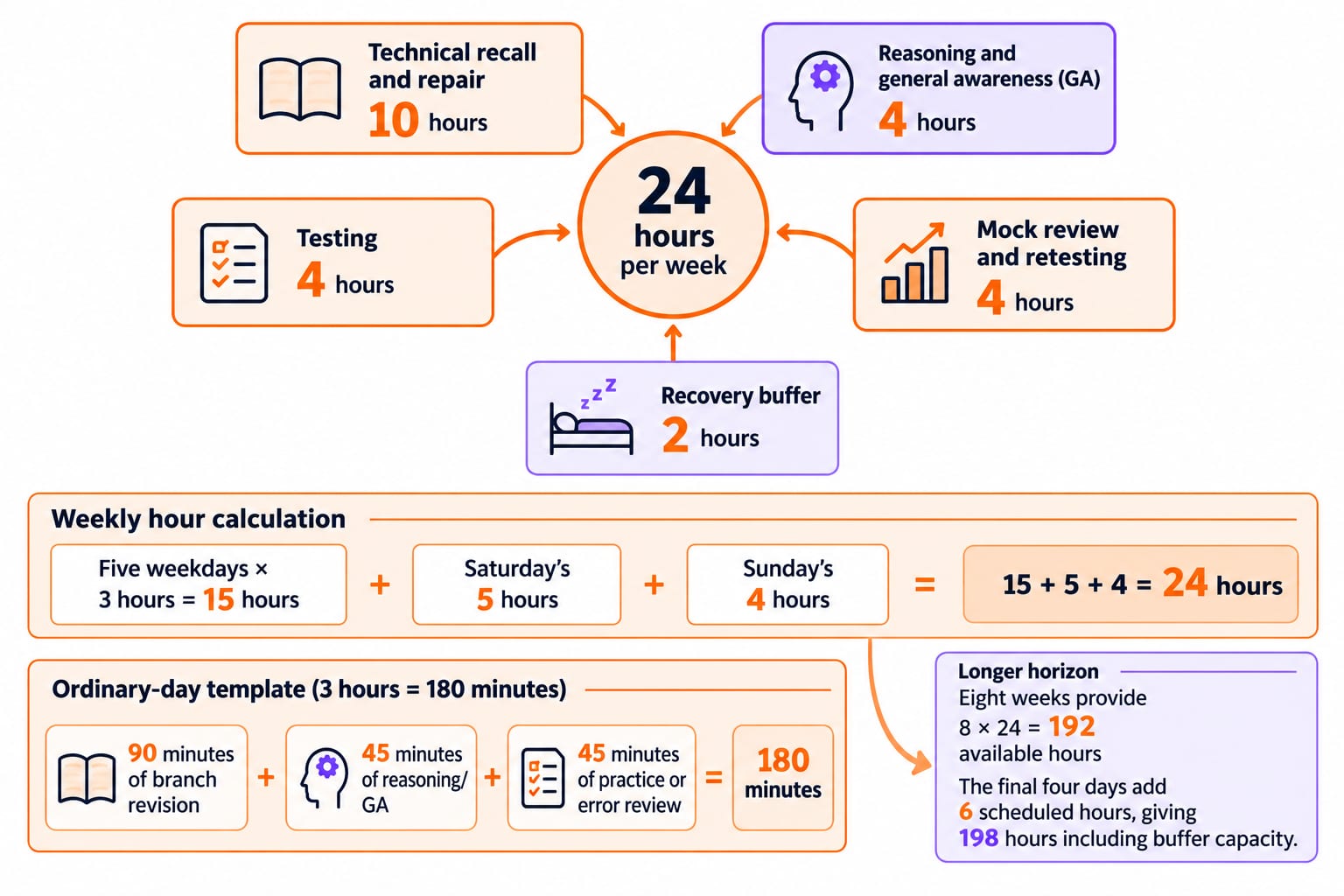
Five weekdays × 3 hours = 15 hours. Add Saturday's 5 and Sunday's 4: 15 + 5 + 4 = 24 hours.
Weekly work | Hours |
|---|---|
Technical recall and repair | 10 |
Reasoning and general awareness (GA) | 4 |
Testing | 4 |
Mock review and retesting | 4 |
Recovery buffer | 2 |
Total | 24 |
Testing and analysis replace normal study blocks. During the one-mock weeks, use remaining testing and review hours for timed sectional sets and their review.
An ordinary day can contain 90 minutes of branch revision, 45 of reasoning/GA and 45 of practice or error review: 180 minutes. Keep that split flexible when branch repair or recovery needs more time.
Eight weeks provide 8 × 24 = 192 available hours. The final four days add 6 scheduled hours, giving 198 hours including buffer capacity. Use your notification's actual paper runtime and rebalance testing against revision where needed.
Days 1–21: Diagnose weaknesses and close small gaps
Plan one full mock weekly: 3 mocks, including the Day 1 baseline. For a separate 40-question technical diagnostic, suppose 24 are correct, 10 wrong and 6 unattempted:
Attempted = 24 + 10 = 34; attempt accuracy = 24/34 × 100 ≈ 70.6%.
Correct across all questions = 24/40 × 100 = 60%.
The second denominator includes skips.
Four ten-question topic samples A, B, C and D yield 8, 5, 3 and 8 correct: 8 + 5 + 3 + 8 = 24. Give A 20 minutes of maintenance, B 60 of targeted practice and C 40 of foundational repair: 120 minutes. Maintain D separately. This priority balances recoverable errors and prerequisite gaps.
Retest repairs after 2 and 7 days. For an electrical example, 24 V across 8 Ω gives I = 24/8 = 3 A, then P = 24 × 3 = 72 W. The wrong step P = I × R = 3 × 8 = 24 mistakes voltage for power: I × R gives volts. Log “used voltage formula for power”. Correct it with P = I²R = 3² × 8 = 9 × 8 = 72 W, matching VI. Other branches should use their own syllabus problems.
Days 22–42: Increase mocks only when analysis stays current
Move to two full mocks weekly, 6 across these 21 days, only when the previous mock's wrong, guessed-right and avoidably skipped questions are reviewed. Replace the next mock with review whenever analysis is unfinished. Six mocks is a ceiling, not a quota.
Assume a practice simulation takes 2 hours and review takes 2 hours. Two pairs need 2 × (2 + 2) = 8 hours, matching 4 testing + 4 review hours. The remaining 16 hours are 10 technical + 4 reasoning/GA + 2 buffer.
If each review needs 3 hours, two pairs take 2 × (2 + 3) = 10 hours. Move 2 technical hours into review: 10 + 8 technical + 4 reasoning/GA + 2 buffer = 24. Compare mocks with comparable difficulty and the same scoring scheme.
Turn each mock into a small, measurable repair list
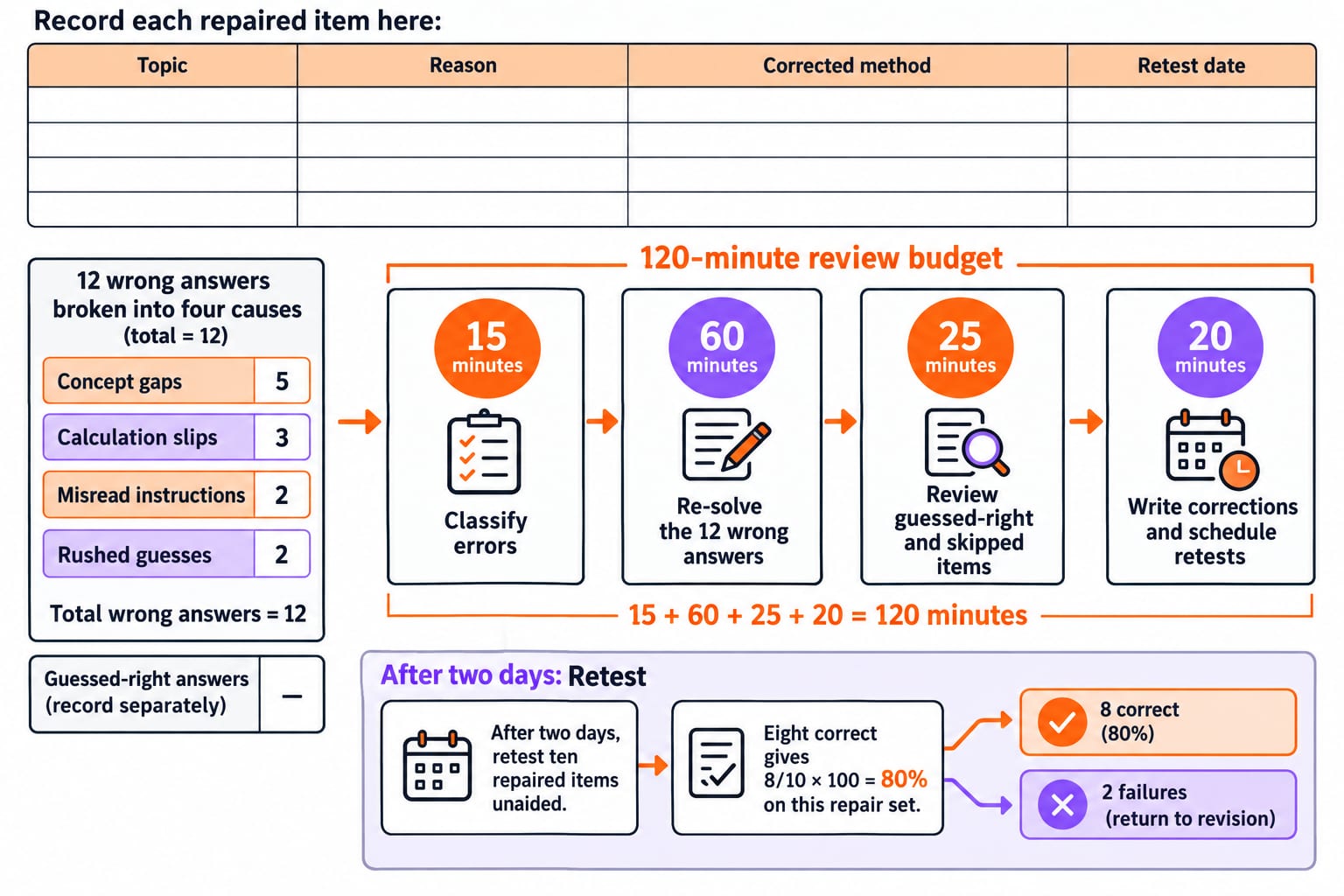
Use the SSC error-ledger method for generic mistake classification; for JE, apply that ledger to branch errors and Paper-I review. For 12 wrong answers, a possible breakdown is 5 concept gaps + 3 calculation slips + 2 misread instructions + 2 rushed guesses = 12. Add guessed-right answers separately.
Record the topic, reason, corrected method and retest date. A saved solution screenshot alone does not show whether you can solve the question.
Budget a 120-minute review explicitly:
15 minutes: classify errors.
60 minutes: re-solve the 12 wrong answers.
25 minutes: review guessed-right and skipped items.
20 minutes: write corrections and schedule retests.
That is 15 + 60 + 25 + 20 = 120 minutes. When a review needs more than 120 minutes, take the extra time from technical study before adding another mock.
After two days, retest ten repaired items unaided. Eight correct gives 8/10 × 100 = 80% on this repair set. Return the two failures to revision. A higher mock score without fewer repeat errors is no reason to add mocks.
Days 43–56: Rehearse execution and recover missed days
Keep two mocks weekly, 4 across these 14 days. The planned total is 3 + 6 + 4 = 13, reduced whenever review falls behind. Practise question selection and pacing within your applicable paper timing. Recall formulas before checking notes, including their units and conditions.
Two missed three-hour weekdays create a 2 × 3 = 6-hour gap. Use the existing 2-hour buffer, remove 2 hours of passive rereading and defer 2 hours of new, low-priority material: 2 + 2 + 2 = 6 hours recovered through rescheduling. Protect error review and sleep.
The related SSC revision routine is CGL-focused; its buffer habit transfers, while your branch revision and JE paper requirements stay central.
Days 57–60: Taper, verify logistics and choose one next action
No full mock is compulsory now. Schedule 2 hours on Day 57 for formula recall and recurring errors, 2 on Day 58 for familiar mixed problems, 1 on Day 59 for error cards and travel/documents, and 1 on Day 60 for light recall. Total: 2 + 2 + 1 + 1 = 6 hours. Check documents and reporting instructions against your admit card, then rest.
Tapering means reducing workload while retaining recall. Avoid new resources and last-minute mock quotas.
Your next action is to block the first week's 24 hours and prepare the baseline ledger. If reasoning/GA needs structured support, inspect the SSC JE non-technical revision course for syllabus fit. Keep a separate source for Civil, Mechanical or Electrical technical revision.
Go deeper with the full courseSSC JE – Non-Technical Course
Keep learning

SSC CPO Last 60 Days Plan: Weekly Revision, Mock Review and Taper
Keep the final 60 days focused on errors that survive your mocks. This Paper I countdown budgets revision and review together, with recovery rules and a lighter final week.
Updated 30 Oct 20265 min readSSC CPO
SSC CGL last 60 days: a revision and mock plan for the final stretch
An SSC CGL last 60 days plan: a phase-by-phase revision and mock schedule, an error-sheet routine, selective revision, and honest advice for missed days.
Updated 29 Oct 20265 min readSSC CGL
IBPS Clerk Last 60 Days Plan: A 150-Hour Revision and Mock Strategy
Turn the final 60 days into a controlled sequence of diagnosis, revision, reviewed mocks, error repair and taper, with plans for both 150 and 100 hours.
Updated 11 Nov 20265 min readIBPS Exams
IBPS RRB PO Last 60 Days Plan: Revision and Mock Taper
Turn the final 60 days into six controlled phases. Use mock evidence, targeted repair, a recoverable weekly timetable and a deliberate two-day taper.
Updated 9 Nov 20265 min readIBPS Exams