

SSC GD Constable Syllabus: What to Study in Every Section
Turn the SSC GD syllabus into useful study sessions. Work through reasoning, arithmetic and language examples, then use a four-section diagnostic to decide what to revise next.
KnowledgeGate Team
Exam prep & CS education
Updated 4 Nov 20265 min read

SSC GD preparation starts with four section labels, but each label calls for a different study job. A pattern trace, a recall card, a profit calculation and a comprehension check make those jobs concrete. The applicable SSC notice remains the authority for recruitment requirements.
Read the SSC GD syllabus as four study buckets
Source note: The source is the SSC GD Examination-2025 notice dated 5 September 2024. Paragraph 12.1 gives the four sections, paragraph 12.1.7 describes matriculation-level questions, and paragraphs 12.1.10.1-12.1.10.4 set out their scope. Use it as a dated syllabus reference. Check your applicable-cycle notice and amendments on SSC's official website before acting.
Official section | Practice focus |
|---|---|
General Intelligence and Reasoning | Patterns and relationships |
General Knowledge and General Awareness | Static topics plus current events |
Elementary Mathematics | Arithmetic and measurement |
English/Hindi | Basic language and comprehension |
The SSC MTS syllabus guide owns that exam's four-block checklist. This GD treatment keeps the section wording tied to the GD notice and uses different worked examples and an error notebook.
Give each section a separate notebook space. Record what you can solve independently, not merely which chapters you have read. KnowledgeGate groups its SSC material within the Govt Job Exam Preparation Courses category, which helps you navigate available resources.
General Intelligence and Reasoning: explain the pattern before timing it
The notice lists analogies, similarities and differences, spatial and visual tasks, relationships, arithmetic reasoning, classification, series and coding-decoding. It describes questions as “principally of non-verbal type”, so include figure-based practice alongside verbal exercises.
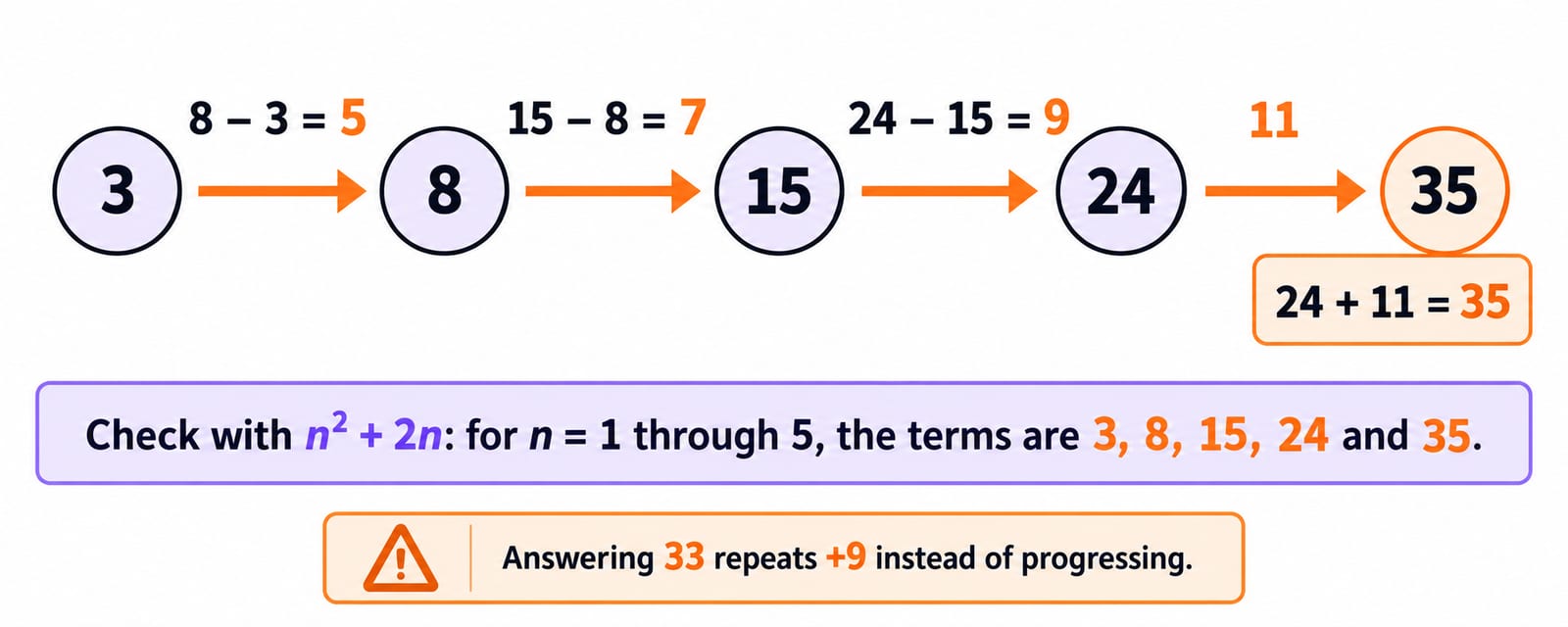
Group your work into pattern spotting, spatial observation and relationships. For the original series 3, 8, 15, 24, ?, calculate the differences:
8 - 3 = 5
15 - 8 = 7
24 - 15 = 9
These are consecutive odd numbers. The next difference is 11, giving 24 + 11 = 35. Check with n^2 + 2n: for n = 1 through 5, the terms are 3, 8, 15, 24 and 35. Answering 33 repeats +9 instead of progressing.
Series, Coding Decoding and Non Verbal Reasoning are matching course modules. SSC CGL Reasoning: High-Yield Topics and Solving Order offers a practice method you can adapt to these topics.
General Knowledge and General Awareness: join facts to topic folders
The notice lists India and neighbouring countries, history, culture, geography, the economic scene, polity and the Constitution, sports, scientific research, everyday science and current events.
Create topic folders rather than one long list of disconnected facts. For science, make three recall cards:
Evaporation: liquid to gas.
Condensation: gas to liquid.
Freezing: liquid to solid.
Hide the answers and name both the starting and ending states. If you reverse condensation, revisit the process: water vapour becoming droplets. The mistake reveals a conceptual gap, so copying the definition again is less useful than explaining the change.
Science, polity, geography and current-affairs modules provide matching practice folders. SSC CGL General Awareness: Build a Durable Static GK Core explains a transferable revision method. Use both CGL articles for study organisation; GD requirements remain anchored in the notice above.
Elementary Mathematics: build arithmetic links, then solve mixed problems
The notice lists whole numbers, decimals, fractions, operations, percentages, ratio and proportion, averages, interest, profit and loss, discount, mensuration, time and distance, ratio and time, and time and work.
A useful learning order is number operations, fractions and percentages, ratios and commercial arithmetic, then rate problems and mensuration.
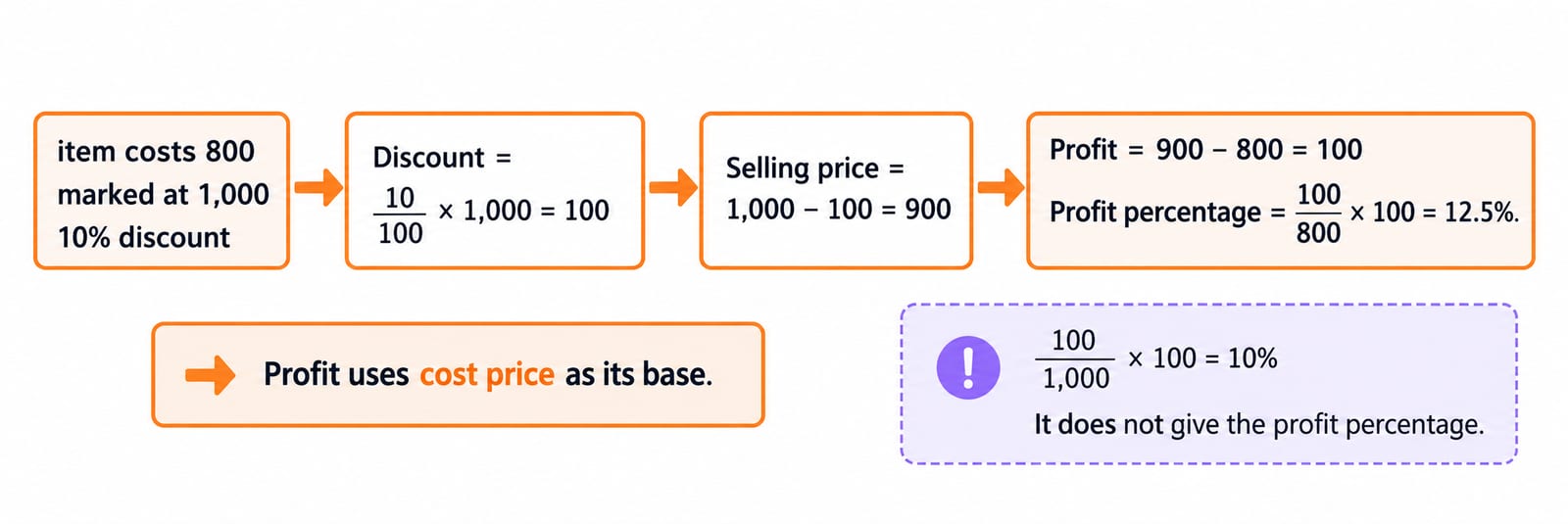
Try this original problem: an item costs 800, is marked at 1,000 and receives a 10% discount.
Discount = 10/100 x 1,000 = 100.
Selling price = 1,000 - 100 = 900.
Profit = 900 - 800 = 100.
Profit percentage = 100/800 x 100 = 12.5%.
Profit uses cost price as its base. Dividing by marked price gives 100/1,000 x 100 = 10%, which happens to reproduce the discount rate here. It does not give the profit percentage.
For a rate check, a vehicle covering 150 km in 3 hours has average speed 150/3 = 50 km/h. Percentage, Profit and Loss, and Speed Time and Distance are matching course modules for these exercises.
English or Hindi: practise meaning alongside grammar
The notice specifies basic English/Hindi understanding and comprehension. Grammar and vocabulary drills are useful preparation choices; treat them as a way to practise that broad scope.
Complete this sentence: “Each of the players ___ ready.” Choose “is” or “are”.
The answer is “is”. “Each” controls singular agreement. The nearby plural noun “players” can distract you, so identify the controlling word before choosing the verb. Then write another sentence using “Each” and explain your choice aloud.
For Hindi comprehension, read: “रीना सुबह बस से स्कूल जाती है।”
Question: “रीना स्कूल कैसे जाती है?” Answer: “बस से”. “सुबह” answers when, while the question asks how. The useful check is to retrieve the exact stated meaning. The course's English modules include vocabulary, subject-verb agreement and reading comprehension.
Turn GD errors into the next practice task
After a short set, tag each miss by cause instead of adding another percentage to a scoreboard. A reasoning error may be a pattern-selection mistake, a General Awareness miss may be a retrieval gap, a mathematics miss may use the wrong base, and a language miss may confuse when with how.
Write the correction beside the question: “Percentage problem; used marked price as profit base; redo with cost price denominator.” Then state the rule in your own words and solve one fresh item that uses the same rule.
Set the next task from the tag: redraw one reasoning pattern, retrieve five awareness cards, redo one arithmetic base calculation, or answer one comprehension prompt. A focused rotation of 20 minutes of awareness recall, 20 minutes of arithmetic correction, 10 minutes of reasoning and 10 minutes of language totals 60 minutes.
The notebook should show the section, the error cause, the corrected rule and the next check. That record tells you what to revise tomorrow without turning practice accuracy into an SSC score prediction.
Choose overlapping resources and keep the GD notice beside them
Identify the official section, study one topic, solve a short set, explain your errors and revisit them. This makes each session produce something you can check.
The SSC CGL Tier 1 course is an optional supplement for overlapping reasoning, arithmetic, awareness and English topics. It is CGL-labelled, so check coverage against GD, especially Hindi, before choosing it.
Start with the four-section diagnostic and select tomorrow's first topic from your error notebook. Also read the applicable notice for physical-test and other recruitment requirements, which sit beyond this syllabus study plan.
Keep learning
SSC GD Constable: How to Analyse Your PYQs and Plan Practice
Old papers become useful when you record the method behind each question. Build a syllabus-backed topic map, separate repeated concepts from repeated wording, and turn mistakes into specific practice tasks.
Updated 6 Nov 20265 min readSSC GD Constable
SSC GD Constable Exam Pattern and Marking Scheme: Sections, Timing and Score Calculation
Understand the SSC GD section structure, calculate your raw score and separate accuracy from marks. Use a worked example and an adjustable timing plan to review your next mock.
Updated 3 Nov 20265 min readSSC GD Constable

SSC GD Constable Eligibility: Age, Qualification and Selection Stages
Check your SSC GD documents against the right dates and understand what follows the written examination. Worked examples explain age boundaries, chest expansion and the difference between preparation gaps and eligibility questions.
Updated 29 Oct 20264 min readSSC GD Constable

SSC GD Constable Preparation Strategy: A 12-Week, 15-Hour Plan
Unsure whether to revise, repair weak topics or take another mock? Use this adaptable 12-week plan to budget study hours, track mistakes and keep physical preparation on your calendar.
Updated 31 Oct 20265 min readSSC GD Constable