

SSC GD Constable Eligibility: Age, Qualification and Selection Stages
Check your SSC GD documents against the right dates and understand what follows the written examination. Worked examples explain age boundaries, chest expansion and the difference between preparation gaps and eligibility questions.
KnowledgeGate Team
Exam prep & CS education
Updated 29 Oct 20264 min read
You know your school qualification, but does it satisfy SSC GD eligibility, and what happens after the written examination? The answer needs your documents, the relevant dates and an understanding of each selection stage. Use the dated 2026 notice to check each requirement against your records.
What to check before choosing SSC GD preparation
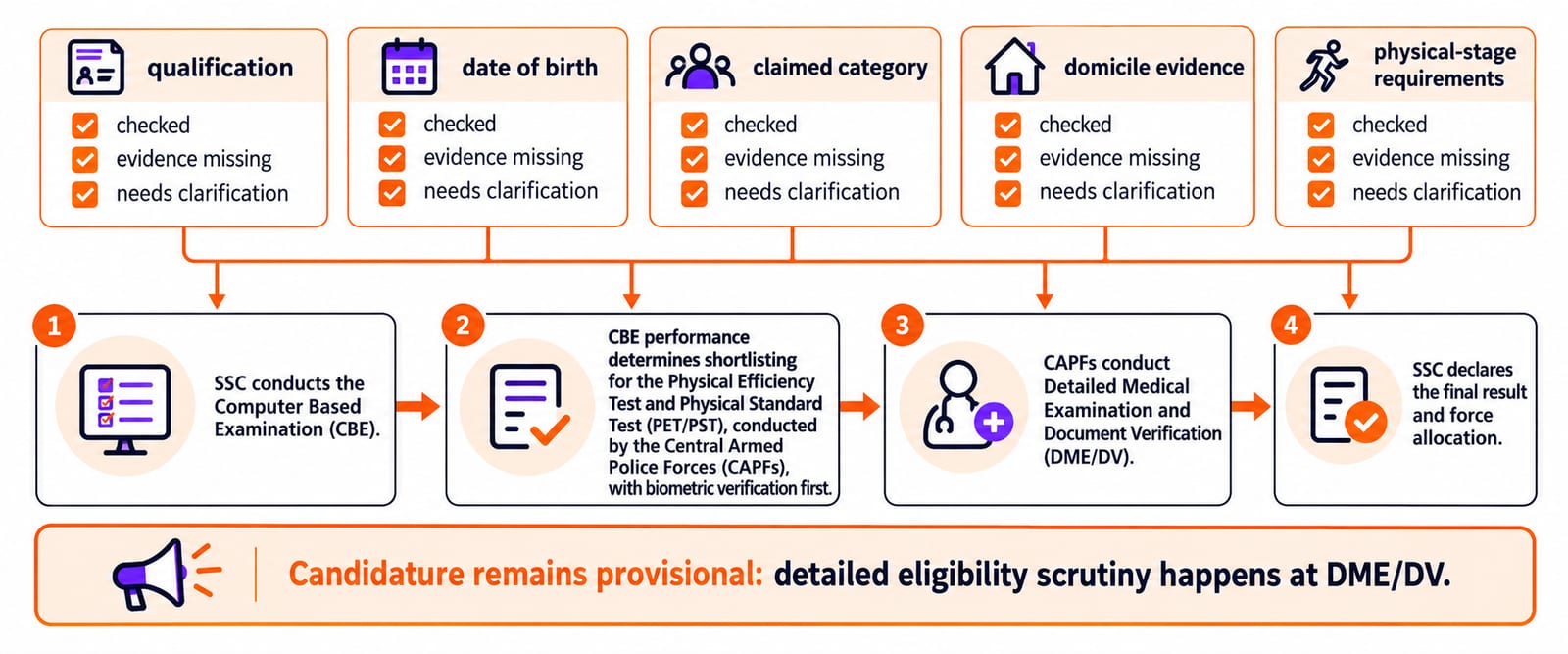
Make five checklist columns: qualification, date of birth, claimed category, domicile evidence and physical-stage requirements. Under each, record evidence and mark “checked”, “evidence missing” or “needs clarification”.
The selection path is:
SSC conducts the Computer Based Examination (CBE).
CBE performance determines shortlisting for the Physical Efficiency Test and Physical Standard Test (PET/PST), conducted by the Central Armed Police Forces (CAPFs), with biometric verification first.
CAPFs conduct Detailed Medical Examination and Document Verification (DME/DV).
SSC declares the final result and force allocation.
Candidature remains provisional: detailed eligibility scrutiny happens at DME/DV. Self-check before the CBE. Use the KnowledgeGate learning hub to organise practice for the written subjects.
For the 2026 cycle, use SSC’s Constable (GD) 2026 notice, published on 1 December 2025. It is the authority for eligibility, physical standards and selection stages; later cycles can change these rules, so check the current notice and amendments at ssc.gov.in.
Qualification and domicile: check the evidence, not just the form
Candidates must be Indian citizens and have passed Matriculation/Class 10 from a recognised board on or before 1 January 2026 for this cycle.
Compare two learners’ result dates:
Learner A’s pass result was declared on 30 December 2025, before 1 January 2026. A satisfies this qualification-date check.
Learner B’s pass result was declared on 2 January 2026, after 1 January 2026. B does not satisfy this check.
Record the board, qualification and result-declaration evidence in your checklist.
Most vacancies are State/UT-wise. The Domicile/Permanent Residential Certificate produced at DME/DV must match the State/UT entered in the application; a mismatch leads to cancellation. Check the notice’s specific exceptions before drawing a conclusion.
If also considering CGL, read SSC CGL eligibility checks for that examination’s requirements.
Age limits: work from the notification’s birth-date interval
The 2026 notice specifies age 18-23 as on 1 January 2026 and gives the birth-date interval explicitly: 2 January 2003 to 1 January 2008, both inclusive. Today’s age is the wrong input because the reckoning date controls the check.
These boundary examples assume no age relaxation:
Date of birth | Unrelaxed interval check |
|---|---|
1 January 2003 | Outside: one day too early |
2 January 2003 | Inside: earliest allowed date |
1 January 2008 | Inside: latest allowed date; turns 18 on the reckoning date |
2 January 2008 | Outside: one day too late; still 17 on the reckoning date |
Use the printed interval rather than rounding age to completed years.
Upper-age relaxation is three years for OBC and five years for SC/ST. Ex-servicemen and other listed categories have separate rows. For a claim, locate the applicable row, verify its certificate requirements, then apply it. Do not add relaxations together yourself.
PET and PST test different things
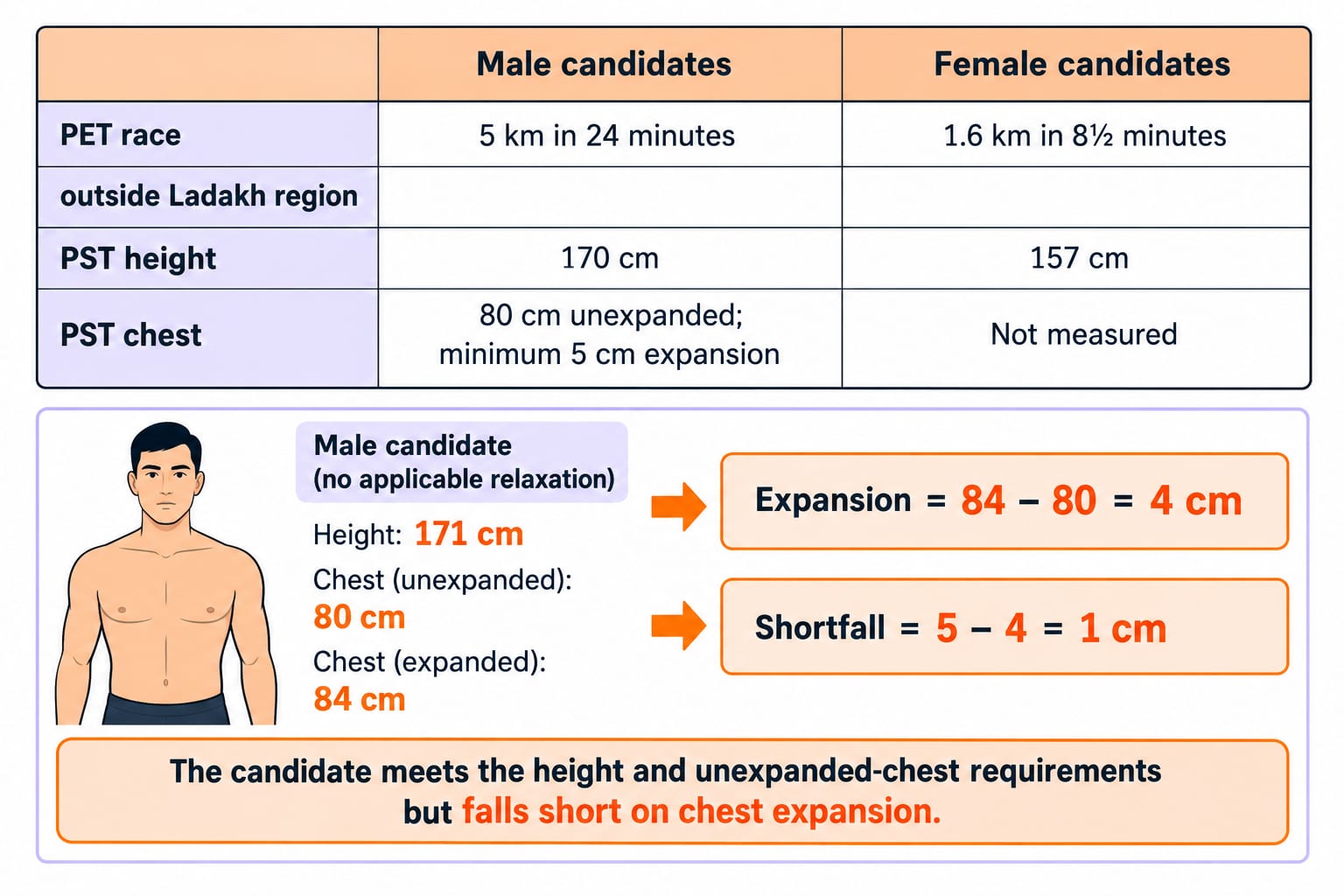
PET checks physical efficiency through the race; PST checks physical measurements. The 2026 notice gives these baseline requirements:
Check | Male candidates | Female candidates |
|---|---|---|
PET race, outside Ladakh region | 5 km in 24 minutes | 1.6 km in 8.5 minutes |
PST height | 170 cm | 157 cm |
PST chest | 80 cm unexpanded; minimum 5 cm expansion | Not measured |
Ladakh has separate race standards. Listed categories have height/chest relaxations; use the applicable official row. Weight must be proportionate to height and age under medical standards. Ex-servicemen are exempt from the PET race but still undergo measurement and must clear medical examination.
Consider a male candidate with no applicable relaxation: height 171 cm, chest 80 cm unexpanded and 84 cm expanded. Height clears the baseline, and unexpanded chest meets it. However:
Expansion = 84 - 80 = 4 cm.
Shortfall = 5 - 4 = 1 cm.
The candidate meets the height and unexpanded-chest requirements but falls short on chest expansion.
Medical checks, documents and the final decision
Place school records, birth-date evidence, domicile evidence and claimed-category certificates beside the corresponding application entries. Compare each entry with its supporting record. Highlight unresolved mismatches for clarification; do not assume they will be overlooked because the written examination went well.
Final allocation uses CBE performance and force preferences, subject to qualifying the required stages and meeting eligibility conditions. A good written score does not guarantee appointment. Medical examination and document scrutiny remain consequential.
For stage instructions, start from ssc.gov.in, identify your examination cycle and follow the official notices to the relevant conducting authority. Check amendments alongside the original notice.
Keep preparation problems separate from eligibility problems
Try this review exercise with a self-made 20-question practice set:
12 correct + 5 incorrect = 17 attempted; 17 + 3 unattempted = 20 questions.
Split the five incorrect answers into three concept errors and two rushed-reading errors: 3 + 2 = 5. Next session, revise those three concepts and redo the two misread questions without a timer.
The mock-analysis error ledger helps you organise these mistakes and plan what to revise next.
“I need more practice” calls for study. “My document does not match my form” calls for clarification. Keep separate action lists.
Your next step: finish the checklist, then choose resources
Complete your checklist using the dated notice, then check SSC’s applicable amendments before acting. Leave uncertain entries marked for clarification.
For overlapping written subjects, consider the SSC CGL Tier 1 course only after comparing its contents with the GD syllabus. Choose study resources after identifying both your learning needs and unresolved document checks.
Keep learning
SSC GD Constable: How to Analyse Your PYQs and Plan Practice
Old papers become useful when you record the method behind each question. Build a syllabus-backed topic map, separate repeated concepts from repeated wording, and turn mistakes into specific practice tasks.
Updated 6 Nov 20265 min readSSC GD Constable
SSC GD Constable Syllabus: What to Study in Every Section
Turn the SSC GD syllabus into useful study sessions. Work through reasoning, arithmetic and language examples, then use a four-section diagnostic to decide what to revise next.
Updated 4 Nov 20265 min readSSC GD Constable
SSC GD Constable Exam Pattern and Marking Scheme: Sections, Timing and Score Calculation
Understand the SSC GD section structure, calculate your raw score and separate accuracy from marks. Use a worked example and an adjustable timing plan to review your next mock.
Updated 3 Nov 20265 min readSSC GD Constable

SSC GD Constable Preparation Strategy: A 12-Week, 15-Hour Plan
Unsure whether to revise, repair weak topics or take another mock? Use this adaptable 12-week plan to budget study hours, track mistakes and keep physical preparation on your calendar.
Updated 31 Oct 20265 min readSSC GD Constable