

SSC GD Constable Exam Pattern and Marking Scheme: Sections, Timing and Score Calculation
Understand the SSC GD section structure, calculate your raw score and separate accuracy from marks. Use a worked example and an adjustable timing plan to review your next mock.
KnowledgeGate Team
Exam prep & CS education
Updated 3 Nov 20265 min read
The SSC GD examination structure sets the sections, scoring rules and time available for a mock. SSC's notice dated 1 December 2025 supplies the rules used here, while the hypothetical scores show how to apply the arithmetic.
Where the written test sits in SSC GD selection
The selection route begins with the Computer Based Examination (CBE). Shortlisted candidates move to the Physical Efficiency Test and Physical Standard Test (PET/PST), followed by medical examination and document verification. Clearing the written stage is the first selection milestone.
Keep preparation for each stage on your checklist. A written-test practice score measures your answers; the remaining stages assess their own requirements. Read those requirements separately before making your preparation plan.
When comparing government-exam preparation options, check which examination each resource actually covers. Shared subjects can help you choose lessons, but GD's selection requirements come from its own notice.
SSC GD sections, question counts and total marks
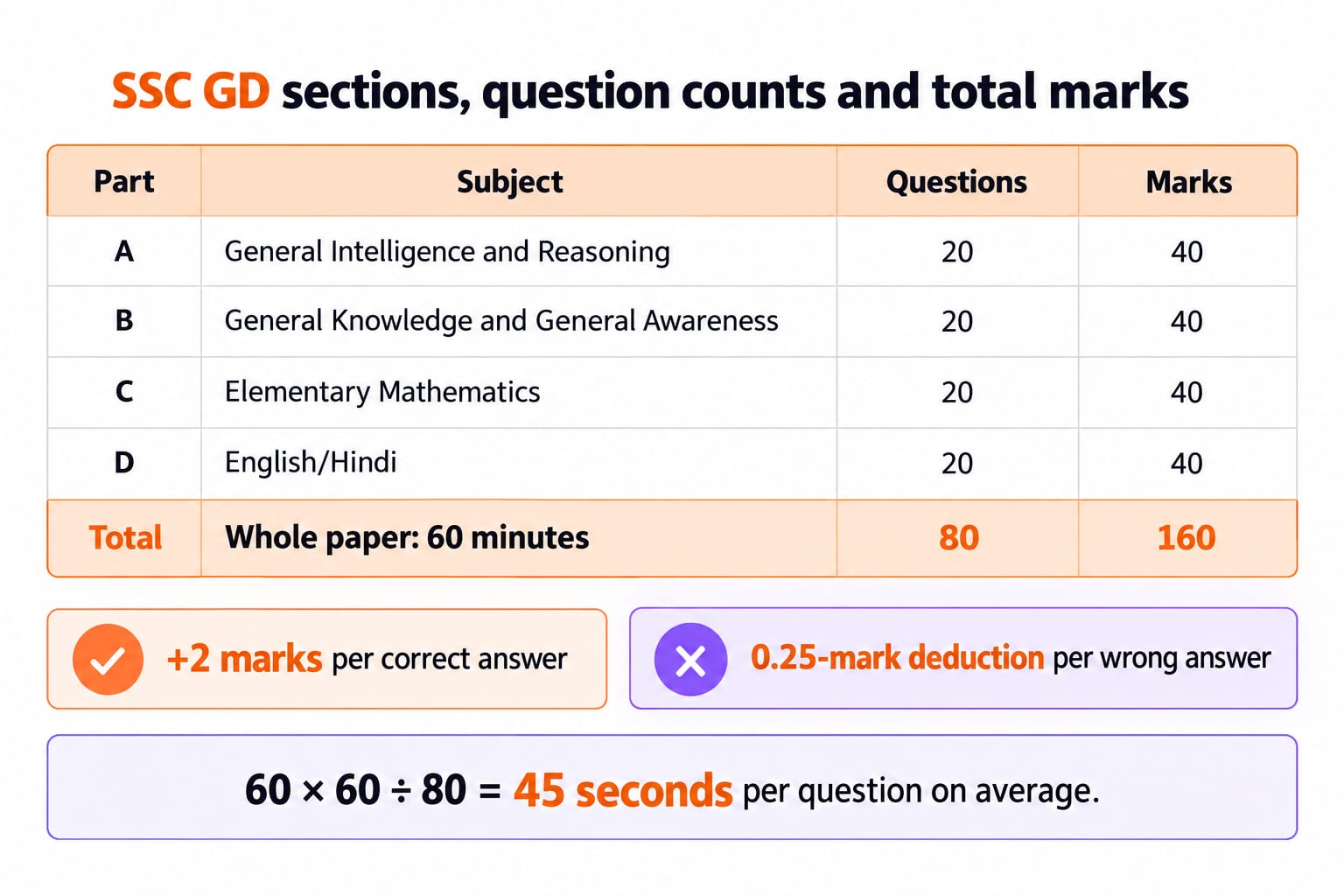
The SSC Constable GD Examination 2026 notification, paragraphs 12.1-12.2, supplies the structure and rules used here. Paragraphs 12.1 and 12.1.2 specify +2 marks per correct answer and a 0.25-mark deduction per wrong answer alongside this pattern:
Part | Subject | Questions | Marks |
|---|---|---|---|
A | General Intelligence and Reasoning | 20 | 40 |
B | General Knowledge and General Awareness | 20 | 40 |
C | Elementary Mathematics | 20 | 40 |
D | English/Hindi | 20 | 40 |
Total | Whole paper: 60 minutes | 80 | 160 |
English/Hindi forms one scored language component of 20 questions worth 40 marks. Questions are objective multiple-choice, at Matriculation level; the CBE is conducted in English, Hindi and 13 regional languages.
The duration belongs to the whole paper. For planning, 60 x 60 / 80 = 45 seconds per question on average. Use that average flexibly, allowing more time for harder questions.
These are the dated notice's rules. Before applying this model to another cycle, check the applicable SSC notification and amendments.
Calculate your raw score after negative marking
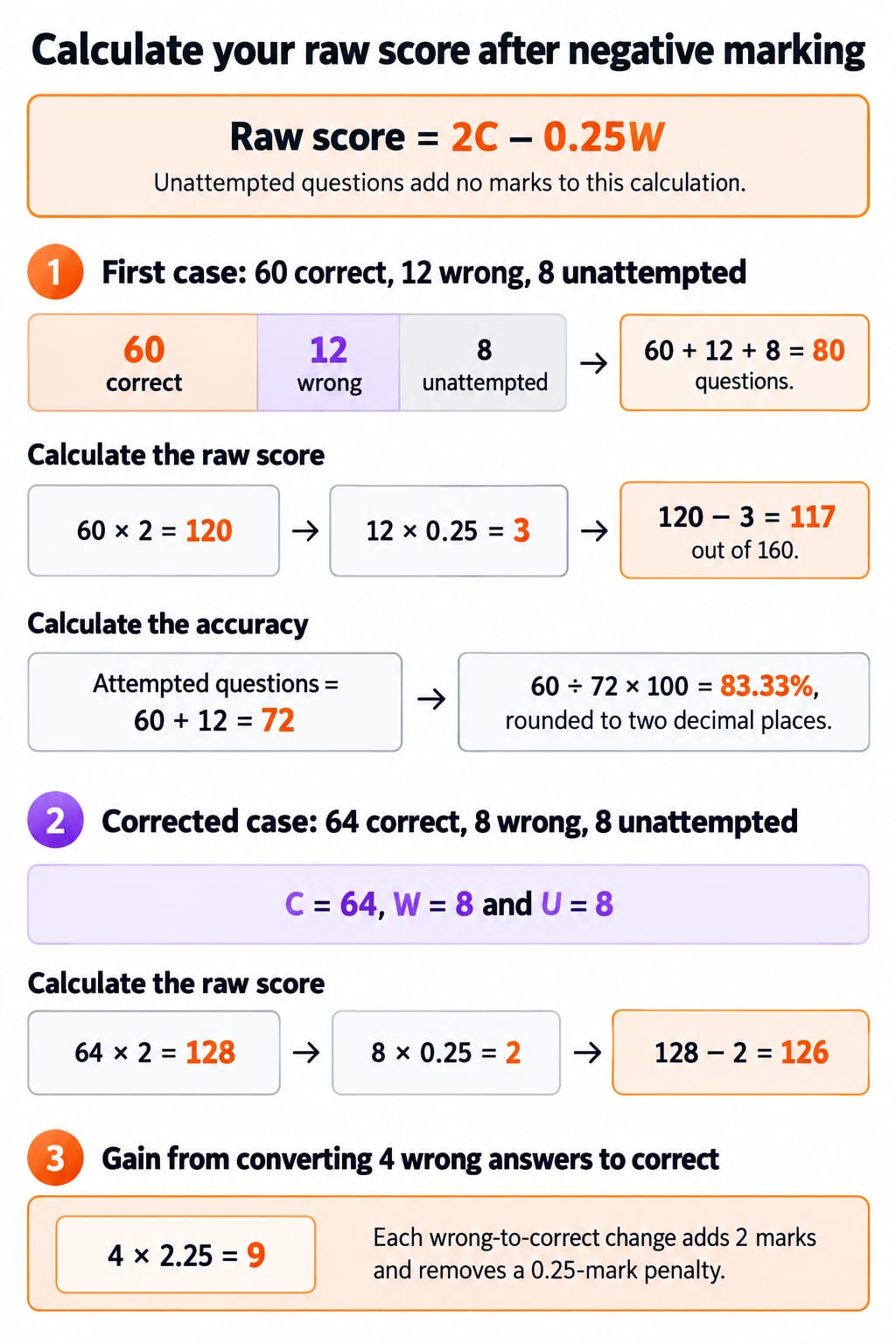
Let C mean correct answers and W mean wrong answers. Using the marking rule above:
Raw score = 2C - 0.25W
Unattempted questions add no marks to this calculation. Consider a hypothetical paper with 60 correct, 12 wrong and 8 unattempted answers:
Account for the paper: 60 + 12 + 8 = 80 questions.
Calculate correct-answer marks: 60 x 2 = 120.
Calculate the penalty: 12 x 0.25 = 3.
Subtract it: 120 - 3 = 117 out of 160.
Attempted questions = 60 + 12 = 72. Attempted-answer accuracy = 60 / 72 x 100 = 83.33%, rounded to two decimal places. Accuracy describes the proportion of attempts answered correctly; it is not your marks percentage.
Now correct four of those wrong answers, leaving attempts unchanged. The new counts are C = 64, W = 8 and U = 8. Correct-answer marks become 64 x 2 = 128; the penalty becomes 8 x 0.25 = 2. Your score is 128 - 2 = 126, a gain of 9 marks.
Each wrong-to-correct change adds 2 marks and removes a 0.25-mark penalty: 4 x 2.25 = 9. These hypothetical examples show how accuracy changes affect raw marks.
Why a raw score is not a selection prediction
Under paragraph 12.1.5 of the same notice, normalised CBE scores and applicable NCC certificate bonus marks determine final merit and cut-off marks. The calculation above gives your raw marks before those adjustments.
Keep three questions separate: how many raw marks did your answers earn, have you met the qualification requirements, and have you been selected? A mock calculation answers only the first.
Use raw marks to compare practice performance under the same scoring rules. Track the trend across mocks to assess your practice progress. Its useful message is which mistakes and delays you should repair next.
Turn the 60-minute paper into a practice plan
Try this allocation in your next mock:
Activity | Minutes |
|---|---|
Reasoning | 15 |
General Awareness | 10 |
Mathematics | 20 |
Language | 10 |
Review | 5 |
Total | 60 |
This is adjustable advice, not an SSC sectional timer. Spending four minutes on one difficult problem uses 4 x 60 = 240 seconds. At the average pace above, that is 240 / 45 = 5.33 average-question time slots, rounded.
Practise an easy first pass, flagging difficult questions and returning to them. Check navigation and flagging in SSC's official mock interface in Candidate's Corner before relying on a workflow. Practise mental and rough-sheet arithmetic because calculators are barred.
After two mocks, compare actual section times with your allocation. Transfer time towards the section where extra minutes produce useful correct answers, retaining the review reserve. Use your practice evidence to decide which uncertain answers to attempt or skip.
Review mistakes by lost marks and causes
Record the cause and a specific repair action. For example:
Section | Topic | Result | Cause | Repair |
|---|---|---|---|---|
Elementary Mathematics | Percentage calculation | Wrong | Multiplied by 0.2 instead of 1.2 | Redo three percentage-increase exercises; retest tomorrow |
A 20% increase on 250 gives 250 x 1.2 = 300. Multiplying 250 x 0.2 gives 50, the increase alone; adding it back gives 250 + 50 = 300.
Distinguish concept gaps, arithmetic slips and time overruns. They need different repairs: relearning, calculation checks or pacing practice. On the next mock, count whether the same error types recur.
The SSC CGL mock-analysis error ledger explains a reusable review method. Adapt the CGL review method using GD's scoring inputs, and track improvement through marks and recurring errors.
Choose the next practice session from your weakest section
Complete one timed mock, calculate raw marks and attempted-answer accuracy, then repair one recurring error category. Choose the next practice set from that evidence rather than repeating a comfortable topic.
For additional lessons in overlapping subjects, inspect the SSC CGL Tier 1 course. Choose lessons from this CGL course that match GD's syllabus and difficulty level, alongside preparation for GD's other requirements.
Bring the corrected method into your next timed session. The useful outcome is fewer repeated errors while keeping enough time to review your answers.
Keep learning

SSC GD Constable: How to Analyse Your PYQs and Plan Practice
Old papers become useful when you record the method behind each question. Build a syllabus-backed topic map, separate repeated concepts from repeated wording, and turn mistakes into specific practice tasks.
Updated 6 Nov 20265 min readSSC GD Constable

SSC GD Constable Syllabus: What to Study in Every Section
Turn the SSC GD syllabus into useful study sessions. Work through reasoning, arithmetic and language examples, then use a four-section diagnostic to decide what to revise next.
Updated 4 Nov 20265 min readSSC GD Constable

SSC GD Constable Eligibility: Age, Qualification and Selection Stages
Check your SSC GD documents against the right dates and understand what follows the written examination. Worked examples explain age boundaries, chest expansion and the difference between preparation gaps and eligibility questions.
Updated 29 Oct 20264 min readSSC GD Constable

SSC GD Constable Preparation Strategy: A 12-Week, 15-Hour Plan
Unsure whether to revise, repair weak topics or take another mock? Use this adaptable 12-week plan to budget study hours, track mistakes and keep physical preparation on your calendar.
Updated 31 Oct 20265 min readSSC GD Constable