SSC CGL General Awareness: Build a Durable Static GK Core
Stop collecting isolated GK facts. Build a 60-card revision spine that connects provisions, timelines, maps, formulas and units for reliable recall.
KnowledgeGate Team
Exam prep & CS education
Updated 1 Aug 20267 min read
You collect one-off GK facts, then cannot retrieve them a week later. A structure tells each fact where it sits and what triggers it.
Build a revision spine across polity, history, geography, economics and science, with current affairs as a changing layer. Each fact then arrives with a neighbour, a contrast and a question that pulls it back out.
Start with the SSC scope, then separate static GK from current affairs
SSC describes General Awareness broadly in its Combined Graduate Level syllabus: the surrounding environment and society, current events, everyday scientific observation, and India and neighbouring countries, especially history, culture, geography, the economic scene, general policy and scientific research. It is not a closed list of microtopics. The full SSC CGL syllabus map shows where the subject sits among the four Tier I areas, and the government-exam preparation hub covers the wider study path.
Ask whether each answer should remain stable. Article 280, the Regulating Act of 1773, India's standard meridian at 82 degrees 30 minutes east, the real-output formula and Ohm's law belong in the static core. New office-holders, recent index releases and policy changes belong in a dated current-affairs layer. Never attach a current name or rate to an evergreen card. The daily sampling habit and monthly compression that the changing layer needs are set out in the SSC CGL General Awareness approach.
Make 12 anchor cards in each of five folders. That gives 5 x 12 = 60 cards, few enough to rewrite one whole folder in a sitting. Every card has exactly four fields: term, defining relation, one contrast, one retrieval question.
Polity: connect provision, institution and function
Build relations, not a loose list of article numbers.
Provision | Defining relation |
|---|---|
Article 14 | Equality before law and equal protection of the laws |
Article 32 | Right to move the Supreme Court for enforcement of Fundamental Rights |
Article 280 | Constitution of the Finance Commission by the President |
Article 324 | Superintendence, direction and control of elections vested in the Election Commission |
Consider: Which constitutional body recommends how the net proceeds of certain taxes are distributed between the Union and the States? The verb recommends distribution points to Article 280, then the Finance Commission. The Comptroller and Auditor General, anchored to Article 148, audits. The Goods and Services Tax Council, anchored to Article 279A, recommends on GST matters.
The finished card is: Article 280 | Finance Commission | Union-State tax distribution recommendation | not CAG or GST Council.
All three concern public finance, so the names alone are weak cues. Classify the verb as audit, recommend distribution, or recommend GST matters, then retrieve the institution.
History and culture: build cause-and-consequence chains
Use this six-node constitutional-development spine:
Regulating Act 1773 -> Government of India Act 1858 -> Indian Councils Act 1909 -> Government of India Act 1919 -> Government of India Act 1935 -> Indian Independence Act 1947
Give every node its one consequence. 1773 brought the Company under parliamentary supervision and created the Governor-General of Bengal. 1858 moved Indian government from the Company to the Crown. 1909 introduced separate electorates. 1919 split provincial subjects into transferred and reserved halves. 1935 granted provincial autonomy and set out a federal scheme. 1947 divided British India into two independent dominions. The consequence is the cue that retrieves the year, so keep the sequence intact rather than squeezing the freedom movement into six lines.
Sort 1935, 1773, 1947, 1909, 1858, 1919. The result is 1773 -> 1858 -> 1909 -> 1919 -> 1935 -> 1947. Which listed Act immediately follows the Indian Councils Act 1909? The chain gives the Government of India Act 1919 and blocks 1935, the other familiar option.
For culture, record an object or site, its location, its period or tradition, and one contrast. A finished card: Sun Temple | Konark, Odisha | thirteenth-century Eastern Ganga temple built as a stone chariot | not the Chennakesava temple at Belur, which is Hoysala. Do not attach a monument to a dynasty merely because both sit in a broad medieval era.
Geography: layer the map with coordinates and direction
Before adding place names, fix the Tropic of Cancer at about 23 degrees 30 minutes north, India's standard meridian at 82 degrees 30 minutes east, and Indian Standard Time at UTC plus 5 hours 30 minutes.
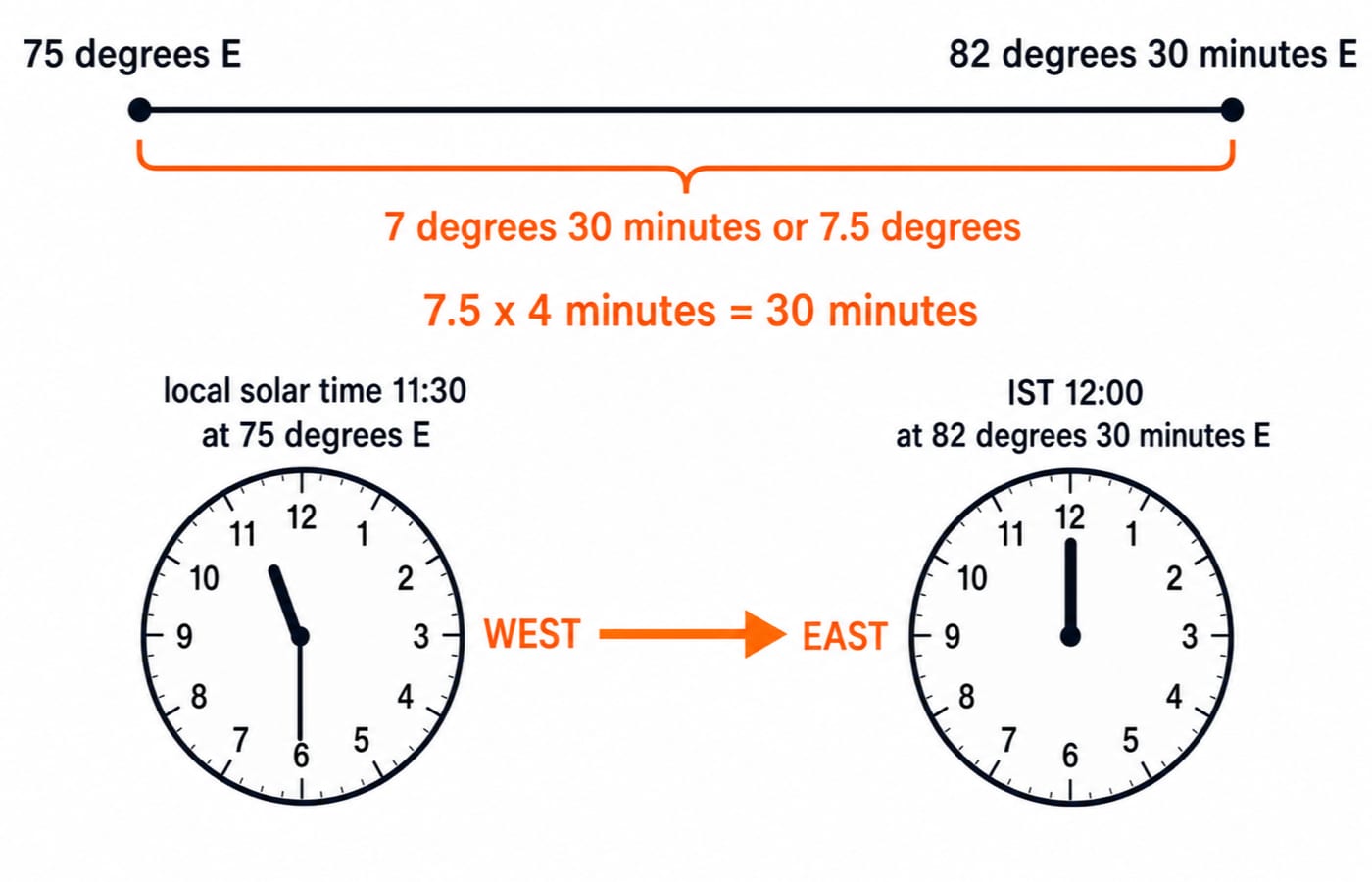
Now compare 75 degrees east with 82 degrees 30 minutes east. Convert the standard meridian to 82.5 degrees. The difference is 82.5 - 75 = 7.5 degrees, or 7 degrees 30 minutes. Earth rotates through one degree of longitude in about 4 minutes, so the solar-time difference is 7.5 x 4 = 30 minutes.
Since 75 degrees east lies west of the standard meridian, its local solar time is about 11:30 when IST is 12:00. Direction decides whether to add or subtract.
Economics: pair each term with a formula and direction
Use the stable relation real output index = nominal output index / deflator x 100. Nominal output carries the price-level effect. The deflator removes that effect so different periods share a constant price basis.
Suppose the base-period nominal output index is 200 and its deflator is 100. Its real output index is 200 / 100 x 100 = 200. Later, the nominal index is 230 and the deflator is 110:
later real output index = 230 / 110 x 100 = 209.0909..., which rounds to 209.09.
Calculate growth from the unrounded value:
real growth = [(230 / 110 x 100) - 200] / 200 x 100 = 4.5454...%, which rounds to 4.55%.
The nominal rise is (230 - 200) / 200 x 100 = 15%, but that is not real growth. The card contrast is nominal includes price-level change | real holds the price basis constant.
Science: keep law, unit, calculation and condition together
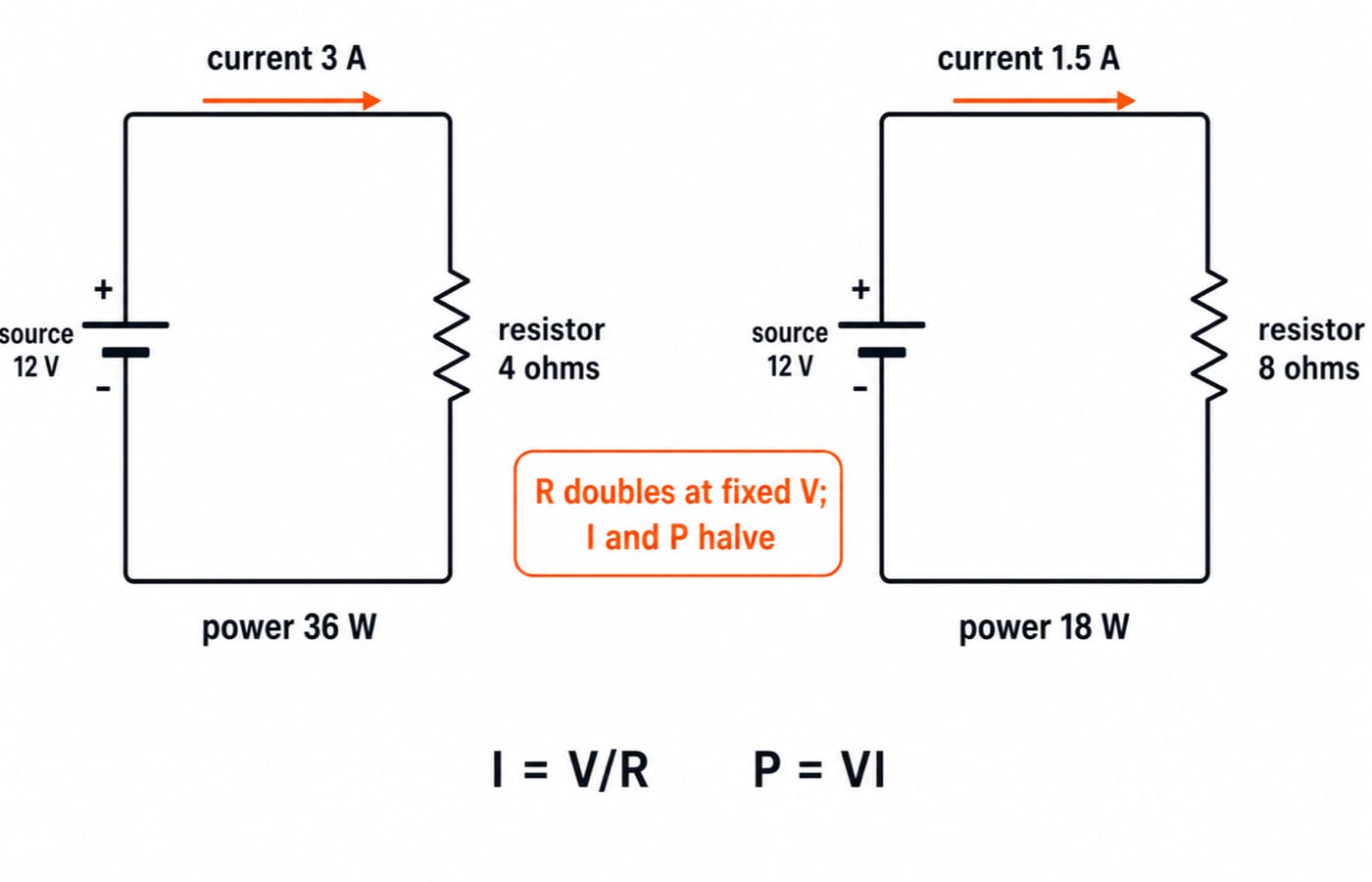
For a 12 V source across a 4 ohm resistor, Ohm's law gives I = V/R = 12/4 = 3 A. Electrical power is P = VI = 12 x 3 = 36 W.
If resistance rises to 8 ohms at the same 12 V, current becomes I = 12/8 = 1.5 A and power becomes P = 12 x 1.5 = 18 W. At fixed voltage, doubling resistance halves both. The held-constant condition matters.
For biology and chemistry, use entity, function or property, unit or condition where relevant, and a confusable alternative. A finished card: haemoglobin | carries oxygen in red blood cells, iron at the centre of the haem group | not chlorophyll, which sits in plant chloroplasts and holds magnesium. This creates a retrieval route, not another catalogue.
How SSC tests the core, and the traps that cost marks
General Awareness is asked as objective multiple-choice questions in Tier I, and again in Tier II Paper I, so the same core is examined twice at different depths. The question count, the marks it carries and the negative-marking rule for the current cycle are in the notification on the official SSC website; confirm them there before you set a target score.
Five checks, one per pillar, each with the trap it punishes and the cue that defeats it:
Polity: map tax-distribution recommendation to Article 280 and the Finance Commission. Trap: any finance body. Cue: recommend distribution.
History: place 1909 before 1919. Trap: jumping to 1935. Cue: the six-node chain.
Geography: obtain 30 minutes and subtract westward. Trap: adding. Cue: west is earlier.
Economics: obtain 209.09 and 4.55% real growth. Trap: the 15% nominal rise. Cue: remove the deflator.
Science: obtain 3 A and 36 W from 12 V and 4 ohms. Trap: lost units or mixed formulas. Cue:
I = V/R, thenP = VI.
Recurring traps are same-domain institutions, reversed chronology, east-west sign errors, nominal-real confusion, and formulas without units. Tie every mock miss to one retrieval cue rather than to a topic name.
The short version: revise a small core until it is retrievable
Repeat a seven-day pass. On Days 1 to 5, build or repair 12 cards for one pillar each day. On Day 6, answer a 25-question mixed set without notes. On Day 7, rewrite only missed relations and calculations. After four passes, retain error-producing cards and retire those recalled correctly in three consecutive mixed sets.
Remember the method: relation before list, chronology before date, map before place name, formula before statistic, and unit before answer.
Start the core alongside SSC CGL Tier 1. If you are already preparing beyond Tier I, the SSC CGL exam preparation page carries the Tier II course as well.
Keep learning
SSC MTS Eligibility and Selection Process: Age, Qualification and Stages
Check your qualification date and birth-date window before planning preparation. This dated SSC MTS example explains age relaxation, the two CBE sessions and Havaldar's additional physical tests.
Updated 5 Oct 20264 min readSSC CGL
SSC CHSL Cutoff Trends: Compare Results and Set a Target Score
Compare the right CHSL result rows before choosing a practice target. Work through a historical benchmark, a personal buffer and two mock-test blocks to decide what to improve next.
Updated 30 Sep 20264 min readSSC CGL
SSC CGL Cutoffs Explained: Compare Tiers, Posts and Categories
A practical test for deciding whether two SSC CGL cutoff figures are genuinely comparable, with completed-result examples and a worksheet for rejecting mismatched rows.
Updated 19 Aug 20265 min readSSC CGL
SSC CGL Mock Analysis: Build an Error Ledger That Guides Every Revision
Turn each useful mock error or delay into evidence, a focused drill, a retest date, and a clear decision to close or reopen the row.
Updated 17 Aug 20265 min readSSC CGL