TCS Aptitude Questions: High-Yield Quant and Reasoning Topics, Solved Step by Step
Learn the first move for common quant and reasoning question families through solved examples on ratios, work, trains, data, remainders, and seating.
KnowledgeGate Team
Exam prep & CS education
Updated 25 Sep 20266 min read103 views

Formulas are rarely the slow part of aptitude. The harder decision is choosing a useful representation before the arithmetic begins. The official TCS iON National Qualifier Test page describes its Cognitive assessment in terms of numerical, reasoning and verbal abilities, and numerical and reasoning practice becomes faster when each question family has a reliable first move.
TCS aptitude questions: build a method map before solving
Ratios and percentages, time and work, speed and distance, data interpretation, remainders, series, and seating arrangements form a useful practice map. They are high-leverage topics because a small set of decisions recurs across them: choose the base, convert a story to a rate, preserve units, or turn conditions into positions. Topic-level weightage can change, so use the official TCS iON page for the current assessment and organise method practice with the table.
Clue in the question | First representation |
|---|---|
Successive change or comparison | Fix the original base |
Workers with different completion times | Use common work units |
Moving objects | Convert to one speed unit |
Table or chart | Write the required denominator first |
Two remainder conditions | Write congruences |
Conditional arrangement | Number the slots or draw a grid |
For each mixed numerical or reasoning question, identify the first move and carry it through to a checked answer. Browse the Aptitude preparation section when one method needs more practice.
TCS percentages and ratios: keep one base throughout
Question: Quant and Reasoning practice groups are in the ratio 5:4. After 3 learners leave Quant and 12 join Reasoning, the groups are equal. Find the original sizes.
Let the original sizes be 5x and 4x. After the changes, the sizes are 5x - 3 and 4x + 12. Set them equal:
5x - 3 = 4x + 12, so x = 15.
The original sizes are Quant = 5 x 15 = 75 and Reasoning = 4 x 15 = 60. The condition checks: 75 - 3 = 72 and 60 + 12 = 72.
Now keep the base visible. Reasoning rises from 60 to 72, so the increase is 12/60 x 100 = 20%. If mock accuracy moves from 72% to 81%, it rises by 9 percentage points, while the relative increase is 9/72 x 100 = 12.5%. The denominator decides which claim the answer supports.
TCS time and work questions: preserve the same total
Question: A can complete a task in 15 days and B in 20 days. They work together for 4 days. C then joins, and all three finish the task in another 4 days. How long would C take alone?
Take total work as LCM(15, 20) = 60 units. A's rate is 60/15 = 4 units per day and B's is 60/20 = 3 units per day. In the first 4 days they complete 4 x (4 + 3) = 28 units, leaving 60 - 28 = 32.
All three finish 32 units in the next 4 days, so their combined rate is 32/4 = 8 units per day. A and B already contribute 7, which leaves C's rate as 1 unit per day. At that rate, C alone needs 60 days. The check is 28 + 4 x (4 + 3 + 1) = 60.
The earlier Arithmetic for Competitive Exams guide owns the basic rate-and-unit method. A change-point problem adds the next requirement: keep one total while the team composition changes.
TCS speed, time and distance: make every unit visible
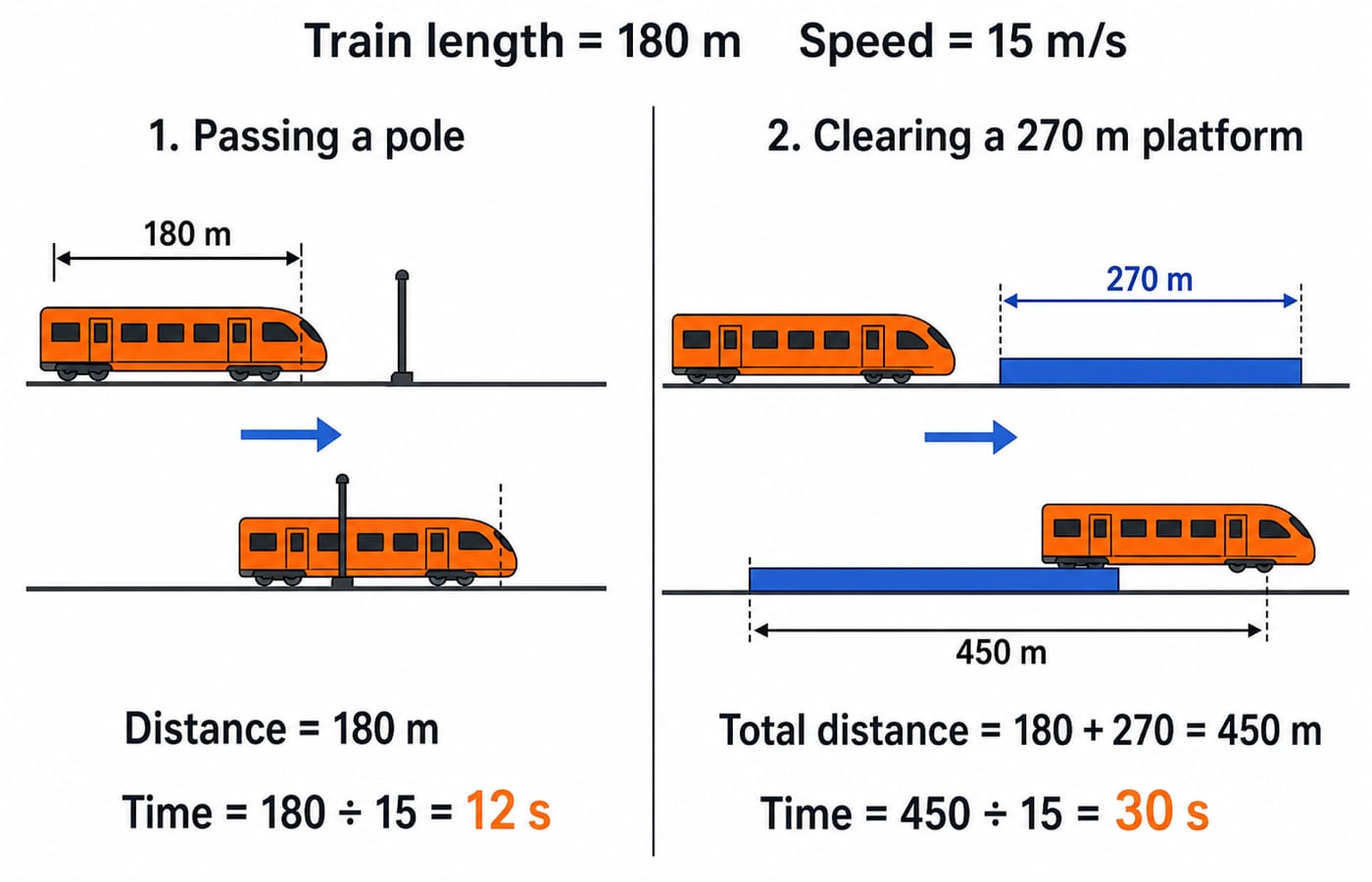
Question: A 180 m train passes a pole in 12 seconds. Find its speed and the time needed to clear a 270 m platform.
For the pole, the train covers its own length because the pole adds no length. Speed = 180/12 = 15 m/s. Converting units gives 15 x 18/5 = 54 km/h.
To clear the platform, the train's front travels 180 + 270 = 450 m. At 15 m/s, time = 450/15 = 30 seconds. Use the sum of lengths when a train clears a stationary object with length; a pole is a zero-length reference.
TCS data interpretation and number systems: control the denominator
Question 1: Compare the accuracy and correct-answer growth in this practice table.
Set | Attempts | Correct | Accuracy |
|---|---|---|---|
A | 120 | 84 | 84/120 = 70% |
B | 150 | 111 | 111/150 = 74% |
C | 180 | 144 | 144/180 = 80% |
From A to C, correct answers rise by 144 - 84 = 60. Relative to A's correct answers, the rise is 60/84 x 100 = 71.43%. Using 60/120 = 50% answers a different question because 120 is the attempt count. Estimate first: 144 is four-fifths of 180, so 80% is plausible.
Question 2: Find the smallest positive n that leaves remainder 5 when divided by 7 and remainder 8 when divided by 11. Write n = 7k + 5. The second condition gives 7k + 5 ≡ 8 (mod 11), so 7k ≡ 3 (mod 11).
The inverse of 7 modulo 11 is 8 because 7 x 8 = 56 ≡ 1 (mod 11). Therefore k ≡ 3 x 8 = 24 ≡ 2 (mod 11). With the smallest non-negative value k = 2, n = 7(2) + 5 = 19. Check both conditions: 19 mod 7 = 5 and 19 mod 11 = 8.
TCS logical reasoning questions: translate words into positions
Question: P, Q, R, S and T sit in one row facing north. R is in the middle. P sits two places to the left of R. T sits immediately to the right of R. Q is not at an end. Find the order.
Number the slots 1 to 5. R = 3, P = 1 and T = 4. Slots 2 and 5 remain. Since Q is not at an end, Q = 2 and S = 5. The unique order is P, Q, R, T, S. A final scan against every condition confirms it.
For a series, try differences before more complicated patterns. In 3, 8, 15, 24, 35, ?, the differences are 5, 7, 9 and 11. The next difference is 13, so the answer is 35 + 13 = 48.
For data sufficiency, test whether each statement fixes a unique answer. Try the first alone, the second alone, and then the pair if required. Stop once uniqueness is established; calculating a value is unnecessary when the question asks only whether the information is sufficient.
The earlier Logical Reasoning Principles guide owns the full constraint method, arrangements and syllogisms treatment. This mixed TCS set uses one compact arrangement to train the translation from prose to numbered slots.
TCS aptitude speed strategy: practise a two-pass 20-minute set
Set your own 20-minute practice timer for a 12-question mixed set. Spend the first 6 minutes on direct ratio, percentage and series questions. Reserve 11 minutes for work, motion, data interpretation and arrangements, then keep 3 minutes for denominators, conversions and marked answers.
If no equation, table or slot diagram appears after 60 seconds, mark the question and move. Run three drills. Shorten the total by 2 minutes only after scoring at least 10 out of 12 twice consecutively. These are practice controls, not an official TCS assessment duration.
Classify each miss as C for concept, M for method choice or A for arithmetic, then revise the dominant class. The TCS NQT preparation guide owns section planning and track selection; this drill isolates quant and reasoning method choice. Use the TCS NQT and Smart Hiring Test Series for TCS-focused simulation.
Finish with a TCS aptitude method checklist
Preserve one percentage base. Convert work into fixed units. Normalise motion units. Put the requested quantity above the correct denominator. Turn arrangement prose into numbered slots. For every question, follow clue → representation → calculation → unit or condition check.
Redo each worked question without looking at the steps. Then build one mixed set and record every C, M and A error. The useful result is not merely a faster answer; it is knowing which first move made the answer reliable.
Keep learning
Mensuration and Geometry for Competitive Exams: Formulas, Shortcuts and Solved Examples
Learn how to choose the right mensuration formula, avoid common geometry traps, and solve 2D path and 3D recasting problems step by step.
Updated 6 Oct 20266 min readAptitude & Reasoning
Age Comparison and Multiple-Condition Problems: 12 Solved MCQs
Practise 12 age-problem MCQs with equations, timelines, back-checks, relation chains, changing ratios, birth years, and family conditions.
1 Oct 20268 min readAptitude & Reasoning

True, False and Cannot Say Questions: 10 Solved Passage MCQs
Learn how to separate contradictions from missing evidence, then apply the method to 10 previous-year passage MCQs with concise, evidence-led solutions.
26 Sep 20268 min readAptitude & Reasoning
Data Interpretation for Competitive Exams: Concepts, Shortcuts and 4 Solved Sets
Learn a repeatable way to read Data Interpretation sets, choose the correct base, calculate efficiently, and check your answer. Four worked sets cover table, bar, pie and line data.
Updated 23 Sep 20266 min readAptitude & Reasoning