

TCP Header Fields MCQs: 12 Solved Questions on Sequence Numbers, Windows and Checksums
Solve 12 TCP header questions with the original stems and options, then check clear explanations for fields, sequence space, windows, checksums and payload size.
KnowledgeGate Team
Exam prep & CS education
Updated 18 Nov 20267 min read
A TCP header question rarely tests one isolated label. It can move from byte-oriented sequence numbers to window scaling, then ask about flags, checksum coverage or the payload left after two headers. Work each item before checking the explanation, and write the unit beside every numerical answer. After these 12 questions, continue with additional TCP header practice. If you first need the transport-layer distinction, revise TCP vs UDP: Transport Layer Explained, then try the adjacent TCP and UDP MCQs.
Read the TCP header as a 32-bit-wide map before solving
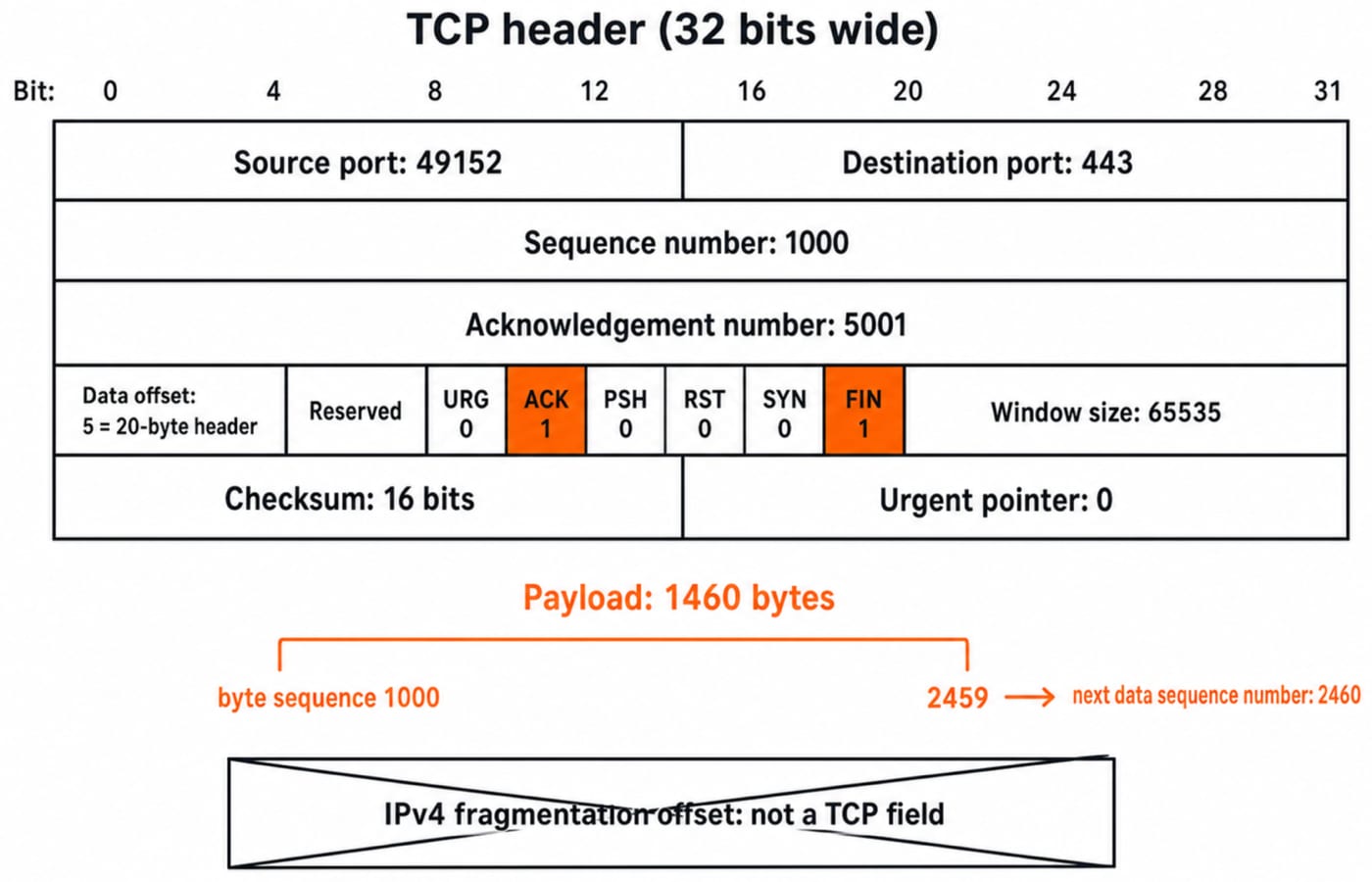
Fixed fields: ports are 16 bits; sequence and acknowledgement numbers are 32 bits; window, checksum and urgent pointer are 16 bits. Data offset counts 32-bit words, so 5 x 4 = 20 bytes is the minimum and 15 x 4 = 60 bytes the maximum. Options extend the base.
Sample: ports 49152 and 443; sequence 1000; acknowledgement 5001; offset 5; ACK=1; FIN=1; window 65535; 16-bit checksum; urgent pointer 0; payload 1460 bytes. Bytes 1000 through 2459 carry data; 2460 is consumed by FIN, so the receiver's next acknowledgement is 2461.
Fragmentation offset is IPv4. Question 12 assumes 65535 - 20 - 20 = 65495 bytes with minimum IPv4 and TCP headers.
Questions 1-3: fields, flags and TCP service properties
Question 1: TCP or IP field? (UGC NET 2023)
Which of the following is not a field in TCP header ?A. Sequence Number
B. Checksum
C. Fregmentation offset
D. Window sizeAnswer: C. Fragmentation offset. The option is printed as 'Fregmentation' in the original paper. Sequence number, checksum and window size are TCP fields. Fragmentation offset belongs to IPv4 and locates fragments, so C is non-TCP.
Question 2: the FIN flag (UGC NET 2015)
Which one of the following control fields in TCP header is used to specify whether the sender has no more data to transmit ?A. FIN
B. RST
C. SYN
D. PSHAnswer: A. FIN. FIN requests an orderly half-close. RST aborts, SYN synchronises sequence numbers, and PSH requests prompt delivery. FIN consumes one sequence position.
Question 3: TCP service properties (GATE 2015)
Consider the following statements.
I. TCP connections are full duplex
II. TCP has no option for selective acknowledgement
III. TCP connections are message streamsA. Only I is correct
B. Only I and III are correct
C. Only II and III are correct
D. All of I, II and III are correctAnswer: A. Only I is correct. TCP is full duplex and supports Selective Acknowledgment, so II is false. It is an ordered byte stream, so III is false. Writes of 600 and 400 bytes may be read as 1000 or two 500-byte chunks, with order intact.
Questions 4-5: byte sequence numbers and receiver flow control
Question 4: byte sequence numbering (GATE 2004)
In TCP, a unique sequence number is assigned to eachA. byte
B. word
C. segment
D. messageAnswer: A. byte. TCP numbers stream bytes. Starting at 1000, a 1460-byte segment covers 1000 through 2459, so the next starts at 2460. Segments and messages are not the unit.
Question 5: receiver flow control (ISRO 2008)
The TCP sliding windowA. can be used to control the flow of information
B. always occurs when the field value is 0
C. always occurs when the field value is 1
D. occurs horizontallyAnswer: A. can be used to control the flow of information. The receiver advertises capacity. Next expected byte 5001 with window 4000 permits 5001 through 9000, exactly 4000 positions. This is not Boolean and differs from the sender limit in TCP Congestion Control for GATE.
Questions 6-7: size a sequence-number field from bandwidth and lifetime
Question 6: valid myTCP lengths (GATE 2023)
Suppose you are asked to design a new reliable byte-stream transport protocol like TCP. This protocol, named myTCP, runs over a 100 Mbps network with Round Trip Time of 150 milliseconds and the maximum segment lifetime of 2 minutes.

Which of the following is/are valid lengths of the Sequence Number field in the myTCP header?A. 30 bits
B. 32 bits
C. 34 bits
D. 36 bitsAnswer: B, C and D: 32, 34 and 36 bits.
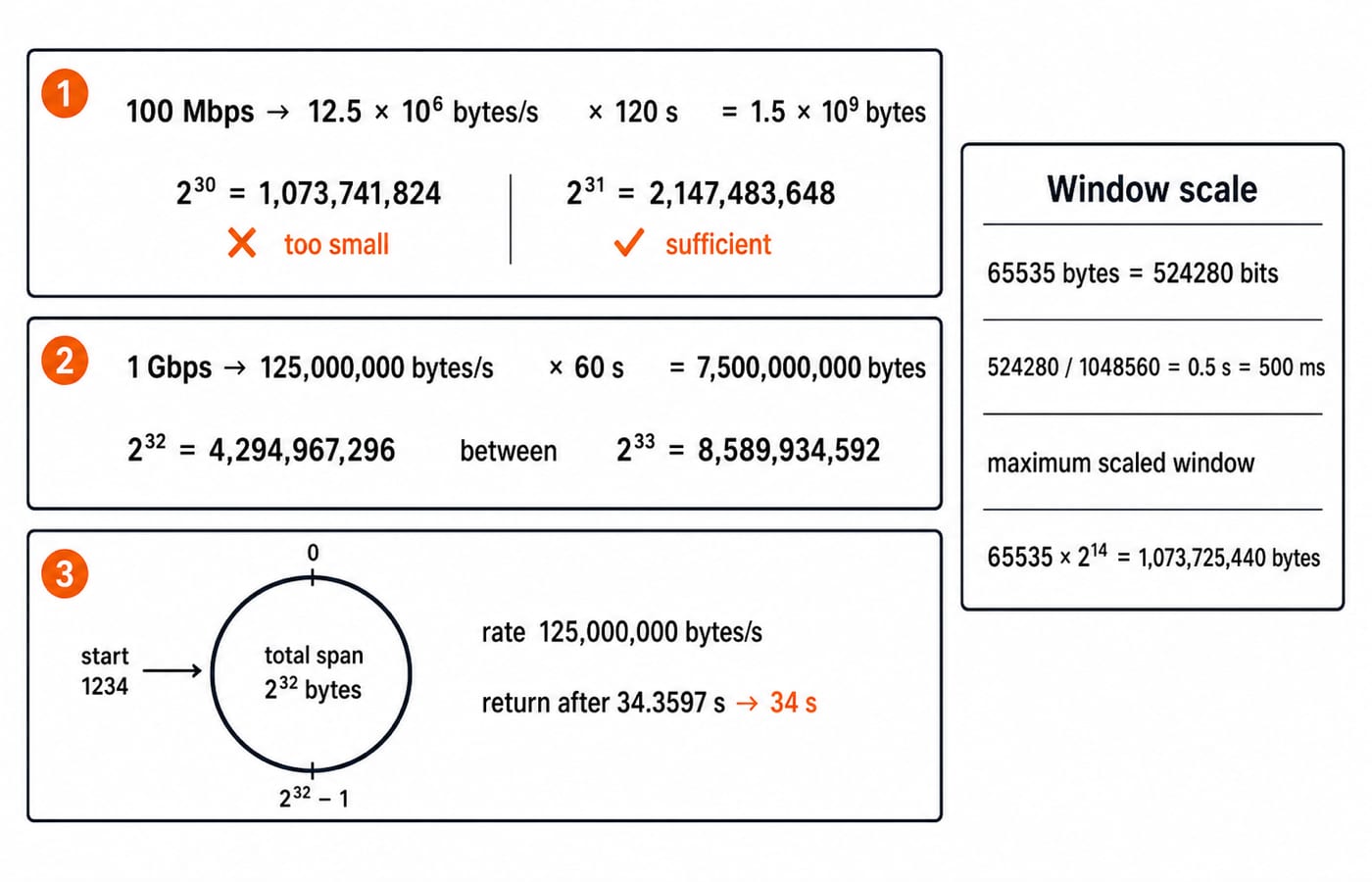
100 Mbps / 8 = 12.5 x 10^6 bytes/s, and 2 minutes = 120 s. Thus 12.5 x 10^6 x 120 = 1.5 x 10^9 bytes. Since 2^30 = 1,073,741,824 is too small and 2^31 = 2,147,483,648 sufficient, the minimum is 31 bits. Every listed length above it is valid. RTT is irrelevant here.
Question 7: minimum bits at 1 Gbps (GATE 2022)
Consider the data transfer using TCP over a 1 Gbps link. Assuming that the maximum segment lifetime (MSL) is set to 60 seconds, the minimum number of bits required for the sequence number field of the TCP header, to prevent the sequence number space from wrapping around during the MSL is ____________.Numerical answer type, so no options are given.
Answer: 33 bits. 1 Gbps = 125,000,000 bytes/s, which gives 7,500,000,000 bytes in 60 seconds. 2^32 = 4,294,967,296 is too small; 2^33 = 8,589,934,592 is sufficient.
Questions 8-9: wrap time and window scaling
Question 8: 32-bit wrap time (GATE 2018)
Consider a long-lived TCP session with an end-to-end bandwidth of 1 Gbps (= 10^9 bits per second). The session starts with a sequence number of 1234. The minimum time (in seconds, rounded to the closest integer) before this sequence number can be used again is _______.Numerical answer type, so no options are given.
Answer: 34 seconds. 2^32 = 4,294,967,296 byte positions and 1 Gbps / 8 = 125,000,000 bytes/s. Their quotient is 34.3597 s, which rounds to 34 s. Starting at 1234 changes labels, not the ring's duration.
Question 9: window scaling (GATE 2015)
Assume that the bandwidth for a TCP connection is 1048560 bits /sec. Let α be the value of RTT in milliseconds (rounded off to the nearest integer) after which the TCP window scale option is needed. Let β be the maximum possible window size with window scale option. Then the values of α and β areA. 63 milliseconds, 65535 x 2^14
B. 63 milliseconds, 65535 x 2^16
C. 500 milliseconds, 65535 x 2^14
D. 500 milliseconds, 65535 x 2^16Answer: C. 500 milliseconds, 65535 x 2^14. 65535 bytes = 524280 bits, so RTT = 524280 / 1048560 = 0.5 s = 500 ms. Shift 14 gives 65535 x 2^14 = 1,073,725,440 bytes; shift 16 is invalid.
Questions 10-12: checksum coverage, width and maximum payload
Question 10: checksum coverage (ISRO 2020)
Checksum field in TCP header is A. ones complement of sum of header and data in bytes
B. ones complement of sum of header, data and pseudo header in 16 bit words
C. dropped from IPv6 header format
D. better than md5 or sh1 methodsAnswer: B. ones complement of sum of header, data and pseudo header in 16 bit words. TCP sums 16-bit words from header, data and an IP-derived pseudo-header, then complements the sum. A omits that pseudo-header, C is false for TCP over IPv6, and D compares different mechanisms.
Question 11: checksum width (UP Police 2016)
The size of 'checksum' in TCP protocol header is _________ bits.A. 16
B. 8
C. 32
D. 4Answer: A. 16. The checksum is 16 bits, or 2 bytes, matching the 16-bit words in Question 10. Sequence and acknowledgement numbers are 32 bits; data offset is 4 bits.
Question 12: maximum payload (UGC NET 2015)
The maximum payload of a TCP segment is:A. 65,535
B. 65,515
C. 65,495
D. 65,475Answer: C. 65,495. Assume maximum IPv4 length, minimum headers and no options:
65,535 - 20-byte IPv4 header = 65,515 bytes65,515 - 20-byte TCP header = 65,495 bytes
B removes one header, A none, and D 60 bytes. This is not a universal application write limit.
Six traps these questions expose
Convert bit rate to byte rate before using
2^n.Separate a theoretical minimum from valid offered sizes.
Use RTT for windows and MSL for lifetime wrap.
Separate receive and congestion windows.
Fragmentation offset is IPv4; TCP checksum uses a pseudo-header.
65,495assumes IPv4 with minimum headers.
One-minute revision and the next practice route
Recall: minimum header 20 bytes; offset unit 4 bytes; sequence and acknowledgement 32 bits; window, checksum and urgent pointer 16 bits; sequence numbers count bytes; FIN ends one direction; unscaled window 65,535 bytes.
Recheck the three conversions without prose:
100 Mbps x 120 s / 8 = 1.5 x 10^9 bytes1 Gbps x 60 s / 8 = 7.5 x 10^9 bytes2^32 / 125,000,000 = 34.3597 s
Redo Questions 6, 7, 8, 9 and 12 unseen, then keep going with more TCP header practice. Use GATE Guidance by Sanchit Sir for structured study, and the GATE CS exam path for the wider route.
Keep learning
Go-Back-N Protocol MCQs: 12 Solved Questions on Windows, Sequence Numbers and Utilisation
Attempt 12 published Go-Back-N questions, then check every unit conversion, window calculation, retransmission step and answer against a worked explanation.
Updated 13 Nov 20268 min readComputer Networks MCQs
MPLS Explained: Label Switching, Header Fields and a Packet Walkthrough
See where an MPLS label comes from, why it changes at each hop, how the shim header is encoded, and when ordinary IP forwarding resumes.
Updated 12 Sep 20266 min read69 viewsComputer Networks

UDP Protocol and Header MCQs: 12 Solved Questions with Explanations
Solve 12 UDP questions, then check the reasoning behind connectionless service, application choices, the 8-byte header, and packet-length calculations.
Updated 31 Oct 20267 min readComputer Networks MCQs
TCP Connection Management & Reliability MCQs: 12 Solved Questions with Explanations
Practise 12 TCP connection management MCQs and MSQs on handshakes, sequence numbers, TIME-WAIT, persist probes, sender windows, resets and SYN floods.
Updated 18 Nov 20268 min readComputer Networks MCQs