

Go-Back-N Protocol MCQs: 12 Solved Questions on Windows, Sequence Numbers and Utilisation
Attempt 12 published Go-Back-N questions, then check every unit conversion, window calculation, retransmission step and answer against a worked explanation.
KnowledgeGate Team
Exam prep & CS education
Updated 13 Nov 20268 min read

Go-Back-N questions mix frames in the path, sender-window limits and safe sequence bits. Solve each problem from the stem and options, then check the conversion. Attempt each, then classify a miss as units, one-way versus round-trip delay, or the 2^m - 1 rule.
Go-Back-N formula map
T_t = L/R;a = T_p/T_t, with one-wayT_p;U = min(1, W/(1 + 2a)); useful rate= U x R.For RTT, use
R x RTT/L. Distinguish one-way pipe occupancy from full utilisation.With
mbits, Go-Back-N hasW_s <= 2^m - 1; receiver window= 1.
Use Go-Back-N Protocol Explained for sender and receiver rules, a six-frame loss trace, wraparound safety and the utilisation derivation. Then use these exam-attributed questions to test sequence-space, delay, window and retransmission reasoning.
Questions 1-3: sequence space and pipeline window size
Question 1: four-bit sequence numbering
UGC NET 2014. Open the solved question
Four bits are used for packed sequence numbering in a sliding window protocol used in a computer network. What is the maximum window size ?
481516
Answer: 15. Four bits give 16 values; Go-Back-N allows 2^4 - 1 = 15. 2^(m-1) is the Selective Repeat trap.
Question 2: minimum sequence bits for a long, fast link
GATE 2015 (NAT). Open the solved question
Consider a network connecting two systems located 8000 kilometers apart. The bandwidth of the network is 500×10^6 bits per second. The propagation speed of the media is 4×10^6 meters per second. It is needed to design a Go-Back-N sliding window protocol for this network. The average packet size is 10^7 bits. The network is to be used to its full capacity. Assume that processing delays at nodes are negligible. Then, the minimum size in bits of the sequence number field has to be ___________.
This numerical-answer item has no options.
Answer: 8 bits. 8000 km = 8 x 10^6 m; T_p = 2 s; T_t = 0.02 s; a = 100; W >= 201. Seven bits cap 127; eight cap 255.
Question 3: optimal window from bandwidth and RTT
ISRO 2018. Open the solved question
Station A uses 32 byte packets to transmit messages to Station B using a sliding window protocol. The round trip delay between A and B is 80 ms and the bottleneck bandwidth on the path between A and B is 128 kbps. What is the optimal window size that A should use?
2040160320
Answer: 40. 32 bytes = 256 bits; 80 ms = 0.08 s; (128,000 x 0.08)/256 = 40.
Selective Repeat ARQ MCQs uses this same protocol-neutral calculation before applying Selective Repeat's half-space rule. Here, keep 40 as the shared pipeline baseline, then apply Go-Back-N's 2^m - 1 limit in Questions 5-6 and go-back retransmission behaviour in Question 11.
Questions 4-6: one trunk, three linked calculations
Question 4: transmission delay versus propagation delay
UGC NET 2022. Open the solved question
Based on the following passage, answer the Questions :A 3000 km long trunk operates at 1.536 Mbps and is used to transmit 64 bytes frames and uses sliding window protocol. The propagation speed is 6 microseconds per km.
The transmission and propagation delays are respectively
T_t = 333.33 microseconds,T_p = 18000 microsecondsT_t = 300 microseconds,T_p = 15360 microsecondsT_t = 33.33 microseconds,T_p = 1800 microsecondsT_t = 1800 microseconds,T_p = 33.33 microseconds
Answer: T_t = 333.33 microseconds,T_p = 18000 microseconds. 64 bytes = 512 bits; 512/(1.536 x 10^6) = 333.33 microseconds; 3000 x 6 = 18,000 microseconds.
Question 5: sequence bits for full efficiency on the same trunk
UGC NET 2022. Open the solved question
Based on the following passage, answer the Questions :A 3000 km long trunk operates at 1.536 Mbps and is used to transmit 64 bytes frames and uses sliding window protocol. The propagation speed is 6 microseconds per km.
The minimum number of bits required in the sequence number field of the packet is
6 bits7 bits5 bits4 bits
Answer: 7 bits. a = 18,000/333.33 = 54; W >= 109. Six bits allow 63; seven allow 127.
Question 6: efficiency when only six bits are available
UGC NET 2022. Open the solved question
Based on the following passage, answer the Questions:A 3000 km long trunk operates at 1.536 Mbps and is used to transmit 64 bytes frames and uses sliding window protocol. The propagation speed is 6 microseconds per km.
If only 6 bits are reserved for sequence number field, then the efficiency of the system is
0.5870.8750.5780.50
Answer: 0.578. W = 63; U = 63/(1 + 2 x 54) = 63/109 = 0.57798. 63/108 omits transmission.
Questions 7-8: satellite-link throughput and packet size
Question 7: maximum useful data rate with Go-Back-10
GATE 2004. Open the solved question
A 20 Kbps satellite link has a propagation delay of 400 ms. The transmitter employs the "go back n ARQ" scheme with n set to 10. Assuming that each frame is 100 bytes long, what is the maximum data rate possible?
5Kbps10Kbps15Kbps20Kbps
Answer: 10Kbps. T_t = 800/20,000 = 0.04 s. Ten frames give 8,000/0.84 = 9,523.8 bps, closest to 10Kbps.
Question 8: solve packet size from a target utilisation
GATE 2008. Open the solved question
A 1Mbps satellite link connects two ground stations. The altitude of the satellite is 36,504 km and speed of the signal is 3 × 10^8 m/s. What should be the packet size for a channel utilization of 25% for a satellite link using go-back-127 sliding window protocol? Assume that the acknowledgment packets are negligible in size and that there are no errors during communication.
120 bytes60 bytes240 bytes90 bytes
Answer: 120 bytes. 2 x 36,504 = 73,008 km, so T_p = 0.24336 s. From 0.25 = 127T_t/(T_t + 2T_p), T_t = 0.00096 s; L = 960 bits = 120 bytes. One altitude leg gives 60 bytes.
Questions 9-10: frames in transit and the sender's wait
Question 9: minimum bits to distinguish in-flight frames
GATE 2009. Open the solved question
Frames of 1000 bits are sent over a 10^6 bps duplex link between two hosts. The propagation time is 25 ms. Frames are to be transmitted into this link to maximally pack them in transit (within the link). What is the minimum number of bits (i) that will be required to represent the sequence numbers distinctly? Assume that no time gap needs to be given between transmission of two frames.
i = 2i = 3i = 4i = 5
Answer: i = 5. T_t = 1 ms, so the link holds 25 frames. Since 2^4 < 25 <= 2^5, five bits are needed.
Question 10: waiting after a 32-frame window
GATE 2009. Open the solved question
Frames of 1000 bits are sent over a 10^6 bps duplex link between two hosts. The propagation time is 25 ms. Frames are transmitted with no gap so that they are maximally packed in transit.
Let i be the minimum number of bits required to represent the sequence numbers distinctly, as calculated in Question 9.
Suppose the sliding-window sender has a window of 2^i frames and acknowledgments are always piggybacked. After sending 2^i frames, what is the minimum time the sender waits before starting the next frame? Choose the closest option and ignore processing time.
16 ms18 ms20 ms22 ms
Answer: 20 ms. The first frame takes 1 ms to transmit and 25 ms to propagate. Its piggybacked ACK rides a 1 ms reverse frame and propagates for another 25 ms, reaching the sender at 52 ms. The 32-frame burst ends at 32 ms, so the wait is 52 - 32 = 20 ms.
Questions 11-12: retransmission timeline and goodput
Question 11: every fifth transmission is lost
GATE 2006. Open the solved question
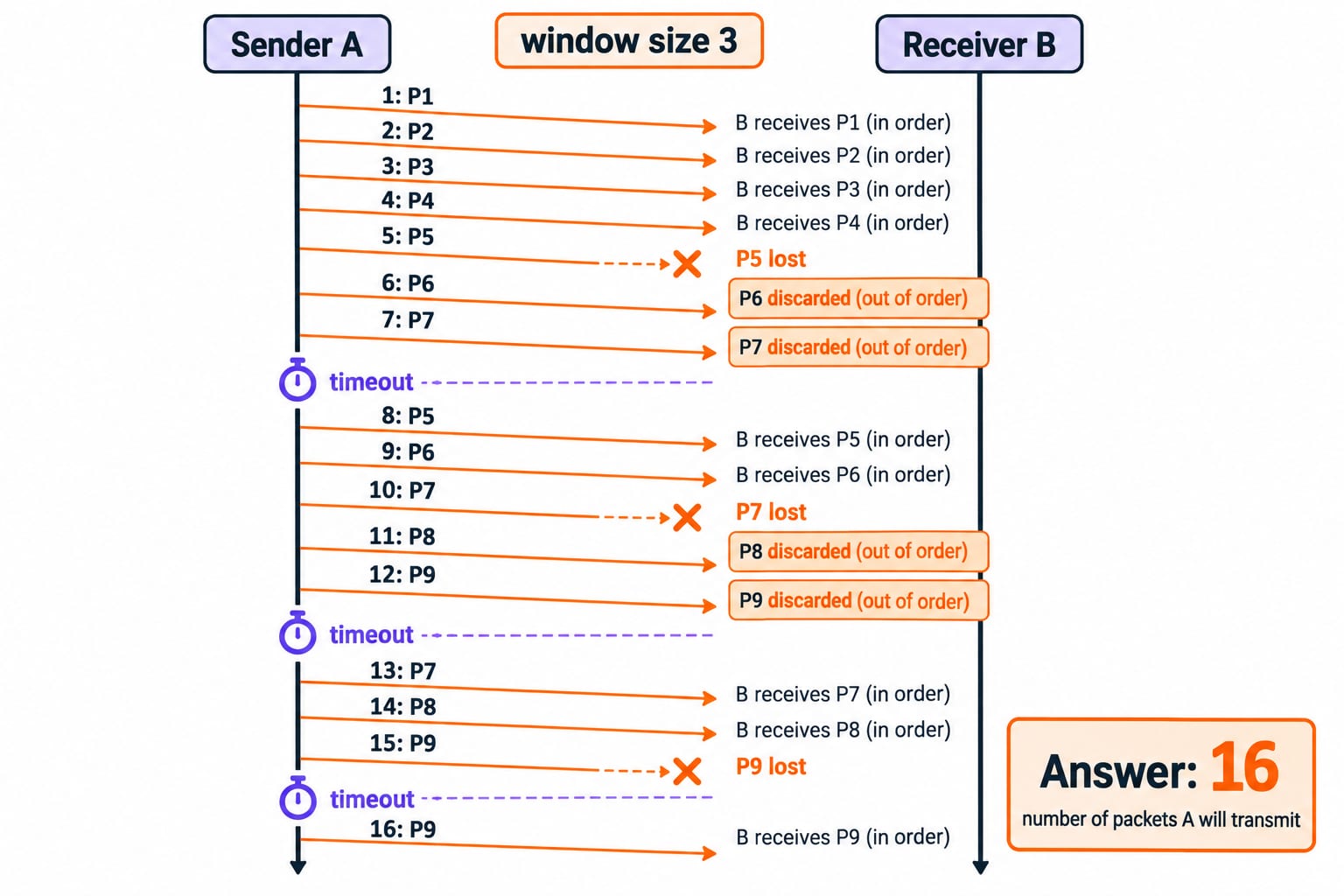
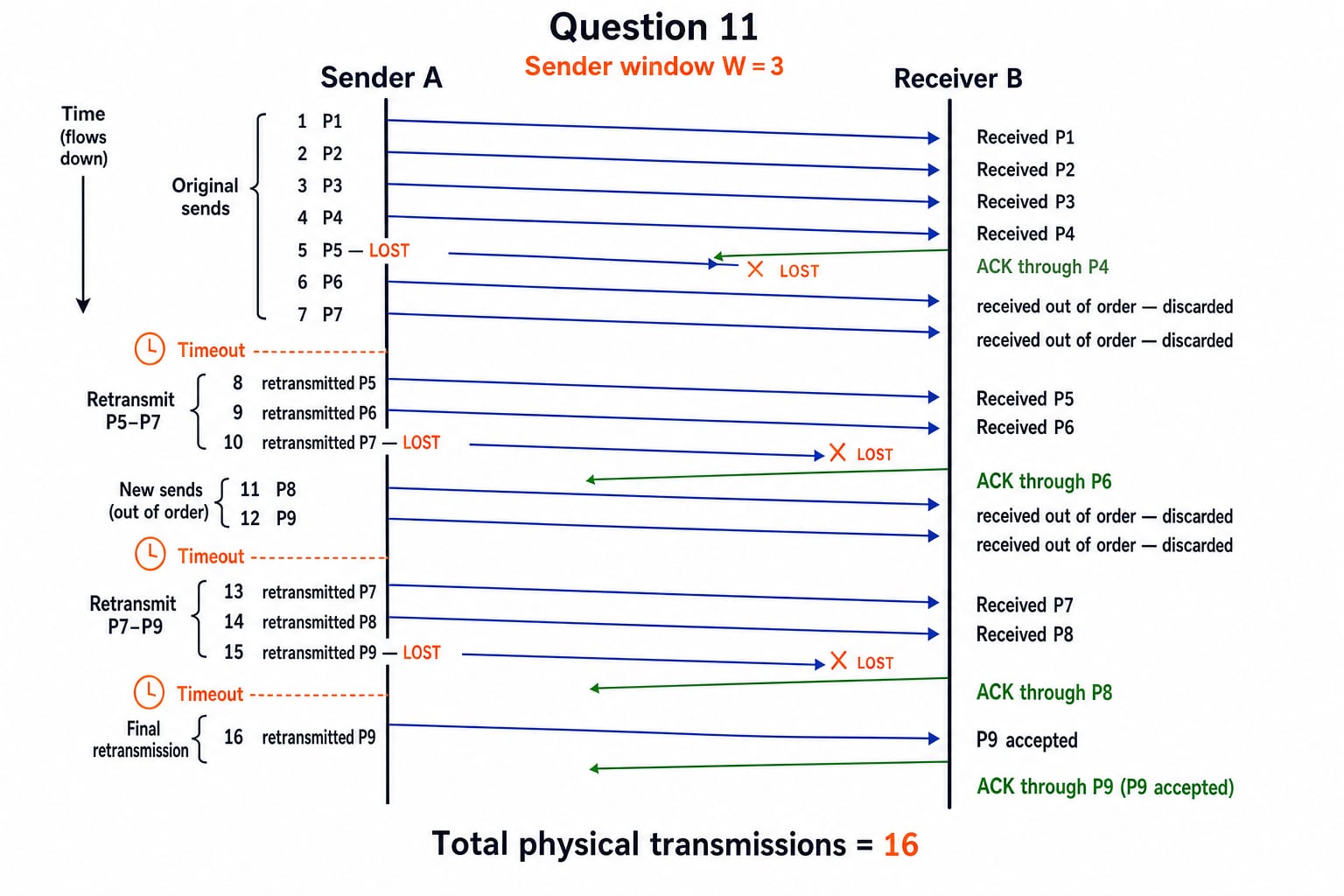
Station A needs to send a message consisting of 9 packets to Station B using a sliding window (window size 3) and go-back-n error control strategy. All packets are ready and immediately available for transmission. If every 5th packet that A transmits gets lost (but no acks from B ever get lost), then what is the number of packets that A will transmit for sending the message to B?
12141618
Answer: 16. Trace: 1:P1, 2:P2, 3:P3, 4:P4, 5:P5 lost, 6:P6 discarded, 7:P7 discarded; timeout; 8:P5, 9:P6, 10:P7 lost, 11:P8 discarded, 12:P9 discarded; timeout; 13:P7, 14:P8, 15:P9 lost; timeout; 16:P9.
Question 12: goodput after the initial pipeline fill
GATE 2006. Open the solved question
Suppose that it takes 1 unit of time to transmit a packet (of fixed size) on a communication link. The link layer uses a window flow control protocol with a window size of N packets. Each packet causes an ack or a nak to be generated by the receiver, and ACK/NAK transmission times are negligible. Further, the round trip time on the link is equal to N units. Consider time i > N. If only acks have been received till time i (no NAKs), then the goodput evaluated at the transmitter at time i(in packets per unit time) is
1 - N/ii/(N + i)11 - e(i/N)
Answer: 1 - N/i. Acknowledged packets = i - N, so goodput = (i - N)/i = 1 - N/i, approaching 1.
Go-Back-N MCQ score diagnosis and next step
Diagnose misses by model, not only by total score. Rework the matching question group without options, then check the invariant in the last column.
Missed questions | Rebuild | One-line check |
|---|---|---|
1, 2, 5, 6 | Sequence space and the legal sender window | W_s <= 2^m - 1 |
3, 4, 7-10 | Transmission time, propagation, RTT and pipe occupancy | Convert bytes to bits; double only a one-way delay |
11, 12 | Retransmission timeline and acknowledged goodput | Count every physical send; subtract the unacknowledged pipeline |
Use GATE Guidance by Sanchit Sir for coverage, GATE Test Series for timed practice, and GATE CS Exam for the broader path. Rework each miss until you can name its model.
Keep learning
Go-Back-N Protocol Explained: Sliding Windows, Worked Numericals and Exam Traps
Trace Go-Back-N through a lost frame, calculate its legal window and link utilisation, and avoid the ACK and wrap-around traps that spoil numericals.
Updated 24 Sep 20266 min readComputer Networks

TCP Header Fields MCQs: 12 Solved Questions on Sequence Numbers, Windows and Checksums
Solve 12 TCP header questions with the original stems and options, then check clear explanations for fields, sequence space, windows, checksums and payload size.
Updated 18 Nov 20267 min readComputer Networks MCQs

Selective Repeat ARQ MCQs: 12 Solved Questions on Window Size and Link Utilisation
Work through 12 Selective Repeat ARQ questions, from out-of-order buffering and sequence-space limits to sliding-window utilisation and bit-field numericals.
Updated 23 Aug 20268 min read54 viewsComputer Networks MCQs

HTTP Protocol MCQs: 12 Solved Questions with Explanations
Solve 12 HTTP Protocol questions on state, ports, methods, status codes, cookies, connections and RTTs. Each answer explains the decisive clue and the close distractors.
Updated 9 Nov 20268 min readComputer Networks MCQs