SBI PO Last 60 Days Plan: Four Revision Phases and a Mock Taper
Turn each mock into a revision decision with a 60-day countdown, phased practice, protected analysis time, and a lighter final week.
KnowledgeGate Team
Exam prep & CS education
Updated 5 Sep 20265 min read
With 60 days left, you have notes, mocks and weak areas, but no rule for what earns the next study hour. This planning model uses mock evidence to drive four revision phases, then tapers the load. It is not an official SBI timetable or cutoff prescription. Keep stage material together under Banking & Insurance Exam Preparation.
The model uses 20 hours per seven-day cycle: five 2-hour weekdays and two 5-hour weekend blocks. At 12 hours per week, the 60 days provide roughly 103 hours. The 22 four-hour mock-and-review windows use 88 hours, leaving about 15 hours for all other work. Scaling the other 84 planned hours to 60 percent would instead require about 138 hours in total, so keep the phase order and taper but fit all non-mock work into the remaining 15 hours.
1. SBI PO last 60 days: lock the stage and take a baseline
Before allocating a topic, open the active notice on the SBI careers page. Record your stage and its current official pattern. Treat that notice as the authority for stages, timings, question counts, marks, penalties, dates and cutoffs.
On Day 60, take one current-stage full mock using the live interface timing. Protect four study hours for the attempt, review and error tagging. This planning allocation is not the official exam duration. Record section-wise attempts, correct answers, accuracy and time-pressure points. Label errors as concept, execution, selection or guess. If your stage is unclear, use the SBI PO Prelims, Mains and Final Stage: A 12-Hour Week Plan.
2. Days 60-46: repair weak topics and take four full mocks
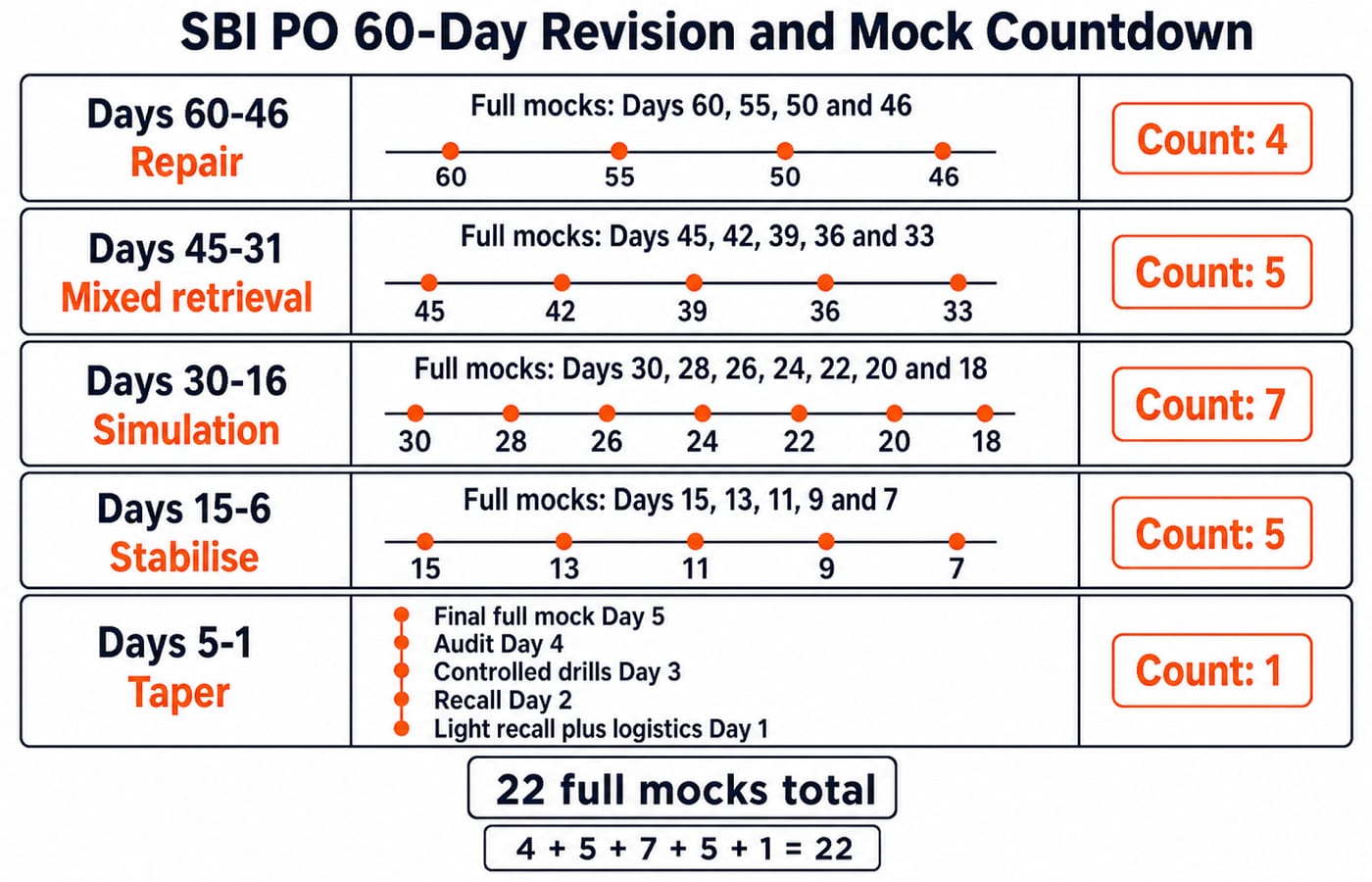
Take full mocks on Days 60, 55, 50 and 46. The 43-hour block contains 15 hours of concept repair, 8 hours of timed topic drills, 16 hours for four protected mock-and-review windows, and 4 hours of buffer: 15 + 8 + 16 + 4 = 43 hours.
Repair only the three weaknesses costing the most baseline correct answers. For each, learn the concept, solve 15 to 20 focused items, re-solve errors without notes, then test it in the next mixed mock. Prelims-stage readers can use SBI PO Prelims as a structured source for lessons and practice.
3. Days 45-31: replace chapter comfort with mixed retrieval
Take five full mocks on Days 45, 42, 39, 36 and 33. Allocate 20 hours to attempt-and-review windows, 13 to mixed timed sets, 6 to targeted repair and 4 to buffer: 20 + 13 + 6 + 4 = 43 hours. Use Days 32 and 31 to close unresolved errors, not add a mock.
Build each 30-item mixed set from 10 strong-area, 10 medium-area and 10 weak-area items. Review every wrong answer and every correct answer over your time target. If a 2-hour block is lost, move at most 60 minutes into the next buffer and remove 60 minutes of low-priority repetition. Do not double the next day or stack full mocks.
4. Days 30-16: use seven mocks to train selection and stamina
Take full mocks on Days 30, 28, 26, 24, 22, 20 and 18. Allocate 28 hours to seven mock-and-review windows, 8 hours to the highest-value repairs, 4 hours to previous-paper pattern review and 3 hours to buffer: 28 + 8 + 4 + 3 = 43 hours. Days 17 and 16 are for closing the log and retesting the top two failure types.
After each mock, choose no more than three actions. Write each as error, cause and next drill. For example: "left an easy set late; selection error; compare all set openings for 90 seconds in the next three mixed drills." "Improve reasoning" is too vague. A mains-stage reader can use SBI PO Mains for stage coverage, while checking current details with SBI.
5. Days 15-6: stabilise the range with five mocks
Take full mocks on Days 15, 13, 11, 9 and 7, then use each following day for review and repair. The rounded 29-hour budget is 20 hours for five mock-and-review windows, 5 hours for error-log drills, 2 hours for formula, vocabulary or fact recall, and 2 hours of buffer. Here, 20 + 5 + 2 + 2 = 29 hours.
Suppose your five personal mock accuracies are 78%, 82%, 81%, 84% and 83%. Sorted, they are 78, 81, 82, 83 and 84. The median is 82%, and the range is 84 - 78 = 6 percentage points. These invented values are planning examples, not an SBI cutoff or expected score.
If a later mock falls to 71%, audit sleep, set selection and repeated errors before rebuilding. Change the plan only if the same cause appears in two consecutive reviews.
6. Days 5-1: taper after the final full mock
Day 5 gets the final full mock and first review in a 4-hour window. Day 4 gets a 4-hour audit of errors and marked questions. Day 3 gets 3 hours of controlled section drills, Day 2 gets 2 hours of recall, and Day 1 gets at most 1 light hour for recall, logistics and shutdown. The taper is 4 + 4 + 3 + 2 + 1 = 14 hours.
Do not start a new topic or take another full mock after Day 5. A weak final mock does not justify an all-nighter. The taper protects recall, sleep and decision quality built during first 55 days.
7. SBI PO mock analysis: turn 80 attempts into the next six-day plan
Consider this fictional diagnostic, not an official paper:
Section | Attempts | Correct | Accuracy |
|---|---|---|---|
Quant | 22 | 18 | 18 / 22 = 81.8% |
Reasoning | 30 | 21 | 21 / 30 = 70.0% |
English | 28 | 25 | 25 / 28 = 89.3% |
Total | 22 + 30 + 28 = 80 | 18 + 21 + 25 = 64 | 64 / 80 = 80.0% |
The 16 wrong answers become a six-day, 360-minute repair plan:
Day 1: 60 minutes on reasoning set selection.
Day 2: 60 minutes on quant calculation and formula errors.
Day 3: 60 minutes on reasoning execution.
Day 4: 60 minutes on English grammar and rushed-reading errors.
Day 5: 30 minutes on reasoning and 30 minutes on quant.
Day 6: a 60-minute retest.
That is 60 + 60 + 60 + 60 + 30 + 30 + 60 = 360 minutes, equivalent to 60 x 6. Use SBI PO Previous Year Analysis: Read Papers for Section Difficulty to classify previous-paper evidence. Reduce a section's repair time only after its accuracy clears your personal target in two consecutive mocks.
8. SBI PO last 60 days: the short version and next step
The mock progression is 4, then 5, then 7, then 5, then 1: 4 + 5 + 7 + 5 + 1 = 22 full mocks. Review time stays protected, and no full mock comes after Day 5.
Choose SBI PO Prelims or SBI PO Mains only for your active stage. If you need no course, run the same calendar with your notes, the current official notice, live mocks and an error log. A mock is useful only when its mistakes change the next six days.
Keep learning
SBI SO Cutoffs: Check Corrections and Build a Practice Target
A cutoff becomes useful only when its post, category and score basis match your comparison. Work through a real SBI correction and a hypothetical target-setting exercise to plan your next mocks.
5 Oct 20264 min readSBI Exams
SBI SO Syllabus: Section-by-Section Study Map for IT Aspirants
Build an IT/System study map around your exact SBI post. Use a historical exam table, original worked exercises and an eight-hour sample week to turn topic lists into practice.
1 Oct 20265 min readSBI Exams
SBI SO Preparation Strategy: A 12-Week Role-Specific Plan
Build an SBI SO plan around the exact Specialist Cadre Officer post you are targeting. This guide gives an 11-hour weekly calendar, diagnostics, repair loops and separate written-test and interview branches.
Updated 24 Sep 20266 min readSBI Exams
SBI SO Exam Pattern and Marking Scheme: Post-Wise Routes Explained
There is no single SBI SO paper pattern. Use this guide to identify your post's route, understand qualifying and merit components, and build a timetable from the official notice.
Updated 22 Sep 20264 min readSBI Exams