RSSB Computer Instructor Syllabus: Basic vs Senior Topic Map and Boundaries
Separate the shared Paper I from Basic and Senior Paper II, see where technical depth changes, and build a revision plan that stays inside official RSSB wording.
KnowledgeGate Team
Exam prep & CS education
Updated 2 Aug 20266 min read60 views
Your long revision list may contain Rajasthan topics, office tools, programming, databases and networks, yet still leave you unsure what belongs to Basic, what belongs to Senior, and how far each heading goes. RSSB's Detailed Advertisement dated 22 May 2026 settles the split: one Paper I that both posts share, then 12 official Paper II headings for Basic and 16 for Senior. A heading earns space in your revision only when active RSSB wording names it, which stops both under-study and quiet expansion. Use the RSSB Computer Instructor preparation hub to compare routes, but check the live RSSB syllabus index again before acting.
Start with two post-specific maps and one shared Paper I
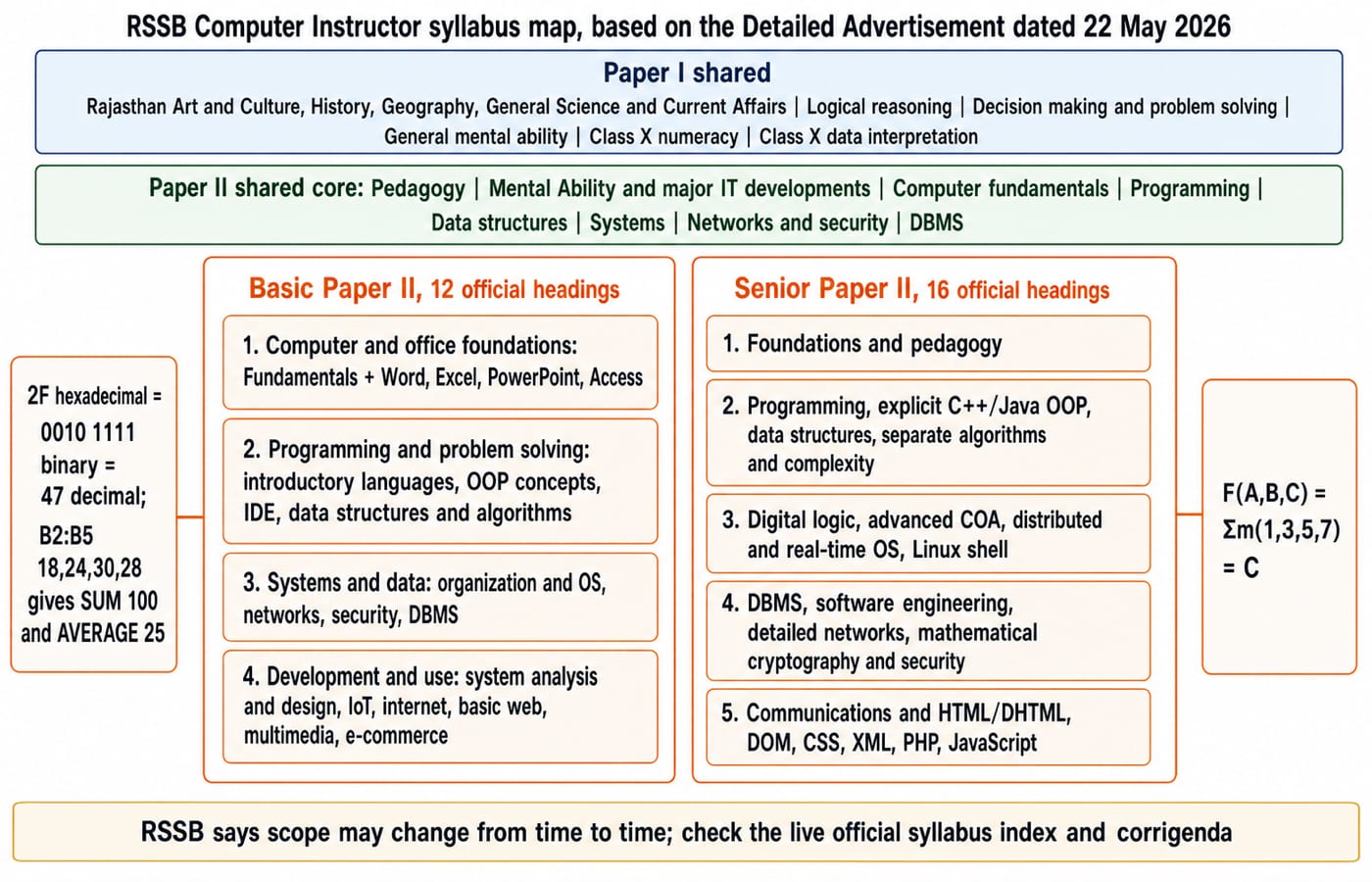
RSSB's 22 May 2026 advertisement gives both posts the same Paper I: Rajasthan Art and Culture, History, Geography, General Science and Current Affairs, plus logical reasoning, decision making, problem solving, general mental ability, Class X numeracy and Class X data interpretation. Keep it as a supporting lane, not a substitute for technical preparation.
Paper II needs separate Basic and Senior maps. Both open with pedagogy and mental ability before any computer science, then diverge in the depth each heading states. First choose Basic or Senior Computer Instructor. Keep RSSB's exact heading, assign a revision module, and add depth only when official subpoints or reliable RSSB previous papers support it. Course chapters and other exams cannot silently enlarge the scope.
Map the Basic syllabus into four bounded modules
The advertisement's 12 Basic Paper II headings fit four revision modules:
A, foundations and office: Pedagogy; Mental Ability; Fundamentals of Computer (I/O devices, decimal, binary, hexadecimal and files); Data Processing (Word, Excel, PowerPoint and Access).
B, programming: Programming Fundamentals; Data Structures and Algorithms.
C, systems and data: Computer Organization and Operating System; Communication and Network Concepts; Network Security; Database Management System.
D, development and use: System Analysis and Design; Internet of Things and its Application, including internet, web, HTML, XML, scripting, multimedia and e-commerce basics.
Two questions show where the Basic ceiling sits. Hexadecimal 2F has 2 = 0010 and F = 1111, so 2F = 0010 1111 in binary; in decimal, 2 x 16 + 15 = 32 + 15 = 47. For cells B2:B5 = 18, 24, 30, 28, =SUM(B2:B5) returns 100 and =AVERAGE(B2:B5) returns 100 / 4 = 25. Both stay inside bounded fundamentals and data processing, and neither reaches advanced architecture or financial modelling. The Basic Computer Instructor course structures that coverage, and Computer Fundamentals for Teaching CS Exams carries the number-system and office-tool revision.
Map the Senior syllabus by the depth it adds
The advertisement's 16 Senior Paper II headings form five modules:
A, pedagogy and foundations: Pedagogy, Mental Ability and Fundamentals of Computer.
B, programming and algorithms: Programming Fundamentals, OOP using C++ and Java, Data Structures and Algorithms, plus separate Algorithms covering traversals, branch and bound, greedy methods and complexity.
C, hardware and systems: Digital Logic Systems, Computer Organization and Architecture, and Operating Systems, including distributed client-server and RPC concepts, real-time OS, accounts, backup and restore, and Bourne shell.
D, data, engineering and networks: DBMS, Software Engineering, Data and Computer Networks, and Network Security.
E, communication and web: Basics of Communication and Web Development.
One Senior-only question type makes the depth gap concrete. For F(A,B,C) = Σm(1,3,5,7), the minterms are 001, 011, 101, 111. Each has C = 1 while A and B vary, so one four-cell K-map group gives F = C. Minimisation of that kind sits under the named Digital Logic Systems heading, which appears on the Senior map and not on the Basic one, so it does not become a Basic requirement merely because both posts test computers. The Senior Computer Instructor course is the matching structured route.
Read the overlap correctly: same label does not mean same depth
Official area | Basic boundary | Senior extension |
|---|---|---|
Programming | Language introductions, OOP concepts, IDEs | C, C++, Java, .NET and Python details; C++ and Java OOP; arrays, pointers, structures, unions, files and arguments |
Data Structures and Algorithms | Structures, sorting, searching | Traversals, branch and bound, greedy methods, complexity |
Computer Organization and OS | Organization, processes, files | Scheduling, deadlocks, memory, disks, RPC, real-time OS, Bourne shell |
DBMS | Design, RDBMS, NoSQL | Algebra, normalisation, indexing, transactions, concurrency |
Networks | Layers, devices, mobile basics | Media, LAN standards, IP, TCP, UDP, DNS |
Security | Viruses, firewalls, backup, LAN or WAN, ethical hacking | Finite-space maths, Euler, Fermat, primality, DES, AES, IDEA, RSA, key management, authentication, hashing, email security |
Web or internet | Basic HTML, XML, scripts, e-commerce | HTML or DHTML, DOM, CSS, XML, basic PHP, JavaScript |
Senior is more explicitly layered, not harder in every topic. List length never creates an official marks split.
Draw the outer boundary for the first pass
Admit a topic only when active RSSB wording names it, it is a prerequisite for a named subpoint, or reliable RSSB previous papers support it. Park everything else until the official core is complete.
React hooks and Next.js stay outside because Senior names HTML or DHTML, DOM, CSS, XML, basic PHP and JavaScript, not modern frameworks. Kubernetes administration stays outside because neither map names containers or orchestration. AES purpose and principles stay inside Senior Network Security because AES is named, but implementing the complete cipher stays outside. For Basic, firewall purpose and backup versus restore stay inside; tool-specific penetration-testing commands stay outside unless later wording or verified papers establish them. Neighbouring teaching-recruitment routes can provide context, but another board's syllabus cannot fill an RSSB gap.
Use the official scheme to size practice, not topic weightage
RSSB's advertisement shows Paper I and Paper II for each post as 100 questions, 100 marks and 2 hours each, with a one-third wrong-answer deduction. That sets paper-level structure, not marks for DBMS, programming, networks or another heading. Never infer weightage from bullet order or length.
Work the deduction once so it is instinctive. In a 100-question one-mark paper, 72 correct give 72 x 1 = 72; 18 wrong deduct 18 x 1/3 = 6; and 10 are deliberately unattempted with option E marked. The result is 72 - 6 = 66 marks. Read the ratio the other way and it becomes a guessing rule: three wrong answers cancel one correct answer, so a blind guess is not worth the risk, while a guess between two surviving options still pays. RSSB's advertisement carries its own OMR instructions, including how option E must be marked, so read them in the active notice.
The short version: audit the map and take the next step
Build this sheet before adding resources:
Official phrase | Basic, Senior or shared | Revision module | Evidence page or link | Status |
|---|---|---|---|---|
Digital Logic Systems | Senior | C, hardware and systems | 22 May 2026 Detailed Advertisement, Senior Paper II | Not started |
Data Processing (Word, Excel, PowerPoint, Access) | Basic | A, foundations and office | 22 May 2026 Detailed Advertisement, Basic Paper II | Not started |
Class X data interpretation | Shared | Paper I general lane | 22 May 2026 Detailed Advertisement, Paper I | Not started |
Create all 12 Basic rows or all 16 Senior rows. Choose the post, copy its headings verbatim, keep Paper I on its own sheet, take the depth column from the overlap table above, and park anything RSSB does not name. Then take the Basic or Senior course route that matches your chosen post, and compare both through the RSSB hub.
Finally, return to RSSB's live syllabus index and active corrigenda before each revision cycle, because a corrigendum can add or drop a heading after any map or course plan has been built.
Keep learning
RSSB Computer Instructor Syllabus Weightage: Prioritise Without Guesswork
Turn the Basic or Senior Computer Instructor syllabus into an auditable study order using coverage, authenticated PYQs, prerequisites and a holdout test.
Updated 4 Aug 20265 min readRSSB Computer Instructor
RSSB Computer Instructor vs DSSSB TGT CS: Role, Qualification and Location Fit
Choose between the RSSB and DSSSB routes only after checking eligibility, role preference, syllabus gaps and your real Rajasthan or Delhi commitment.
Updated 30 Jul 20266 min readRSSB Computer Instructor
RSSB Computer Instructor PYQs: Build a Weekly Study Plan From Every Paper
A score cannot tell you what to study next. This method turns each RSSB Computer Instructor PYQ into tagged evidence, a weekly repair queue and a fresh retest.
Updated 28 Jul 20265 min readRSSB Computer Instructor
RSSB Computer Instructor Eligibility and Exam Structure: Basic vs Senior Checklist
Check whether your exact qualification fits the Basic or Senior RSSB Computer Instructor route, then understand the two papers and negative marking.
Updated 25 Jul 20265 min readRSSB Computer Instructor