RSSB Computer Instructor vs DSSSB TGT CS: Role, Qualification and Location Fit
Choose between the RSSB and DSSSB routes only after checking eligibility, role preference, syllabus gaps and your real Rajasthan or Delhi commitment.
KnowledgeGate Team
Exam prep & CS education
Updated 30 Jul 20266 min read
For a CS graduate, RSSB Computer Instructor and DSSSB TGT Computer Science look interchangeable because the technical preparation overlaps. It does overlap, and the two routes still are not the same choice. Four things separate them, and any one of them can decide your answer on its own: the post label, the qualification gate, the route-specific syllabus edges and the Rajasthan-versus-Delhi commitment. Take them in that order, checking each against the current notification, before you give a year to either route.
RSSB Computer Instructor vs DSSSB TGT CS starts with the role label
Begin with what each recruiting route actually names, then verify that label in its current documents.
decision layer | RSSB route | DSSSB route | evidence to verify |
|---|---|---|---|
post label | Basic Computer Instructor | TGT (Computer Science) | current advertisement and recruitment rules |
jurisdiction | Rajasthan | Delhi | recruiting board and user-department notice |
reader's role question | instructor-focused work | school-subject teaching | official job description and service rules |
Do not infer duties or career paths from a course title. RSSB names an instructor grade and splits it into Basic and Senior, while DSSSB names a Trained Graduate Teacher whose taught subject is Computer Science: one label sits on an instructor ladder, the other on a school subject-teacher ladder. So settle which RSSB grade you are weighing against DSSSB TGT CS before anything else, and RSSB Basic vs Senior Computer Instructor covers that choice. Read the duty list itself off each board's job description and service rules, never off the post name.
RSSB and DSSSB qualification fit is a hard gate, not a preference score
Create this document sheet before scoring personal fit:
exact award title | branch or main subject | semester coverage | teacher-training credential | official equivalence proof |
|---|---|---|---|---|
copy from certificate | copy from mark sheets | list every available semester | copy exact credential and duration | attach the applicable official order |
Check every cell against current notifications. Neha records BCA, 3 years, Computer Science in all 6 semesters, B.Ed, 2 years, and all final certificates available. Mohit records BTech Information Technology, 4 years, 8 semester mark sheets, no teacher-training credential, and no equivalence order.
For both routes, Neha's award, subject, semesters and teacher-training evidence are match; equivalence needs official clarification. Mohit's award and semesters are match, branch needs official clarification, and absent teacher-training and equivalence evidence mismatch wherever mandatory. A match label only means the paperwork answers the question as asked. The recruiting board's own scrutiny decides eligibility, and it can read a branch name or an equivalence order differently from you.
RSSB vs DSSSB syllabus overlap: reuse the CS core, separate the edges
Build the map from RSSB's current detailed Computer Instructor advertisement and DSSSB's official indicative syllabus for TGT Computer Science.
Shared core: computer fundamentals, C/C++ programming and data structures, DBMS, computer organisation or architecture, operating systems, computer networks and security, software engineering, and web or Internet technology.
RSSB Basic emphasis named in its syllabus: pedagogy, mental ability, data processing and office tools, system analysis, and IoT.
DSSSB TGT CS additions named in its indicative syllabus: mathematics, physics, business communication and management, accounting or economics, statistics, numerical techniques, graphics and multimedia.
Marks and weightage come from the current notification, not from the size of these buckets. Rebuild all three from the new official document whenever either board revises its syllabus.
Combine the shared core in one revision plan, with separate route-edge checklists. This keeps reusable study visible without hiding specific gaps.
RSSB and DSSSB course mapping: assign each preparation layer honestly
Use each resource for the layer it actually covers.
preparation need | RSSB resource | DSSSB resource |
|---|---|---|
exam-specific technical syllabus | RSSB Basic Computer Instructor Course, structured coverage of the Basic Computer Instructor syllabus | DSSSB TGT CS 2026 Section B Course, full syllabus coverage with PYQs, mock tests and exam-focused strategy |
non-technical or common section | verify and schedule from the current RSSB syllabus | |
post choice | first resolve Basic versus Senior | first resolve the exact DSSSB post code and department |
Study the shared core once, from one source, and keep route-specific material for the edges. Running two full technical courses in parallel means revising the same DBMS and operating-systems chapters twice while the route edges stay untouched.
Rajasthan or Delhi: test the location commitment before choosing the exam
Ask for each route: Where can I live for 5 years? Can my family move? Which local-language and administrative context can I handle? Will I accept a posting outside my preferred city? Score yes as one; maybe as zero.
Candidate A records Delhi as yes + yes + yes + yes = 4/4 and Rajasthan as no + no + maybe + no = 0/4. Candidate B records Rajasthan as yes + yes + yes + yes = 4/4 and Delhi as maybe + no + yes + no = 1/4. A low score here is a warning about the move, not about the exam. Posting and transfer conditions themselves sit in each board's service rules, so read those before you treat a 4/4 as settled.
RSSB vs DSSSB fit score: two fully worked candidate decisions
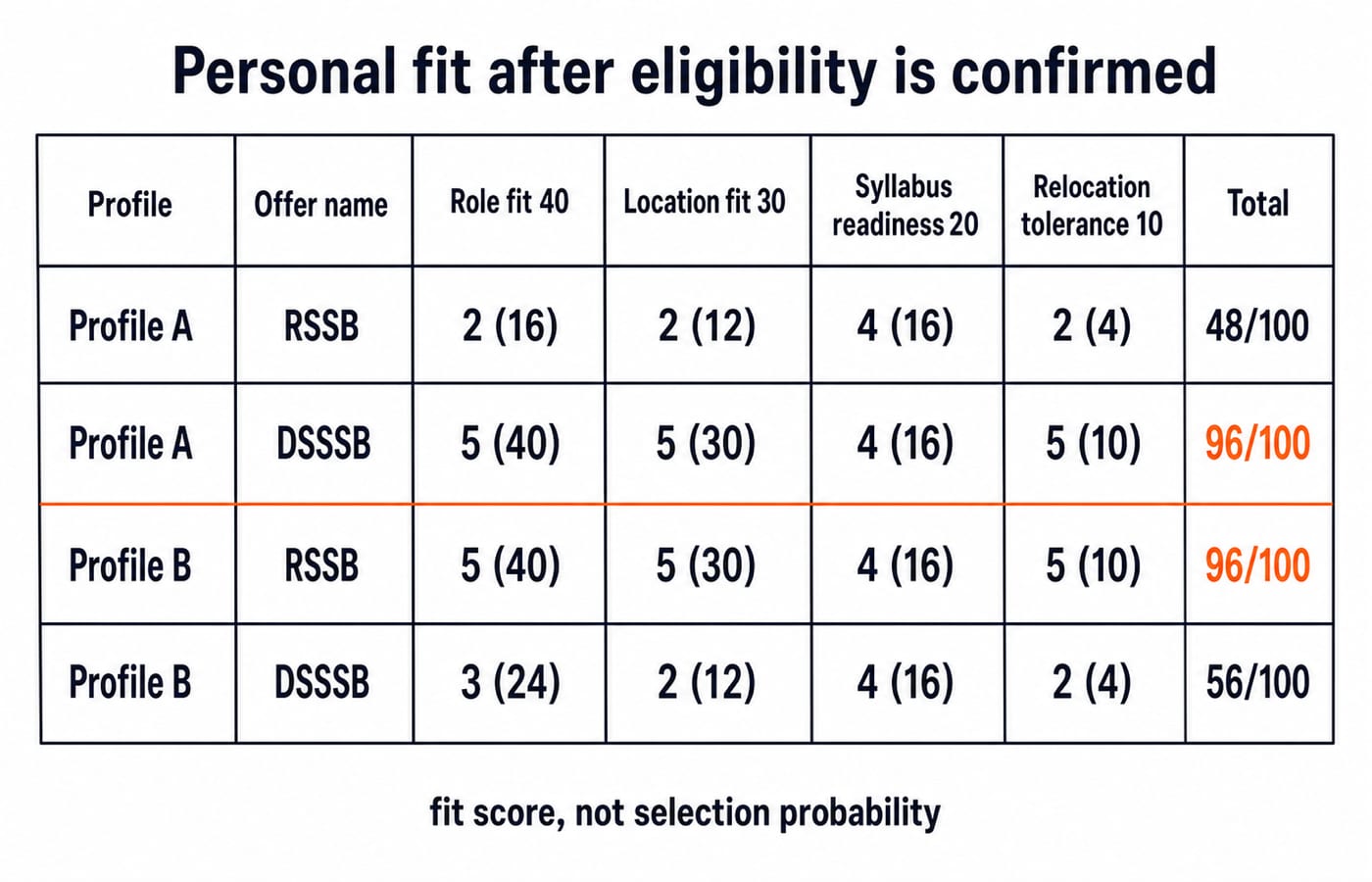
Score only after official qualification is confirmed yes. Weight role fit 40, location fit 30, syllabus readiness 20 and relocation tolerance 10. Rate each 1 to 5 and calculate rating / 5 x weight.
profile and route | ratings in weight order | weighted contributions | total |
|---|---|---|---|
Profile A, RSSB |
|
|
|
Profile A, DSSSB |
|
|
|
Profile B, RSSB |
|
|
|
Profile B, DSSSB |
|
|
|
The higher score names your primary preparation route. Cutoffs turn on the vacancies and the field in a given cycle, so a 96 buys you focus, not a safer mark.
RSSB and DSSSB dual preparation: use a 12-hour weekly split
Use 6 hours shared CS core + 3 hours primary-route topics + 2 hours PYQs or mock review + 1 hour notification and document log = 12 hours. A DSSSB-primary reader uses the 3-hour block for Section A or DSSSB-only topics. An RSSB-primary reader uses it for RSSB-only topics. Give the secondary route no dedicated time until the primary route's weekly work is complete.
If 3 hours disappear, keep 6 shared + 2 primary + 1 review = 9 hours. Drop secondary exploration first. The repaired week keeps the shared foundation and the primary route intact.
RSSB or DSSSB: the short version and the official check
Use this order: official eligibility -> role fit -> location commitment -> syllabus gap -> preparation resource. Recheck the current notice at RSSB for the Rajasthan route and at DSSSB for the Delhi route before acting on any qualification, syllabus, recruitment-cycle or service-condition detail.
Once you have chosen a primary route, continue through Govt Teaching Job Exam Preparation. Shared CS study can support both applications, but it cannot erase a qualification or location mismatch.
Keep learning
RSSB Computer Instructor Syllabus Weightage: Prioritise Without Guesswork
Turn the Basic or Senior Computer Instructor syllabus into an auditable study order using coverage, authenticated PYQs, prerequisites and a holdout test.
Updated 4 Aug 20265 min readRSSB Computer Instructor
RSSB Computer Instructor Syllabus: Basic vs Senior Topic Map and Boundaries
Separate the shared Paper I from Basic and Senior Paper II, see where technical depth changes, and build a revision plan that stays inside official RSSB wording.
Updated 2 Aug 20266 min read60 viewsRSSB Computer Instructor
RSSB Computer Instructor PYQs: Build a Weekly Study Plan From Every Paper
A score cannot tell you what to study next. This method turns each RSSB Computer Instructor PYQ into tagged evidence, a weekly repair queue and a fresh retest.
Updated 28 Jul 20265 min readRSSB Computer Instructor
RSSB Computer Instructor Eligibility and Exam Structure: Basic vs Senior Checklist
Check whether your exact qualification fits the Basic or Senior RSSB Computer Instructor route, then understand the two papers and negative marking.
Updated 25 Jul 20265 min readRSSB Computer Instructor