RSSB Computer Instructor PYQs: Build a Weekly Study Plan From Every Paper
A score cannot tell you what to study next. This method turns each RSSB Computer Instructor PYQ into tagged evidence, a weekly repair queue and a fresh retest.
KnowledgeGate Team
Exam prep & CS education
Updated 28 Jul 20265 min read
You attempt an RSSB Computer Instructor paper, note a percentage, then return to the same broad timetable. The score gives no next study action. Tag every question by concept, cognitive step and mistake source, and the same attempt turns into a ranked weekly repair queue that ends in a fresh retest.
Start with an official paper and a clean baseline
Get the paper, answer key and current syllabus from RSSB's official Candidate Corner. Use its Question Paper, Answer Key and Syllabus sections, and recheck current specifics there.
Record the source and paper identity, Basic or Senior level, question number, answer, result and time. If the level is undecided, use the RSSB Basic vs Senior Computer Instructor comparison first.
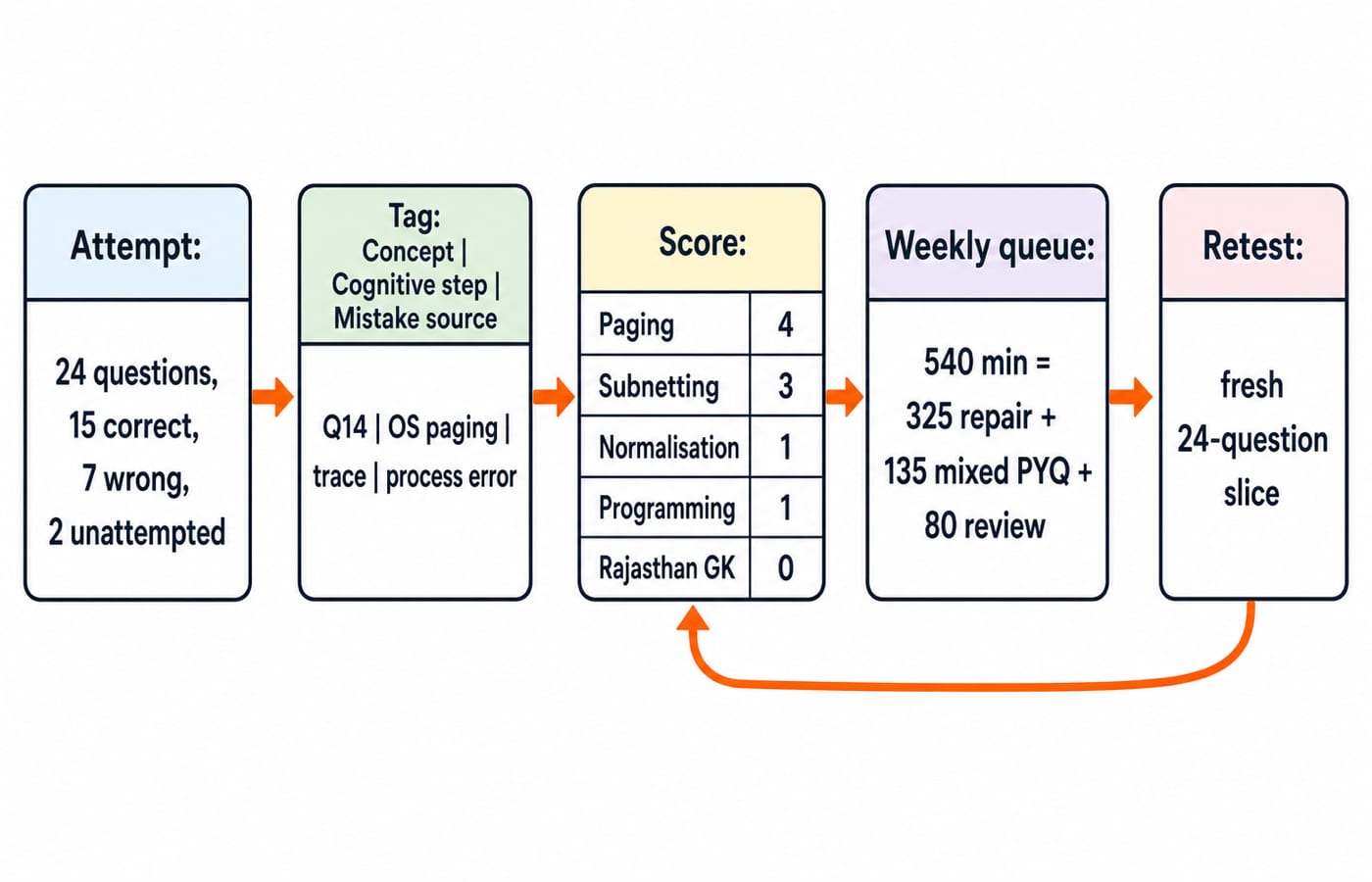
Take a slice of 24 questions: say 15 correct, 7 wrong and 2 unattempted. That is 9 unresolved, so 9 / 24 = 37.5%. Use whatever slice size your paper gives you; the arithmetic does not change.
Tag every question in three passes
Do it in three passes over the paper, one tag per pass; tagging all three at once tempts you to defend the answer you gave. Pass one, name the concept. Pass two, name the cognitive step (recall, interpret, trace, calculate or eliminate). Pass three, name the mistake source (concept gap, recall gap, process error, careless read or time skip).
Question | Concept | Given values | Cognitive step | Result/time | Mistake source | Next action |
|---|---|---|---|---|---|---|
Q3 | DBMS normalisation |
| interpret | Wrong, 80 sec | concept gap | Rebuild the 2NF/3NF sequence |
Q8 | Subnetting |
| calculate | Correct, 95 sec | process error, block size computed twice | Five block-boundary questions |
Q14 | FIFO page replacement |
| trace | Wrong, 7 faults | process error, pointer not updated | Redraw the frame table |
Q21 | C programming |
| trace | Correct, 35 sec | none | Spaced review |
Do not over-tag. One primary mistake source per question keeps the queue sortable.
Convert the tags into priority scores
Aggregate by concept and calculate priority score = questions seen x unresolved rate.
Concept | Seen | Correct | Unresolved | Priority calculation | Score |
|---|---|---|---|---|---|
OS paging | 6 | 2 | 4 |
| 4 |
Subnetting | 5 | 2 | 3 |
| 3 |
DBMS normalisation | 4 | 3 | 1 |
| 1 |
Programming traces | 5 | 4 | 1 |
| 1 |
Rajasthan GK | 4 | 4 | 0 |
| 0 |
Totals are 24 seen, 15 correct and 9 unresolved. Sort the scores 4, 3, 1, 1, 0 and repair in that order. For ties, place a repeated concept gap before a one-off careless read. This is why PYQs beat buying another question bank for diagnosis.
Build a nine-hour weekly practice queue
Nine hours splits as 540 minutes = 325 targeted repair + 135 mixed PYQ + 80 review. If your week holds six hours or twelve, scale all three blocks by the same factor. By score order, repair gets paging 140, subnetting 105, normalisation 40 and programming 40 minutes. Rajasthan GK gets no repair block after 4 out of 4, but stays in mixed practice.
Day | Work | Total |
|---|---|---|
Monday | 70 paging + 5 error log | 75 |
Tuesday | 60 subnetting | 60 |
Wednesday | 70 paging + 5 active recall | 75 |
Thursday | 45 subnetting + 15 normalisation | 60 |
Friday | 40 programming + 35 mixed PYQs | 75 |
Saturday | 100 mixed PYQs + 20 tagging/error log | 120 |
Sunday | 25 normalisation + 50 active recall and re-queueing | 75 |
Daily totals add to 540 minutes. If you are already running the RSSB Computer Instructor 12-week preparation plan, fold these blocks into its weekly hours rather than adding them on top.
Run the queue as a four-week repair loop
Week 1, diagnosis: tag the 24-question slice, score five concepts and build the queue. Do not reread every solution.
Week 2, repair: solve 20 fresh paging, 16 subnetting, 8 normalisation and 8 programming-trace questions, 52 total. Log repeated or consequential errors.
Week 3, interleaving: do three mixed sets of 12, 36 total, leaving 48 hours between encounters with a repaired concept. After choosing a level, use the RSSB Basic Computer Instructor Test Series or RSSB Senior Computer Instructor Test Series.
Week 4, retest: take a fresh 24-question slice, rescore, and let new evidence set the next cycle.
Recover from missed days without inventing extra hours
Do not turn a missed 75-minute Wednesday into a 135-minute Thursday. Keep daily caps. If 70 paging + 5 recall is missed, replace 25 lower-priority minutes on Thursday and 25 on Friday with paging. Carry the displaced 50 into the next queue and accept 25 missed minutes. Actual work is 540 - 75 = 465 minutes, or 7 hours 45 minutes.
After two missed days, repeat a smaller repair week. Preserve concept-gap repair, fresh PYQ retrieval, then optional rereading.
Promote a topic only after fresh evidence
Set one exit rule and hold to it: two fresh six-question sets, each at least 4 out of 6, with no repeat of the same misconception. A lucky answer with the wrong method fails.
After retesting, promote when accuracy holds twice, retain when an error repeats, and sample again when too few questions appeared. Review promoted topics after 2 days and 7 days. Once repairs hold, separate whole-paper timing and mock review from repair work.
Short version: attempt, tag, score, queue, retest
Attempt, tag, score, queue and retest on fresh material. Every paper should end with a dated next-action queue, not only a percentage.
Use the RSSB Computer Instructor category to choose the Basic or Senior path, then the matching test series. Today, analyse the first 24 usable questions from one official paper and schedule the top two concept clusters before another attempt.
Keep learning
RSSB Computer Instructor Syllabus Weightage: Prioritise Without Guesswork
Turn the Basic or Senior Computer Instructor syllabus into an auditable study order using coverage, authenticated PYQs, prerequisites and a holdout test.
Updated 4 Aug 20265 min readRSSB Computer Instructor
RSSB Computer Instructor Syllabus: Basic vs Senior Topic Map and Boundaries
Separate the shared Paper I from Basic and Senior Paper II, see where technical depth changes, and build a revision plan that stays inside official RSSB wording.
Updated 2 Aug 20266 min read60 viewsRSSB Computer Instructor
RSSB Computer Instructor vs DSSSB TGT CS: Role, Qualification and Location Fit
Choose between the RSSB and DSSSB routes only after checking eligibility, role preference, syllabus gaps and your real Rajasthan or Delhi commitment.
Updated 30 Jul 20266 min readRSSB Computer Instructor
RSSB Computer Instructor Eligibility and Exam Structure: Basic vs Senior Checklist
Check whether your exact qualification fits the Basic or Senior RSSB Computer Instructor route, then understand the two papers and negative marking.
Updated 25 Jul 20265 min readRSSB Computer Instructor