RSSB Computer Instructor 12-Week Preparation Plan: Concepts, PYQs and Mixed Mocks
Turn 18 scheduled weekly hours into a Basic or Senior RSSB plan with a baseline, daily retrieval, source-labelled practice, repair blocks and full-paper simulations.
KnowledgeGate Team
Exam prep & CS education
Updated 22 Jul 20266 min read
Twelve weeks is enough for one concept pass, a repair phase and paper-wise mocks, provided you fix your route in Week 1 and log every wrong answer after it. Most candidates have about eighteen hours a week, not forty, and two Paper II syllabi to choose between before spending any of them. Sixteen of those hours are core and two are flex, so a missed evening does not collapse the week. Eligibility and syllabus detail sit with the rest of the RSSB Computer Instructor exam prep.
Before Week 1, choose Basic or Senior and freeze the official scope
Start with RSSB Advertisement 07/2026, then recheck the current RSSB notice. Basic and Senior each have Paper I and Paper II. Every paper carries 100 marks, has 100 multiple-choice questions and lasts 2 hours. Wrong answers lose one-third mark, and each paper has a qualifying rule. That rule is not a merit cutoff.
Record on one page: target post: Basic or Senior, Paper I headings, Paper II headings, question count, duration, wrong-answer rule, source PDF and date checked. Use RSSB Basic vs Senior Computer Instructor to choose your route, and keep the two Paper II lists separate.
Week 1: take a 40-question baseline and build the tracker
Set a 40-question diagnostic: 20 per paper, with Paper I split between 10 Rajasthan knowledge and 10 general ability. The Paper II baskets are:
Basic: fundamentals/data processing, programming, DSA, OS/COA, DBMS, networks/security, system analysis and Internet/IoT.
Senior: fundamentals/programming/OOP, DSA/algorithms, digital logic/COA, OS, DBMS, software engineering, networks/security/communication and web development.
For 28 correct, 9 wrong and 3 blank, practice score is 28 - (9 x 1/3) = 25/40. Attempt rate is 37/40 = 92.5%; attempted-question accuracy is 28/37 = 75.7%. Follow current RSSB response-sheet instructions for unattempted items.
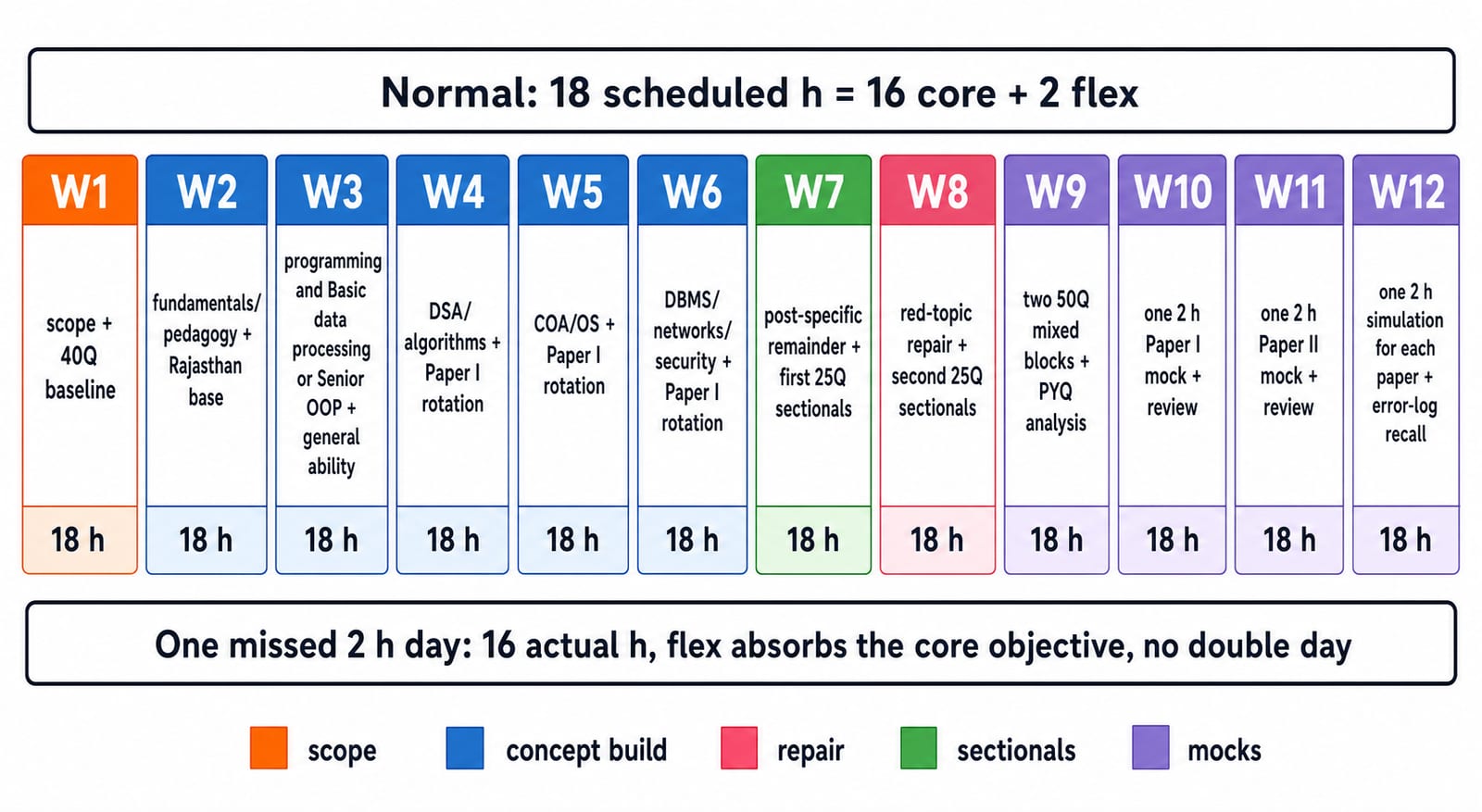
Week 1: 2 h scope + 1 h baseline + 2 h analysis + 5 h weakest Paper II basket + 4 h Paper I foundation + 2 h retrieval setup + 2 h flex = 18 h. The 2 h of retrieval setup is where the tracker gets built: one row per missed question, logging source, topic, your response, the correct answer and the error type. The repair blocks in Weeks 7 to 9 run entirely off those rows.
Use an 18-hour weekly engine that survives a missed day
Weekly schedule: 2 h Paper I Monday/Thursday; 2 h Paper II Tuesday/Wednesday/Friday; 2 h Paper I + 2 h Paper II Saturday; 2 h retrieval/PYQ analysis + 2 h flex Sunday. Total: 6 h Paper I + 8 h Paper II + 2 h retrieval/PYQ analysis + 2 h flex = 18 h.
Each block is 70 min learn/repair + 30 min closed-book retrieval + 20 min source-labelled questions = 120 min. Write six recall prompts from memory before you open notes, then fill a tracker row for every question you miss.
Move a missed Thursday Paper I objective to Sunday flex, completing 16 core hours without the buffer. Never double Friday. If Sunday is lost, carry one red-topic block into Week 7.
Weeks 2 and 3: build Paper I continuity and the right foundation
Rotate the Advertisement 07/2026 Paper I topics for 6 h weekly. Week 2: 3 h Rajasthan art/history + 2 h geography/science + 1 h retrieval. Week 3: 2 h logical/analytical ability + 2 h numeracy/DI + 1 h decision making/mental ability + 1 h Rajasthan recall.
Week 2 Paper II: 3 h fundamentals + 2 h pedagogy/mental ability + 2 h weak-topic repair + 1 h questions. Work the fundamentals from one source all week rather than three, and let the advertised syllabus headings, not that source's chapter order, decide what you skip.
In Week 3, Basic covers data processing and programming/OOP introductions; Senior covers programming fundamentals and C++/Java OOP. End 8 h of Paper II with a 20-question closed-note check. 15/20 is your own review trigger, not a score to chase.
Weeks 4 to 6: complete the core CS pass in dependency order
Schedule 5 h DSA/algorithms + 3 h programming repair in Week 4, 4 h computer organisation + 4 h operating systems in Week 5, and 3 h DBMS + 3 h networks/security + 2 h error replay in Week 6. Retain 6 h Paper I plus 2 h retrieval and 2 h flex, which keeps every week at 18 h, because Paper I is equally marked.
For Week 4 retrieval, start with [7, 2, 9, 4]. Compare 7 and 2, swap: [2, 7, 9, 4]. Compare 7 and 9, no swap. Compare 9 and 4, swap: [2, 7, 4, 9]. Invariant: after one pass, the largest unsorted value is final. State it before checking notes.
The paths then separate. Basic combines computer organisation/OS before system analysis and Internet/IoT. Senior separates COA/OS before digital logic, software engineering, communication and web development.
Weeks 7 to 9: turn post-specific gaps and errors into repair blocks
Week 7 Basic finishes system analysis/design, Internet/IoT and web material; Senior finishes digital logic, software engineering, communication basics and web development. Advertisement 07/2026 lists these topics. Add one 25-question sectional per paper. At the paper's own pace of 100 questions in 120 minutes that is 30 minutes, so budget at least 45 minutes of review on top of it.
Week 8: 6 h red technical + 4 h red Paper I + 4 h two sectionals + 2 h retrieval + 2 h flex = 18 h. Week 9: 2 h for two 50-question, 60-minute mixed blocks + 3 h review + 5 h repair + 4 h Paper I recall + 2 h Paper II recall + 2 h flex = 18 h.
Nine errors need 4 concept gaps x 20 min = 80 min, 3 recall gaps x 10 min = 30 min, 2 risky guesses x 10 min = 20 min. Schedule the 130 minutes as 50 min Tuesday + 50 min Thursday + 30 min Sunday. Treat a question as previous-year only when you have the actual paper, year and source, and analyse those papers rather than only attempting them. Sunday sorts two things by the same syllabus headings. Tag every question in a real paper to its heading, so the headings that keep reappearing reorder the weeks you have left, then tag your own logged rows the same way, so a heading carrying repeated error types goes into the next repair block.
Weeks 10 to 12: rehearse each paper and review longer than you attempt
Week 10 uses a 100-question Paper I simulation in 120 minutes, then 4 h review + 6 h two largest error groups + 4 h Paper II retrieval + 2 h flex. Week 11 mirrors Paper II: 4 h review + 6 h repair + 4 h Paper I retrieval + 2 h flex. With simulation, each week totals 18 h.
For 72 correct, 18 wrong and 10 blank, practice score is 72 - (18 x 1/3) = 66/100; attempt rate is 90/100 = 90%; accuracy is 72/90 = 80%. Classify all 28 non-correct items before interpreting 66. It is a diagnostic, not a target.
Week 12 assigns 4 h to one simulation of each paper, 8 h to review, 4 h to error-log recall and 2 h to buffer. Use Teaching Exam Mock Strategy for CS Papers to review by error type, not score alone. Add no broad new topic.
The short version: choose the route and protect the feedback loop
Sequence: official scope, 40-question baseline, six weeks of Paper I plus post-specific CS, three weeks of sectionals and repair, then paper-wise mocks and rehearsal.
Only a red-topic objective is ever allowed to move forward, and progress means fewer repeated errors, not a perfect streak.
Basic candidates can map the confirmed syllabus to the RSSB Basic Computer Instructor Course. Senior candidates can use the RSSB Senior Computer Instructor Course.
Keep learning
RSSB Computer Instructor Syllabus Weightage: Prioritise Without Guesswork
Turn the Basic or Senior Computer Instructor syllabus into an auditable study order using coverage, authenticated PYQs, prerequisites and a holdout test.
Updated 4 Aug 20265 min readRSSB Computer Instructor
RSSB Computer Instructor Syllabus: Basic vs Senior Topic Map and Boundaries
Separate the shared Paper I from Basic and Senior Paper II, see where technical depth changes, and build a revision plan that stays inside official RSSB wording.
Updated 2 Aug 20266 min read60 viewsRSSB Computer Instructor
RSSB Computer Instructor vs DSSSB TGT CS: Role, Qualification and Location Fit
Choose between the RSSB and DSSSB routes only after checking eligibility, role preference, syllabus gaps and your real Rajasthan or Delhi commitment.
Updated 30 Jul 20266 min readRSSB Computer Instructor
RSSB Computer Instructor PYQs: Build a Weekly Study Plan From Every Paper
A score cannot tell you what to study next. This method turns each RSSB Computer Instructor PYQ into tagged evidence, a weekly repair queue and a fresh retest.
Updated 28 Jul 20265 min readRSSB Computer Instructor