

RRBs vs Nationalised Banks: Ownership, Purpose and Reach
A village branch does not tell you whether a bank is an RRB or a nationalised bank. Compare their legal origins, ownership and reach, then test the distinction with a worked 200 crore rupees example.
KnowledgeGate Team
Exam prep & CS education
Updated 30 Oct 20265 min read
Both RRBs and nationalised banks can serve rural customers, so a village branch cannot identify the institution. Here, RRB means Regional Rural Bank, not Railway Recruitment Board. For banking and insurance exam preparation, compare four things: founding law, ownership, mandate and area of operation. These explain the difference more reliably than the address of a branch or the occupation of a borrower.
RRB and nationalised bank describe different institutional origins
An RRB is established under a statutory framework designed for rural development. Nationalisation means transferring existing banking undertakings into public ownership. These are different routes to creating a banking institution; saying that “RRBs were nationalised in 1976” confuses them.
The Department of Financial Services’ Review of Performance of RRBs during FY 2023-24 describes their rural-development purpose and RBI regulation with NABARD supervision. The nationalisation frameworks are the Banking Companies (Acquisition and Transfer of Undertakings) Acts, 1970 and 1980. The Department of Financial Services, Banking page distinguishes these banks from SBI, constituted under the SBI Act, 1955, while including both within its public-sector-bank classification.
Therefore, SBI is a public sector bank, but it is not one of the banks nationalised in the two waves associated with those acquisition Acts. Public ownership alone does not tell you the institution’s legal origin.
Ownership: work through the 50:15:35 RRB model
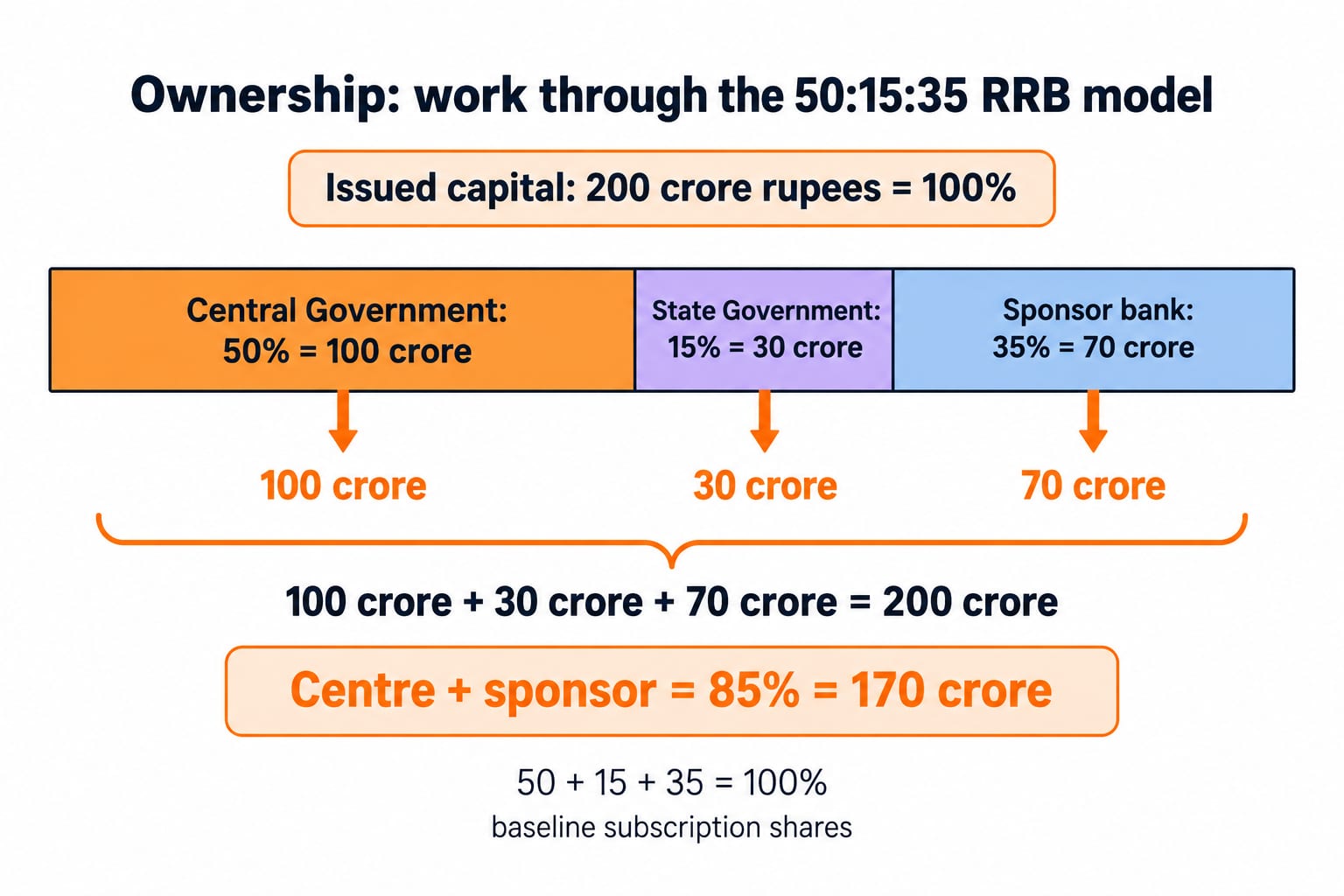
Section 6 of the Regional Rural Banks Act, 1976, available on India Code, gives the baseline subscription shares: Central Government 50%, concerned State Government 15%, sponsor bank 35%. Sections 3 and 4 cover incorporation, the notified area and offices; the Act also defines permitted banking business.
Suppose an RRB has 200 crore rupees of issued capital subscribed in the baseline ratio:
Central Government: 200 crore × 50/100 = 100 crore.
State Government: 200 crore × 15/100 = 30 crore.
Sponsor bank: 200 crore × 35/100 = 70 crore.
Check the percentages: 50 + 15 + 35 = 100%. Check the amounts: 100 crore + 30 crore + 70 crore = 200 crore. Centre plus sponsor hold 50% + 35% = 85%, equal to 100 crore + 70 crore = 170 crore.
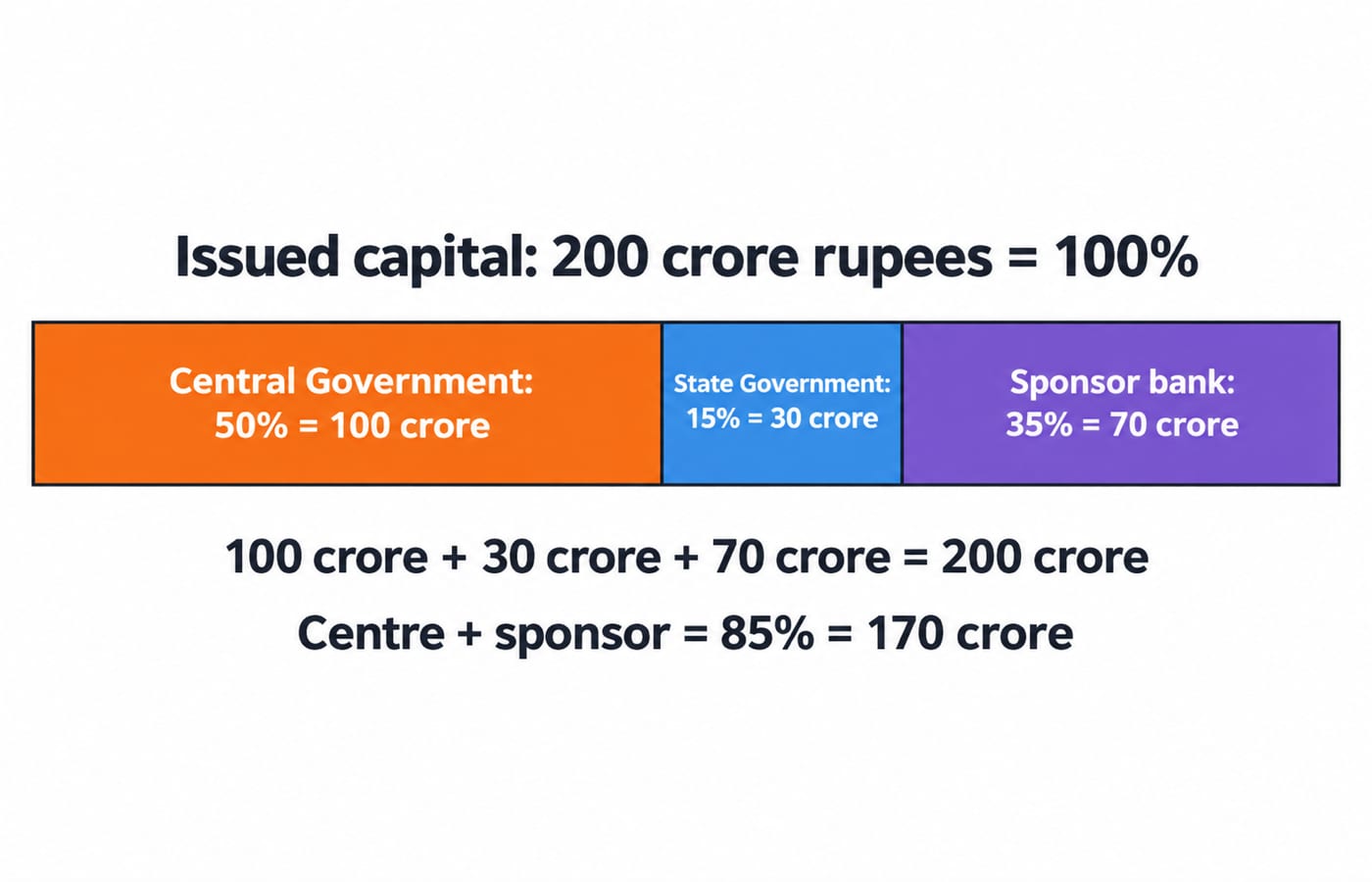
These amounts are illustrative, not a named bank’s accounts or a statutory minimum. Sponsorship does not make the RRB a sponsor-bank branch. A nationalised bank does not use this three-party subscription formula, and nationalisation does not imply 100% government ownership today.
Section 6 permits other capital sources with safeguards, including at least 51% combined Central Government and sponsor-bank holding, and consultation with the concerned State Government if its holding falls below 15%.
Mandate and reach: compare purpose without inventing exclusivity
The legal frameworks and oversight arrangements above give this comparison:
Basis | Regional Rural Bank | Nationalised bank |
|---|---|---|
Origin | RRB Act framework | Nationalisation Acts |
Ownership model | Baseline Centre-State-sponsor subscription | Government-controlled shareholding |
Core mandate | Rural productive activity and financial inclusion | Broad commercial banking and public objectives |
Reach | Notified area of operation | Wider banking networks |
Sponsorship | Statutory sponsor-bank relationship | No equivalent RRB ownership formula |
Oversight | RBI regulation and NABARD supervision | RBI regulation and supervision |
For a separate treatment of NABARD's refinance, development and supervision roles, see NABARD Functions and Responsibilities; this post focuses on classifying the bank itself by legal origin, ownership and reach.
An RRB’s rural focus does not restrict it to crop loans. It also accepts deposits and provides other permitted banking services. Similarly, nationalised banks serve agriculture and rural customers alongside other borrowers. A savings account or an agricultural loan is therefore insufficient evidence for classifying the bank.
“Regional” does not mean “one district forever”. The relevant boundary is the notified area under the statutory framework. Nor does a wider network mean every nationalised bank has an identical footprint. Separate the bank’s permitted reach from the location of the particular branch mentioned in a question.
Classify a bank from evidence, not its customer’s address
Consider two hypothetical banks.
Bank A is established under the RRB Act. Its 200 crore baseline capital comes from the Centre, State and sponsor in amounts of 100 crore, 30 crore and 70 crore respectively. It lends 2 lakh rupees to a small farmer.
Bank A is an RRB because its founding framework and ownership evidence establish that classification. The farmer’s occupation and the loan amount do not independently establish it.
Bank B is constituted under the 1970 nationalisation framework. It also lends 2 lakh to a small farmer. Bank B is a nationalised bank because of its legal origin.
The borrower type and amount remain constant, while the institutional classification changes.
Four exam traps and their corrections
Each shortcut misses a different piece of evidence:
“Every PSB was nationalised in the two nationalisation waves.” Check the founding law. SBI has its separate Act and still belongs to the public sector.
“An RRB is a sponsor-bank branch.” Check incorporation. The RRB is a distinct bank; its sponsor’s participation does not erase that identity.
“An RRB is a cooperative bank.” Check the statutory framework and ownership. Study the cooperative banking structure separately before comparing rural institutions.
“50:15:35 can never change.” Check section 6’s provisions for capital changes and its safeguards. Remember the baseline without treating it as a permanent ownership guarantee.
Also check labels before accepting a numerical answer. Reversing State and sponsor gives 70 crore to the State and 30 crore to the sponsor. The total still equals 200 crore, but both allocations are wrong. A correct total cannot detect a swapped label.
How to practise the distinction for banking-awareness questions
Try this check. Decide which statements are correct:
I. Under the baseline model, the State subscribes 35%.
II. Nationalised banks can serve rural borrowers.
III. An RRB is simply a sponsor-bank branch.
(a) Only I
(b) Only II
(c) I and II
(d) II and III
Answer: (b). Statement I is false because the State’s baseline share is 15%. Statement II is true because nationalised banks also serve rural borrowers. Statement III is false because the RRB is separately incorporated.
Now try a numerical check: in the hypothetical 200 crore baseline example, how much do Centre and sponsor contribute together? 100 crore + 70 crore = 170 crore. Independently, 200 crore × 85/100 gives the same amount.
The IBPS Rural Banks XIV recruitment archive contains previous-cycle recruitment notices. Check the applicable official notice for your own post and cycle for stages and syllabus. Continue with static banking awareness revision, separating institutional basics from changing mergers and notifications.
Short version and a useful next step
Ask three questions: How was the bank established? Who subscribes its capital? What are its mandate and permitted area?
Close the page and reconstruct 100 crore, 30 crore and 70 crore from the baseline percentages. Then explain why both example banks could lend 2 lakh to a farmer despite belonging to different institutional categories.
If you are targeting IBPS PO Mains, the IBPS PO Mains preparation course is an optional structured next step for that preparation. Use the comparison above as a revision exercise: identify the institution first, then interpret its activities.
Keep learning

Why Solving PYQs Beats Buying Another Question Bank
Every serious aspirant eventually asks: should I buy another question bank? Usually the answer is no. Solve the previous-year questions properly first. Here is why.
Updated 29 Oct 20264 min read102 viewsGATE Strategy & Roadmap

Programming Languages MCQs: 12 Solved Questions on Definition and Purpose
Build the foundations behind basic programming-language questions, then solve 12 published MCQs on translators, errors, pseudocode, parameters and language quality.
Updated 30 Oct 20267 min readProgramming Languages Survey
RRB NTPC CBT 1 vs CBT 2: Purpose and Preparation Shift
See what to retain after CBT 1, what to change for CBT 2, and how to turn diagnostics, subject drills and mock errors into a focused transition plan.
Updated 30 Oct 20265 min readRRB NTPC
C++ STL Containers: Choose by Access Pattern, Mutation Cost and Ownership
Choose a C++ STL container from the workload, not from habit. Trace sequence operations, keyed counts, invalidation and object lifetime through exact examples.
Updated 27 Sep 20266 min readC++