

NABARD Functions and Responsibilities: Refinance, Development and Supervision
Who owes whom when NABARD refinances a rural bank? Follow a worked example, distinguish infrastructure finance from farmer loans, and separate supervision from regulation.
KnowledgeGate Team
Exam prep & CS education
Updated 30 Oct 20265 min read
NABARD supports rural credit, but does that mean every farmer borrows from it, or that it regulates every bank? These are different responsibilities, and mixing them up makes banking-awareness statements difficult to judge. The National Bank for Agriculture and Rural Development becomes easier to understand when you trace the money and identify each institution's role.
What NABARD does in the rural credit system
NABARD's description of its functions and duties covers financial, developmental and supervisory work. Financial support makes resources available for eligible lending. Developmental work strengthens institutions and rural livelihoods. Supervision examines specified banks and their functioning.
Planning and monitoring connect these responsibilities: where can credit be used productively, and how is implementation progressing?
Activity | Main role | What to recognise |
|---|---|---|
Refinance an eligible rural bank | Financial | Funding supports the lending institution |
Support institutional capacity | Developmental | Skills and systems become stronger |
Inspect a Regional Rural Bank (RRB) | Supervisory | The bank's functioning is examined |
These are useful explanatory categories, not mutually exclusive legal compartments. One initiative may support more than one objective. For Banking & Insurance preparation, learn the activity behind each label rather than memorising an unexplained list of functions.
Refinance explained with a 10 lakh worked example
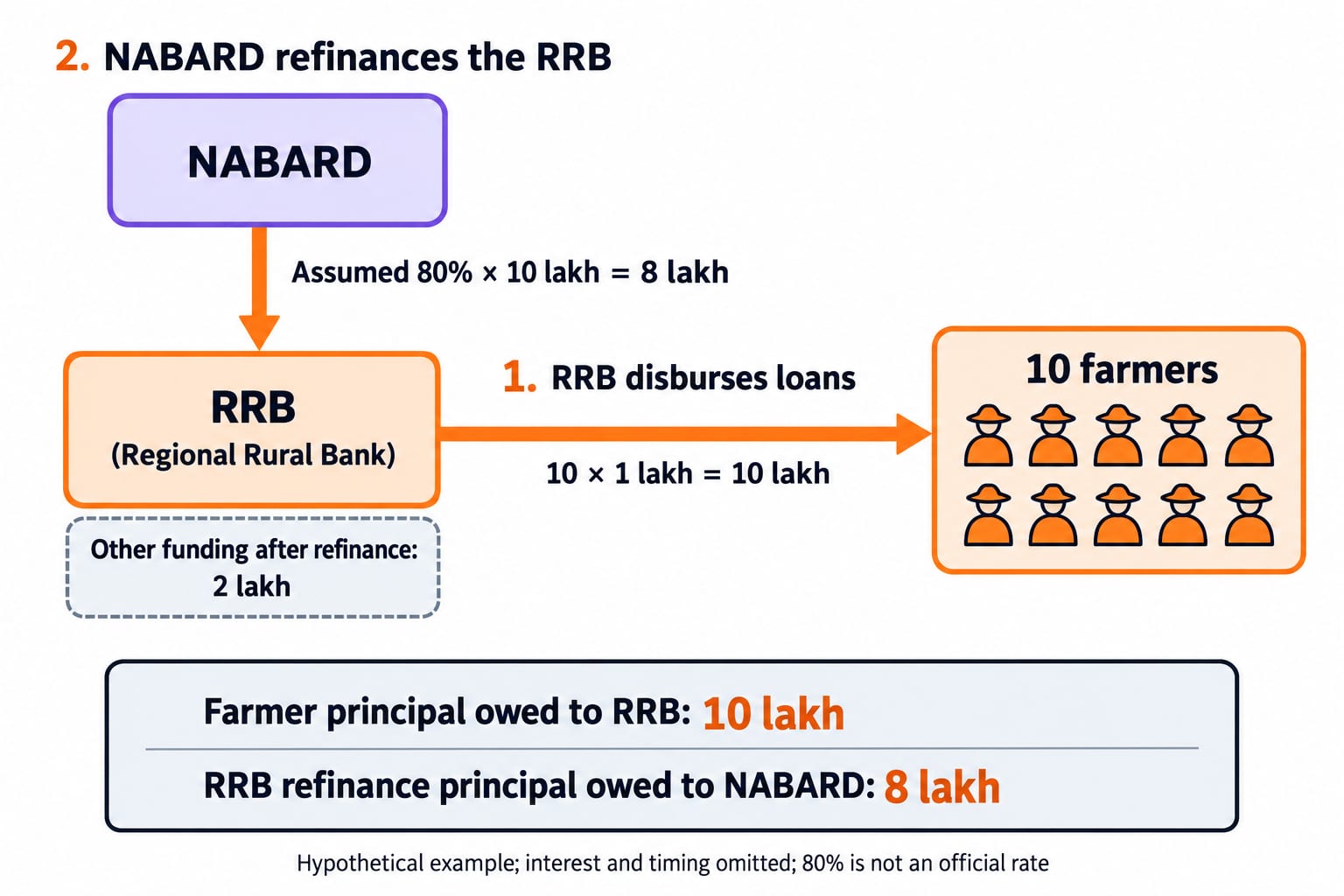
Refinance means finance provided to an eligible lending institution to support its lending activity. NABARD's operational norms distinguish short-term support and longer-term refinance through eligible institutions; eligibility and conditions depend on the facility.
Every rupee figure below is a made-up teaching number, not a NABARD rate, norm or district statistic. The assumed 80% refinance share and infrastructure funding split are illustrative. Ignore interest and repayment timing in the calculations.
Suppose an RRB first disburses ten eligible farm loans of 1 lakh each. NABARD subsequently refinances an assumed 80% of this portfolio.
Borrower credit: 10 x 1 lakh = 10 lakh.
NABARD refinance: 0.80 x 10 lakh = 8 lakh.
RRB's other funding after refinance: 10 lakh - 8 lakh = 2 lakh.
The farmers still owe the RRB 10 lakh principal in aggregate. Separately, the RRB owes NABARD 8 lakh of refinance principal. These are two lending relationships, not two separate disbursements to farmers.
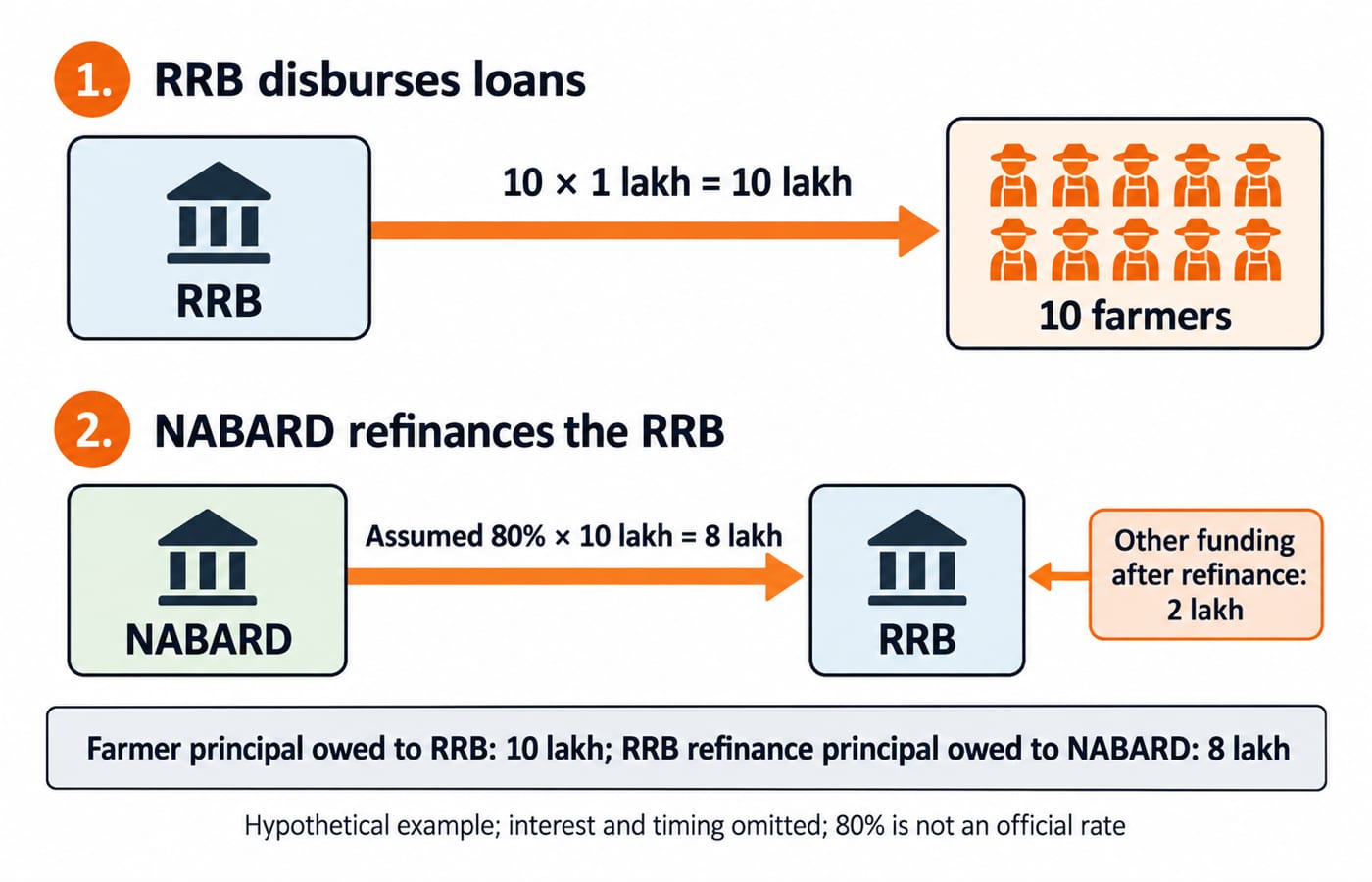
Subtracting refinance from farmer debt incorrectly gives 2 lakh. Adding it to borrower credit incorrectly gives 18 lakh. Refinance changes the bank's funding composition; it is neither a borrower subsidy nor a loan waiver.
Short-term production needs include inputs for a crop cycle. Longer-term investment needs include productive assets such as farm equipment. Recognise the purpose without assuming one fixed repayment period for every facility.
Rural infrastructure finance is a different channel
NABARD's State Projects Department describes the Rural Infrastructure Development Fund (RIDF) as a channel for rural infrastructure lending to state governments and state-owned corporations. This differs from refinancing a bank's individual farm loans.
Consider a public irrigation project costing 50 lakh. Assume the state government borrows 40 lakh for the project and contributes 10 lakh:
40 lakh loan + 10 lakh state contribution = 50 lakh project cost.
These financing shares are illustrative, not RIDF norms. Farmers may benefit from the irrigation facility without each receiving part of the 40 lakh as a personal loan. In this example, the state government is the borrower; the farmers are beneficiaries.
Before classifying an activity, identify the borrower, the funding channel and the purpose. NABARD's functions extend beyond refinance, so the claim that it never lends directly to eligible institutions is also incorrect.
Development, credit planning and monitoring
NABARD's developmental role includes capacity building and support for rural development. Better institutional systems and skills can improve the ability to use credit productively. Supporting that ability is different from sanctioning a particular loan.
RBI's Lead Bank Scheme explanation describes NABARD's Potential Linked Credit Plans as assessments that inform district credit planning. Potential is an estimate of opportunity, not money already lent.
Consider three stages for the same district and planning period:
Stage | Amount | Meaning |
|---|---|---|
Assessed credit potential | 100 crore | Identified lending potential |
Bank sanctions | 70 crore | Credit approved |
Disbursements against those sanctions | 55 crore | Credit actually released |
The potential-to-sanction gap is 100 crore - 70 crore = 30 crore. Sanctioned credit awaiting disbursement is 70 crore - 55 crore = 15 crore.
Adding all three stages to claim 225 crore of finance double-counts overlapping activity. Monitoring asks where progress stalls. These gaps alone establish neither default nor misconduct, and none of the figures automatically represents NABARD's own disbursement.
Supervision versus regulation: the main exam trap
For the separate classification of an RRB versus a nationalised bank, see RRBs vs Nationalised Banks: Ownership, Purpose and Reach. That post owns legal origin, ownership and reach; this section owns NABARD's supervisory boundary.
NABARD's Department of Supervision identifies statutory inspection responsibilities for RRBs, State Cooperative Banks and Central Cooperative Banks, including District Central Cooperative Banks (DCCBs). It also describes reporting inspection findings to RBI's Department of Regulation.
RBI's explanation of rural banking distinguishes its banking regulatory responsibilities from NABARD's supervisory responsibilities. Regulation concerns the applicable banking framework; supervision examines how specified institutions function within it. Do not turn this distinction into the blanket claim that NABARD regulates all rural banks.
Misleading statement | Correction |
|---|---|
Every farmer borrows from NABARD | Identify the actual lending institution |
Refinance is a waiver | Farmer debt and the bank's refinance debt remain |
All cooperative institutions have identical supervision | Identify the institution and its tier |
NABARD sets monetary policy | Monetary policy belongs to the central bank's role |
The earlier three-tier cooperative banking structure post owns the PACS-DCCB-State Cooperative Bank chain and its tier-specific authority questions. This post focuses on NABARD's functions across refinance, rural infrastructure, credit planning and supervision, including how NABARD interacts with RRBs and cooperative banks.
How to practise NABARD function questions for banking exams
These two checks are original practice questions, not PYQs.
Check A: An RRB lends 10 lakh and receives 8 lakh refinance. What aggregate farmer principal remains owed to the RRB, ignoring interest and repayment?
(a) 2 lakh
(b) 8 lakh
(c) 10 lakh
(d) 18 lakh
Answer: (c). 2 lakh is the bank's other funding, 8 lakh is refinance, and 18 lakh incorrectly adds bank funding to borrower lending. Farmer principal remains 10 lakh.
Check B: Match RRB inspection, refinance to an eligible institution and district credit-potential assessment with supervision, financial support and planning.
Answer: RRB inspection to supervision; refinance to financial support; credit-potential assessment to planning. The matches follow the action performed, not merely the institution's name.
Use static and current banking-awareness revision to organise further study. For recruitment requirements, select your own post and cycle from NABARD's official careers notices, then read the relevant notice and syllabus.
The short version and your next revision step
Remember three verbs: finance, develop, supervise. Then redraw the 10 lakh loan, 8 lakh refinance and 2 lakh other-funding example from memory. Label the farmers as borrowers, the RRB as their lender and NABARD as the refinancer.
Keep borrower debt separate from the bank's funding composition. For readers also preparing for IBPS PO Mains, the IBPS PO Mains preparation course is an optional next step for broader banking preparation.
Finish by explaining, without looking back, why refinance leaves aggregate farmer principal at 10 lakh.
Keep learning

NABARD Grade A Finance Preparation: Resources and an 8-Week Plan
Build a Finance specialist study plan around accounting, calculations and management applications. Use a 12-hour weekly schedule, a worked project appraisal and an error-based review routine.
Updated 29 Oct 20265 min readBanking Exams

Concept of Growth and Development MCQs: 10 Solved Questions for Teaching Exams
Is becoming taller the same as becoming more capable? Solve ten questions on growth, developmental principles, motor skills and play, then use the explanations to identify your mistakes.
Updated 20 Nov 20267 min readCTET & UPTET

Web Development Project Ladder: 3 Portfolio Builds with Review Gates
Move from a responsive event page to a persistent React tracker and a role-aware full-stack review board. Each four-week block ends in evidence, scoring, and repair.
Updated 19 Nov 20265 min readWeb Development

Software Development Life Cycle MCQs: 12 Solved Questions on SDLC Stages
Solve 12 published SDLC MCQs with direct explanations, stage cues, and a worked campus clinic portal that connects requirements, design, testing, and maintenance.
Updated 17 Nov 20267 min readUGC NET Computer Science