C++ STL Containers: Choose by Access Pattern, Mutation Cost and Ownership
Choose a C++ STL container from the workload, not from habit. Trace sequence operations, keyed counts, invalidation and object lifetime through exact examples.
KnowledgeGate Team
Exam prep & CS education
Updated 27 Sep 20266 min read

Knowing the STL containers does not tell you which one fits a workload. A habitual choice can hide linear shifts, lose ordering or leave dangling handles after mutation. Access, insertion position, ordering, duplicate policy, stability and ownership determine container choice, and exact values show the effects. Coding & DSA Courses for Placements provides the wider programming route.
C++ STL container choice starts with the operations you must preserve
First decide whether the problem is positional or keyed. A sequence preserves position order; an associative container organises elements by keys. Ask whether access is by index or key, iteration must be sorted, duplicates matter, mutations occur at particular positions, handles must survive mutation, or the container owns its values.
For a resizable indexed sequence, consider std::vector first. Its storage is contiguous, index access is constant time and traversal is efficient. Choose something else when the workload requires efficient changes at both ends, stable node handles or keyed lookup. The decision here is whether vector survives the workload constraints, not how to call each member function.
Vector, deque and list: compare position access with mutation location
Container | Storage shape | Random access | End insertion | Middle insertion or erasure | Handle stability |
|---|---|---|---|---|---|
| Contiguous | Index access |
|
| Reallocation invalidates all handles; a middle change invalidates handles at or after it |
| Segmented | Index access | Either end |
| End insertion invalidates iterators but preserves references; middle changes have broader invalidation |
| Node-based | No index access; traversal |
|
| Existing handles survive insertion; erasure invalidates the erased element |
For [10, 20, 30, 40, 50, 60], zero-based index 4 returns 50 directly from a vector or deque. A list needs four iterator increments. Inserting 35 before 40 gives [10, 20, 30, 35, 40, 50, 60]. Vector shifts exactly 40, 50 and 60. List takes three increments to find 40, then relinks in constant time; the search cost remains.
Placing 5 at the front produces [5, 10, 20, 30, 35, 40, 50, 60]. Vector shifts all seven existing values. Deque inserts in constant time. List does too at its known begin(), but gives up random access and contiguous traversal.
The earlier C++ deque, list and forward_list: Choose the Right Non-Vector Container owns the shared 35-insertion trace across three non-vector sequences, including predecessor and tail handling. This section uses the shorter trace only to compare positional access with mutation location.
Set, map and unordered containers: choose keys, ordering and duplicate policy
std::set<int> stores unique keys; std::map<int, int> adds mapped values. Both iterate in key order, with O(log n) search, insertion and erasure. Unordered containers do not promise sorted iteration. With a suitable hash and equality relation, their operations are average O(1) but worst-case O(n).
std::set<int> stores unique keys; std::map<int, int> adds mapped values. Both iterate in key order, with O(log n) search, insertion and erasure. Unordered containers do not promise sorted iteration. With a suitable hash and equality relation, their operations are average O(1) but worst-case O(n).
Feeding [42, 17, 42, 9, 17, 42] into a set produces [9, 17, 42]. Updating a frequency map with ++count[key] produces {9: 1, 17: 2, 42: 3} in iteration order. Unordered versions hold the same data without portable iteration order. Choose map for a sorted report and unordered map when lookup dominates and order is irrelevant. Bucket layout, load-factor tuning and custom hashes are separate implementation questions; this section uses unordered storage only as the no-sorted-output branch.
Set and map reject equivalent keys. To retain every occurrence, use multiset, multimap or sequence records.
C++ set and map: Ordered Containers, Custom Keys and Bounds owns comparator equivalence, composite keys and ordered-bound traces. This guide stops at the earlier decision: whether the workload requires sorted unique keys, sorted key-value pairs or neither.
C++ STL decision guide: solve one workload from constraints to container
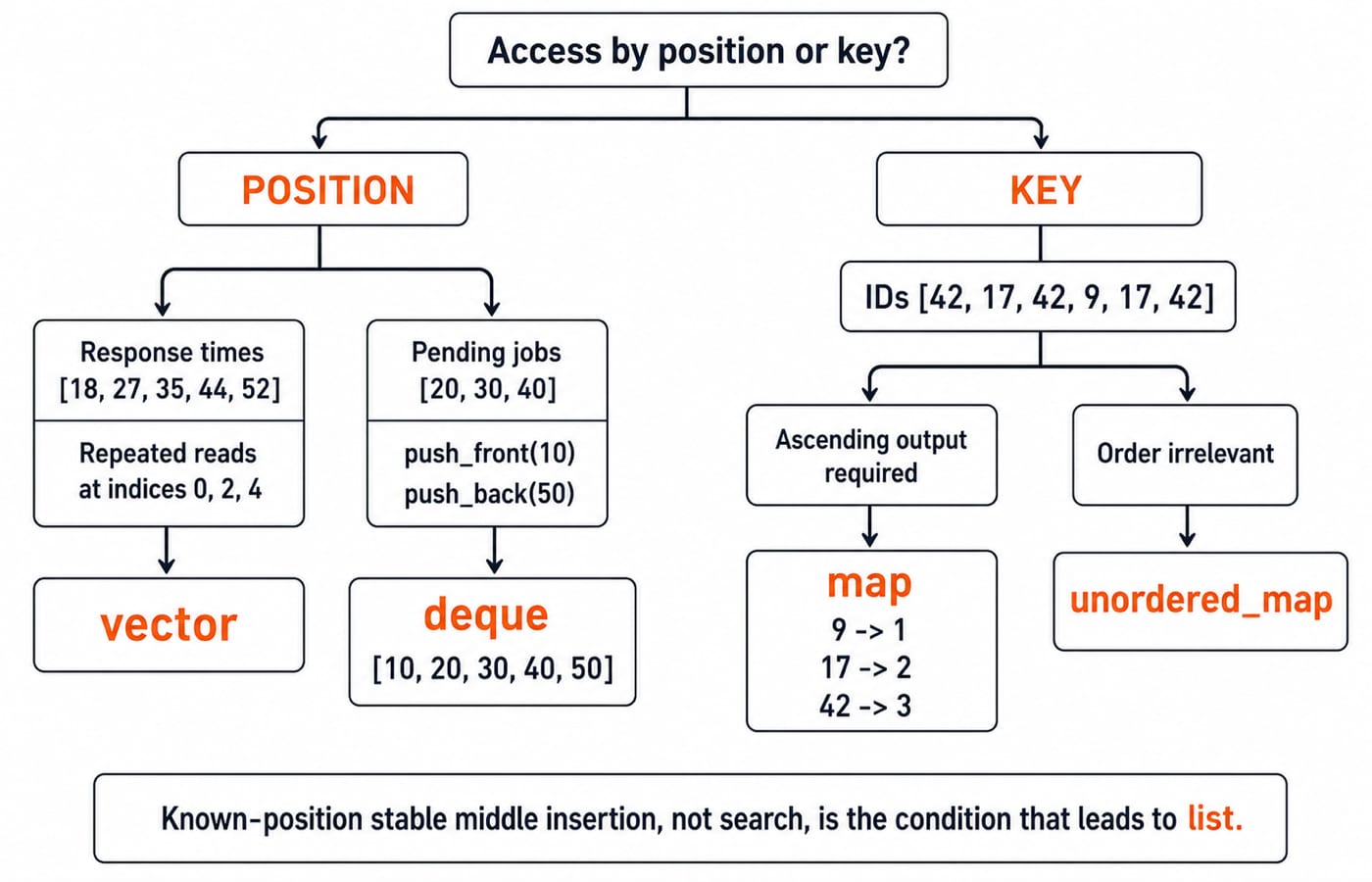
A dashboard has three workloads. Part A stores response times [18, 27, 35, 44, 52], appends measurements and repeatedly reads indices 0, 2 and 4. Choose vector<int> because indexing and compact iteration dominate.
Part B starts with pending jobs [20, 30, 40], then accepts urgent job 10 at the front and regular job 50 at the back. A deque<int> produces [10, 20, 30, 40, 50] without shifting the originals.
Part C counts request IDs from [42, 17, 42, 9, 17, 42] and must print ascending IDs. A map<int, int> gives:
9 -> 1
17 -> 2
42 -> 3
If Part C needs only lookups, use unordered_map<int, int> and call reserve(3) as a capacity hint. Operations remain average, not guaranteed, constant time.
List fails Part A's index requirement. Vector makes Part B's front insertion linear. Unordered map cannot provide Part C's ascending iteration. The operation mix and output contract decide.
C++ container ownership: values, unique pointers and observing raw pointers
A standard container owns and destroys its element objects. With vector<Item>, those objects are values:
struct Item { int id; std::string label; };
Item source{17, "Asha"};
std::vector<Item> by_value;
by_value.push_back(source);
source.label = "Changed";
Now by_value[0].label == "Asha", because the container holds its own copied value.
Exclusive ownership can move into a container:
auto owner = std::make_unique<Item>(Item{23, "Bharat"});
std::vector<std::unique_ptr<Item>> owned;
owned.push_back(std::move(owner));
After the move, owner == nullptr and owned[0]->label == "Bharat". Clearing owned destroys its unique_ptr and therefore the heap-allocated Item.
For a non-owning view, store &external from Item external{31, "Charu"}; in vector<Item*> observed. Clearing the vector destroys only the pointer, so external.label remains "Charu". The pointer dangles if external dies first. Raw pointers observe, unique_ptr owns exclusively, and shared_ptr fits genuinely shared lifetime.
Iterator and reference invalidation: mutation can change the ownership decision
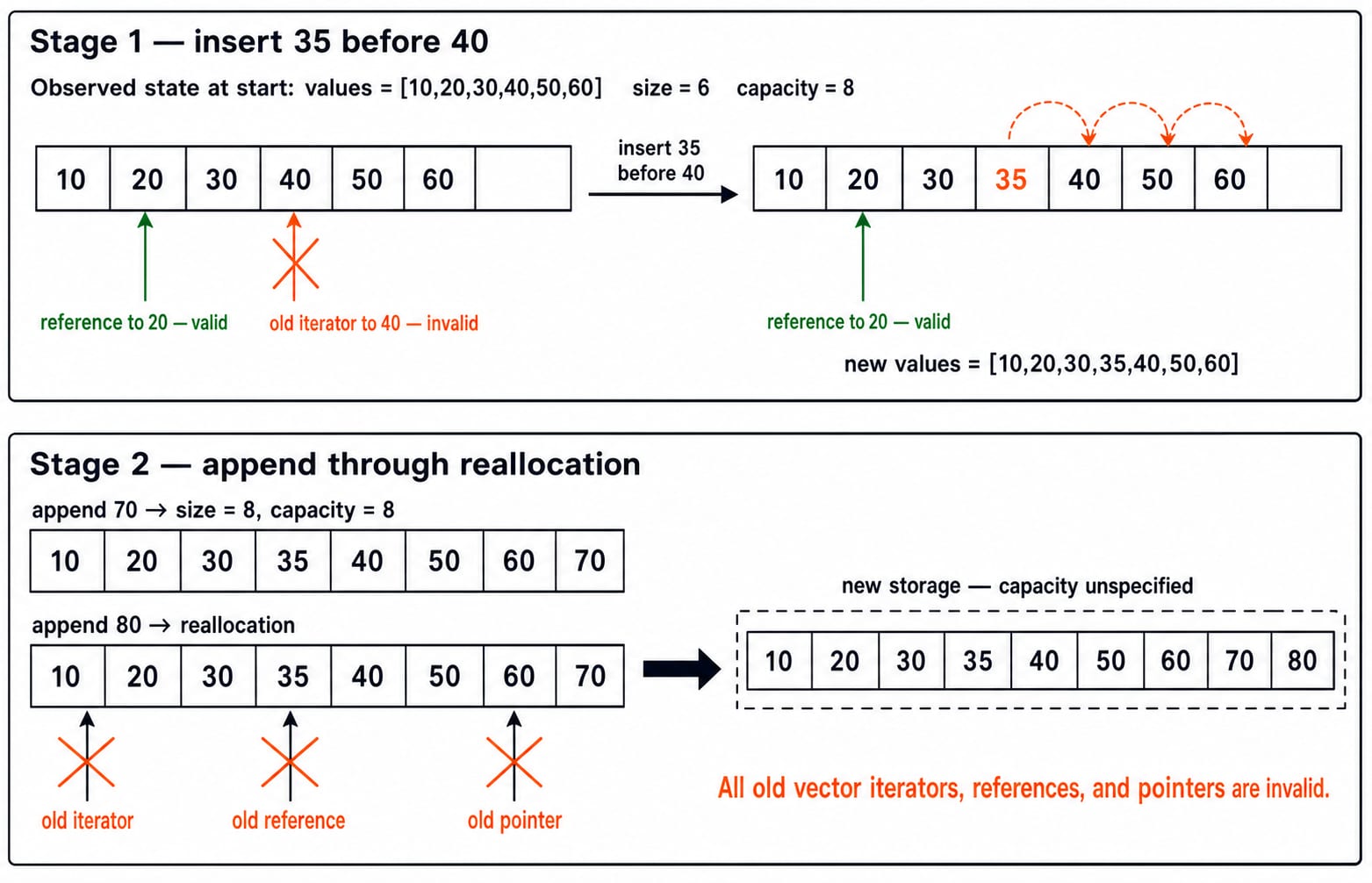
Take vector [10, 20, 30, 40, 50, 60] with size() == 6 and capacity() == 8. Hold a reference to 20 and an iterator to 40. Insert 35 before 40 without reallocation. The reference stays valid, but the iterator does not: insertion invalidates handles at or after its position. The result is [10, 20, 30, 35, 40, 50, 60].
Append 70 to reach size and capacity 8. Appending 80 must reallocate, invalidating every old iterator, reference and element pointer. The new capacity is implementation-specific. reserve reduces reallocations but cannot make handles stable across a later middle insertion.
List, set and map insertion preserves existing-element handles; erasure invalidates only the erased element. Unordered rehashing invalidates iterators, not existing-element pointers or references. Deque end insertion invalidates iterators but preserves references, while middle changes invalidate more. Check the operation before caching a handle.
C++ Iterators and Invalidation: Container Rules and Safe Erase Loops owns iterator categories, erase-loop repair and the full handle matrix. Here invalidation matters only when it changes which container satisfies the workload.
C++ STL container questions: expose the hidden constraint before answering
Assessment prompts usually hide one decisive constraint: a known list position versus a required search, ordered output versus exact-key lookup, or a handle kept across mutation. Trace the operation before naming a container. Reject slogans: list insertion is constant time only after the position is known, unordered_map gives average rather than guaranteed O(1), and raw-pointer containers do not own pointees. State the dominant operation, ordering need and lifetime rule, then predict the exact output or invalid handles.
C++ STL containers: the short version and next step
vector: default indexed sequence.deque: efficient changes at both ends.list: stable handles and known-position node changes.set: sorted unique keys.map: sorted key-value pairs.unordered_setorunordered_map: average constant-time key operations when order is irrelevant.
Values own their state, unique_ptr transfers exclusive lifetime, and raw pointers only observe unless another contract says otherwise. Practise these choices with the C++ Programming Course: Concepts, MCQs and Coding.
Implement the dashboard and print the three exact results. Then remove the sorted-output requirement from Part C and justify switching from map to unordered_map in one sentence.
Keep learning

C++ unordered_map and unordered_set: Hashing, Equality and a Custom-Key Frequency Counter
Build a correct mental model for C++ unordered containers, then trace a custom-key counter through a real collision without merging distinct keys.
Updated 2 Oct 20266 min readC++

C++ STL Algorithms: Sort, Search, Transform and Clean Data in One Pipeline
Trace nine sensor readings through sort, lower_bound, transform, erase-remove and accumulate, with every iterator rule and intermediate value explained.
Updated 25 Sep 20266 min readC++

C++ std::vector Internals: Growth, Capacity, Reallocation and Iterator Invalidation
Learn how std::vector manages contiguous storage, why an append can relocate every element, and which iterators, pointers and references survive each mutation.
Updated 24 Sep 20266 min readC++

C++ std::string_view: Fast Read-Only Text APIs Without Accidental Copies
Learn when a read-only text API should take std::string_view, then trace one request parser and spot the lifetime errors that make views dangle.
Updated 22 Sep 20266 min readC++